It is a Friday evening in late October. A regional club is hosting a cup match, the stands are half full, and the sun drops behind the far goal about twenty minutes into the first half. The old halogen lamps flicker on, and within minutes the touchline nearest the car park is a patchwork of bright and dark. The goalkeeper loses the ball against a shadow. A spectator in the third row squints against a glaring lamp. After the final whistle, the club secretary asks the question that every venue manager eventually asks: "How much light does this pitch actually need, and what would it take to fix it properly?"
The honest answer starts with a number most buyers never look at: lux on the playing surface. Wattage is only the supply side of the equation. This article walks through the demand side, so you can size a LED stadium lighting project before you ever request a quotation.

First, decide which lighting class your pitch belongs to
Europe's sports lighting standard, EN 12193, does not ask for one universal brightness. It defines three lighting classes based on the level of competition and the viewing distance of spectators, and it attaches a minimum average illuminance and a minimum uniformity to each one. Lighting manufacturers such as Schréder and BEGA describe the classes in the same way: Class I for top-level competition and high-performance training, Class II for mid-level regional competition, and Class III for local club play, school sports and recreation.
| Lighting class | Typical use | Average illuminance (lx) | Min. uniformity (Emin/Eavg) | Max. glare rating (GR) |
|---|---|---|---|---|
| Class I | National / international level, top training | 500 | 0.7 | 50 |
| Class II | Regional / mid-level competition | 200 | 0.6 | 50 |
| Class III | Local club, school, recreation | 75 | 0.5 | 55 |
Source: EN 12193 excerpt as presented in SITECO's sports lighting application examples. Always confirm against the latest edition of the standard and any federation rules that apply to your league. Broadcast events add vertical illuminance requirements on top of these figures.
Notice the gap between the rows. Moving from Class III to Class I does not double the light; it multiplies it by more than six (75 lx to 500 lx). That single decision is the biggest driver of your fixture count and your electricity bill, which is why it should be settled before anyone talks about wattage.
Turning lux into lumens: the back-of-the-envelope method
Lux is lumens per square metre. If you know the area and the target illuminance, you can estimate the luminous flux the installation must deliver:
Required flux (lm) = Target lux × Pitch area (m²) ÷ (Utilization factor × Maintenance factor)
For this example we use a pitch of 105 × 68 m (7,140 m²). Light from pole-mounted floodlights never lands entirely on the grass; some spills past the touchlines and some is lost to the fixture's own optics. We assume a utilization factor of 0.5 and a maintenance factor of 0.8 (dirt and lumen depreciation over time), giving a combined 0.4. The fixture efficacy is taken as 160 lm/W, which matches the Aosay 500W–1000W LED stadium flood light.
| Lighting class | Target (lx) | Required flux (million lm) | Installed LED power (kW) | 1000W fixtures | 500W fixtures |
|---|---|---|---|---|---|
| Class III | 75 | 1.34 | 8.4 | 9 | 17 |
| Class II | 200 | 3.57 | 22.3 | 23 | 45 |
| Class I | 500 | 8.93 | 55.8 | 56 | 112 |
Illustrative estimate only, calculated with the formula and assumptions above. A real project needs a photometric simulation (for example in DIALux) that accounts for pole positions, mounting height, aiming angles and the exact fixture photometry.
Two lessons jump out. First, a modest Class III training pitch can be lit with fewer than ten 1000W fixtures, while a Class I pitch needs more than six times as many. Second, using 1000W units rather than 500W units roughly halves the number of heads you have to mount, wire and aim. On a tall mast that is not a small saving, because every extra fixture is extra weight, extra cabling and extra time for the crane.
Why efficacy matters more at stadium scale
When the installed load reaches tens of kilowatts, the difference between lamp technologies stops being a footnote. The chart below compares the power needed to reach each target illuminance with a 160 lm/W LED system against a conventional high-intensity discharge (HID) floodlight system. We assumed 90 lm/W for the HID system after optics and ballast losses, which is a typical order of magnitude for metal halide installations rather than a measured figure for any specific product.
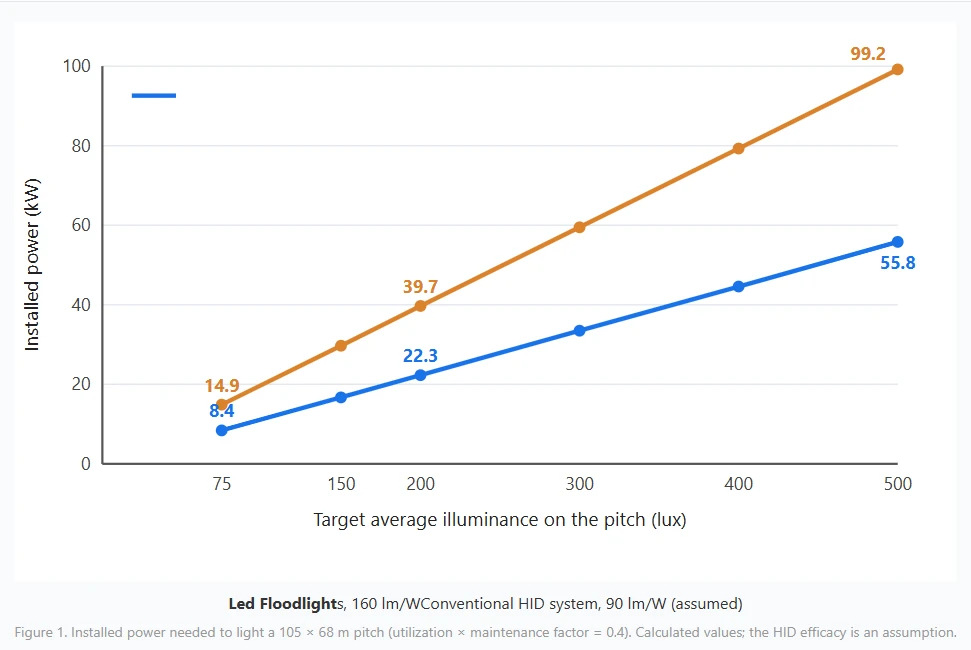
Because both lines come from the same formula, the gap is simply the efficacy ratio (160 ÷ 90). At Class I levels that gap is roughly 43 kW, or about 44% less connected load for the LED system, before counting the maintenance visits you avoid. Independent lighting makers report even larger savings when dimming and control are added; Schréder, for instance, quotes up to 75% less energy than HID in its sports lighting guide. Over a season of evening matches and training sessions, those kilowatts add up quickly.
Light that lands evenly is worth more than light that is simply bright
Go back to the opening scene. The goalkeeper did not lose the ball because the pitch was too dark on average; the problem was the dark patch beside the touchline and the glare from a lamp aimed carelessly. That is why Table 1 lists uniformity and glare rating next to the lux level. A Class I pitch must keep its darkest point at 70% of the average, and glare must stay within the stated limit so that players tracking a high ball and spectators in the stands are not dazzled.
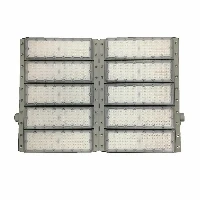
This is where fixture selection supports the design rather than replacing it. The Aosay stadium flood light is offered with 60° and 90° beam angles, so designers can use the narrower beam for long throws from distant masts and the wider beam for the near side of the pitch. It also comes in 3000K to 6000K, and 5000K is the colour temperature most buyers choose for matches because it gives a clear, natural view of the ball and the kit colours. Mixing 500W, 600W, 800W and 1000W units in one scheme is common, since the near and far zones of a large field rarely need identical output.
For the outdoor environment, the housing is rated IP65, runs from −30°C to +55°C, and uses a Meanwell driver with a five-year warranty, which covers the practical question of whether the same fixture can serve a northern winter and a tropical summer. Beyond that, the parameter sheet matters less than the layout, so spend your effort on the photometric plan.
Three questions to answer before you request a quotationhttps://www.benweilight.com/industrial-lighting/led-stadium-light/1000w-led-flood-light-football-stadium-lights.html
If you are an importer, a contractor or a facility owner scoping a sports lighting project, you can shorten the quotation process by collecting the following information first:
- Which lighting class and sport? Football at Class II (200 lx) and Class III (75 lx) lead to very different fixture counts, as Table 2 shows. If the venue will be televised, say so early.
- What are the field and pole conditions? Pitch dimensions, number of masts, mounting height and whether existing poles will be reused all change the aiming plan and the choice between 500W and 1000W heads.
- What are the local supply and climate conditions? The fixtures accept AC85–265V, but your target colour temperature, any dimming requirement and the climate zone should be confirmed in advance.

Get a lighting plan for your pitch
The estimates in this article give you the order of magnitude. Turning them into a bankable design means a photometric simulation for your specific field and a fixture list you can price. The Aosay team supplies outdoor LED lighting for stadiums, football fields, basketball courts and large arenas, and we can help you compare the 500W, 600W, 800W and 1000W options against your target lux.
Send us your pitch dimensions, lighting class, mast layout and destination country, and we will come back with a recommended fixture configuration and quotation. Contact us through the inquiry page. If you want to see the product first, the 1000W LED stadium flood light page has the full specifications.