How to Choose a Truly Durable Die‑Cast Aluminum LED Floodlight?
In outdoor lighting projects, LED floodlights are gaining popularity year by year. Yet faced with a wide range of products on the market, many project purchasers and lighting designers ask: What core features should a truly durable die‑cast aluminum LED floodlight have? How is it better than traditional HID luminaires? This article provides professional, actionable answers from four dimensions: material science, thermal management, optical efficiency, and selection configuration.
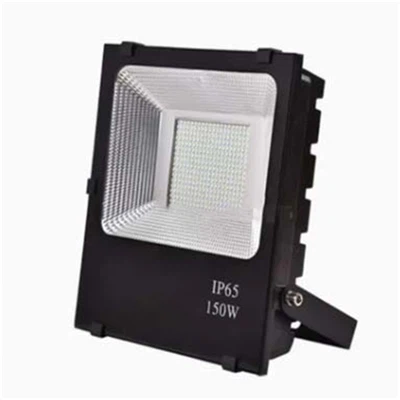
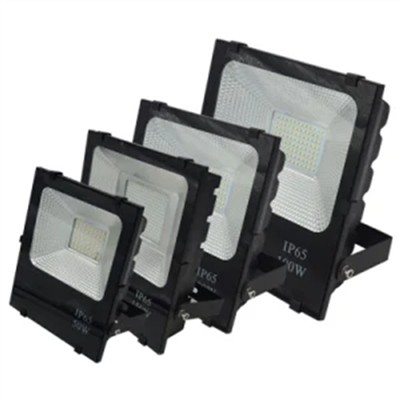
1. Material Determines the "Foundation" – Why Must the Housing Be Die‑Cast Aluminum?
For an outdoor floodlight that is constantly exposed to sun, wind, rain, and corrosive environments, the housing material directly affects the lamp's life and stability.
Traditional luminaires often use sheet steel or ordinary welded aluminum housings, which are heavy, prone to rust, and have poor heat dissipation. ADC12 die‑cast aluminum, on the other hand, is formed under high pressure in a single molding process, offering extremely high structural density and strength. As shown in Benwei's product specifications, ADC12 has excellent corrosion resistance and can perform reliably in harsh environments such as coastal areas or around chemical plants, operating stably in extreme temperatures from -40°C to 70°C.
In terms of material strength, die‑cast aluminum housings are usually combined with ultra‑clear tempered glass and powder coating, resisting strong winds, heavy rain, salt spray, and UV aging. Some high‑spec products achieve IK07 or IK08 impact protection ratings, meaning they maintain structural and optical integrity even after physical impact.
Most importantly is its heat dissipation role. Poor thermal management directly leads to increased lumen depreciation and shortened lifespan. Die‑cast aluminum housings often incorporate fin‑type heat sinks, serving not only as the enclosure but also as a thermal pathway, quickly conducting the junction temperature (Tj) generated by the LED chips to the outside, ensuring the temperature rise stays within a safe threshold. This is the key to extending the rated LED lifespan (typically over 50,000 hours).
2. Heat Dissipation Comparison – Why Is ADC12 the Industry Standard?
There's a saying in the industry: "The killer of LEDs is not current, but high temperature." In thermal management, the thermal conductivity of different materials directly determines heat transfer efficiency. The table below compares the thermal conductivity of common lamp materials.
| Material Type | Typical Grade | Thermal Conductivity (W/m·K) | Relative Efficiency | Typical Applications |
|---|---|---|---|---|
| Die‑cast Aluminum | ADC12, A380 | ~96-100 | Baseline (42%) | Mainstream LED floodlight housings, explosion‑proof |
| Extruded Aluminum | 6063 | ~180-209 | High | High‑power heat sinks, "sunflower" coolers |
| Cold‑forged Aluminum | Custom grade | ~226 | Very high (2.3× of ADC12) | Industrial high‑end cooling assemblies |
Die‑cast aluminum has a thermal conductivity of typically 96–100 W/(m·K), while extruded aluminum (6063) can reach as high as 209 W/(m·K) and cold‑forged aluminum even 226 W/(m·K). Thus, cold‑forged aluminum has 2.3 times the thermal conductivity of die‑cast aluminum and 1.26 times that of extruded aluminum.
Since extruded aluminum conducts heat better, why is die‑cast aluminum still the mainstream material for floodlights? The answer lies in the trade‑off between manufacturing cost and structural rigidity. Extruded and cold‑forged aluminum usually require complex CNC machining or forging, making it difficult to produce large‑size lamp housings with complex curved surfaces and integrated cooling fins. Die‑cast aluminum, however, can form the housing, heat‑sink fins, and mounting bracket interfaces in one step. While providing thermal conductivity of 96–100 W/(m·K) – sufficient for medium‑to‑high power LED cooling – it significantly reduces mass‑production costs and offers better impact resistance and IP protection.
3. Power & Application Scenario Selection Guide
In real projects, choosing the right power for LED floodlights is key to balancing lighting performance and energy saving. The following table provides power recommendations for different scenarios.
| Application Scenario | Recommended Power Range | Mounting Height (m) | Typical Illuminance (Lux) | Suggested Beam Angle |
|---|---|---|---|---|
| Small courtyard / entrance | 10W – 30W | 3 – 5 m | 50 – 100 Lux | 120° – 180° |
| Building facade / terrace | 30W – 50W | 4 – 6 m | 100 – 150 Lux | 60° – 120° |
| Small to medium parking lot | 50W – 100W | 6 – 8 m | 50 – 100 Lux | 90° – 120° |
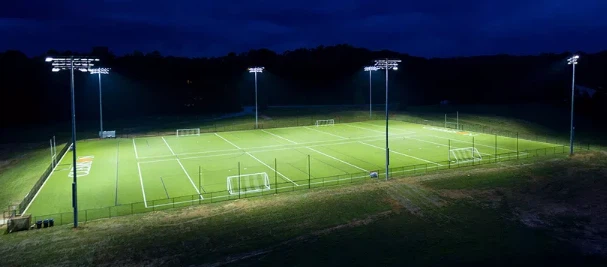
| Stadium / large square | 150W – 300W | 8 – 12 m | 150 – 300 Lux | 60° – 90° |
For outdoor floodlights, an IP65 or IP66 rating is recommended for reliable dust and water resistance. The IP66 rating of Benwei products means complete dust protection and resistance to powerful water jets. It is also advisable to choose products with anti‑corrosion coatings to withstand acid rain, salt spray, and other harsh weather conditions.
If you require precise glare control and beam shaping, choose die‑cast aluminum LED floodlights with narrow asymmetric or wide symmetric optical lenses – widely used in building facade lighting and commercial landscape projects where light control is critical.
Inference
The combination of die‑cast aluminum and LED technology achieves a crushing technical advantage over traditional luminaires in thermal management, weather resistance, luminous efficacy, and total cost of ownership. Studies show that LED lighting systems can reduce outdoor energy consumption by up to 75%, and high‑quality LED luminaires require infrequent replacement, making them the best choice for commercial and industrial upgrades.
If you are planning an outdoor lighting upgrade or need cost‑effective die‑cast aluminum LED floodlights for your factory, parking lot, or building facade, feel free to click online inquiry or send an enquiry to our sales team. We offer free lighting simulation, power selection advice, and customized solutions.