Introduction
The global port and shipyard industry operates around the clock, with lighting systems accounting for a substantial portion of energy expenditure and maintenance costs. Traditional metal halide and high-pressure sodium fixtures, while historically dominant, suffer from rapid lumen depreciation, frequent lamp replacements, and poor resistance to the corrosive marine atmosphere. The transition to LED technology has been driven not merely by energy savings but by the fundamental need for reliability in environments where a single lighting failure can compromise safety, halt operations, or create hazardous working conditions.
According to international lighting standards, different zones within a port facility demand specific illumination levels. Berthing docks typically require 50 to 100 lux to ensure safe mooring operations, while loading and unloading areas demand even higher levels for enhanced safety and productivity during 24-hour operations. Container yards generally need 20 to 50 lux for adequate visibility, and crane operating areas require 150 to 200 lux of vertical illumination to facilitate precise container handling. These varying requirements necessitate a lighting solution that is not only powerful but also adaptable and precisely controllable.
This paper aims to provide a comprehensive selection framework for procurement professionals, port engineers, and shipyard facility managers seeking to specify the optimal 150lm/W LED floodlight for their operations. The discussion proceeds from an analysis of the unique environmental challenges through a detailed examination of key performance parameters, culminating in a practical selection checklist.

The Environmental Challenge: Why Ports and Shipyards Demand More
The marine and coastal environment is uniquely hostile to lighting equipment. Salt-laden air accelerates the corrosion of metallic components, particularly fasteners and mounting brackets that may be overlooked during specification. Wind-driven rain and sea spray can penetrate inadequately sealed cable glands, leading to driver failure. Continuous vibration from heavy machinery and ship movements stresses mounting systems and internal connections. UV radiation degrades poor-quality plastics and coatings, causing yellowing of lenses and peeling of surface finishes.
A study of coastal flood lighting emphasizes that common failure points in these environments include corroded mounting brackets, rusting screws and bolts, peeling paint or weak surface coating, water entering cable glands, lens yellowing or cracking, driver failure from humidity or heat, and loose brackets after vibration or wind exposure. These failure modes underscore a critical principle: in port and shipyard applications, the specification must extend beyond wattage and lumen output to encompass every component of the fixture assembly.
Furthermore, the salt content in coastal air varies significantly by location. While standard 304 stainless steel hardware performs adequately in inland and freshwater environments, coastal installations with chloride concentrations between 50 and 500 parts per million may require 316 stainless steel to prevent pitting corrosion. However, for projects within a reasonable distance from the coastline, properly passivated 304 stainless steel hardware-combined with anti-corrosion coating on the aluminum housing-provides a cost-effective and highly durable solution.
Understanding the 150lm/W Benchmark
Luminous efficacy, expressed in lumens per watt (lm/W), is the single most important indicator of a lighting fixture's energy efficiency. A 150lm/W rating means that for every watt of electrical power consumed, the fixture produces 150 lumens of visible light. To place this in perspective, traditional metal halide lamps typically achieve 60 to 90lm/W, while high-pressure sodium lamps reach approximately 100 to 120lm/W. A 150lm/W LED floodlight therefore represents a 50 to 150 percent improvement in energy efficiency over legacy technologies.
The significance of this benchmark extends beyond simple energy savings. Higher efficacy means that fewer fixtures are required to achieve a given illumination level, reducing both the initial capital expenditure and the ongoing maintenance burden. For a port facility requiring 50 lux across a 65-meter radius high-mast installation, the selection of 150lm/W fixtures over 120lm/W alternatives can reduce the fixture count by approximately 20 percent while maintaining identical ground-level illuminance.
The achievement of 150lm/W system efficacy is not accidental. It requires the integration of premium LED chips, an efficient driver, and an optical system that minimizes light loss. Philips Lumileds SMD 2835 chips, for example, deliver exceptional thermal conductivity and lumen maintenance. The LUXEON 2835 platform has demonstrated efficacy exceeding 200lm/W at the chip level, with system-level efficacy of 150lm/W representing an optimized balance between performance, cost, and thermal management. The SMD 2835 package offers a viewing angle of 120 degrees and is tested to LM-80 standards, ensuring lumen maintenance of 72,000 hours on an L70 TM-21 basis.
Thermal Management and Lifespan: The Critical Relationship
The operational lifespan of an LED floodlight is inextricably linked to the effectiveness of its thermal management system. Unlike traditional light sources that emit heat as infrared radiation, LEDs generate heat at the semiconductor junction, and this heat must be conducted away from the chip to prevent accelerated degradation. Research has established that junction temperature directly dictates lumen depreciation rates. At a junction temperature of 105°C, brightness may decline to 70 percent of initial output after only 10,000 hours of operation. At 95°C, this extends to 20,000 hours. At 75°C, the L70 lifespan reaches 40,000 hours, and at 65°C, it can extend to 90,000 hours.
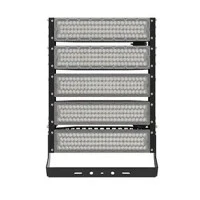
This relationship explains why a poorly designed fixture-even one using premium LED chips-will fail prematurely in a port environment where ambient temperatures frequently exceed 40°C. The die-cast aluminum heat sink with finned architecture employed in professional-grade floodlights provides the surface area necessary for effective convective heat dissipation. The modular design of the floodlight discussed herein, with each module featuring an independent heat sink and LED board, offers a further advantage: individual modules can be angled and spaced to maximize airflow, and the failure of one module does not compromise the thermal management of adjacent modules.
The practical implication for procurement is clear. A 150lm/W LED floodlight with superior thermal management will maintain 90 percent or more of its initial lumen output after 50,000 hours of operation. In a port that operates 12 hours per day, this equates to over 11 years of service before replacement is required, dramatically reducing maintenance logistics and costs. The utilization of advanced thermal interface materials and the elimination of thermal bottlenecks at the LED-to-heat sink interface further ensure that junction temperatures remain within optimal ranges even under continuous maximum load.
Ingress Protection: IP65 vs. IP66 and Beyond
The IP (Ingress Protection) rating system, defined by international standard EN 60529, provides a standardized method for classifying the degree of protection offered by an electrical enclosure against the intrusion of solid particles and liquids. The first digit indicates protection against solids, with a rating of 6 signifying a "dust-tight" enclosure that provides complete protection against dust entry. The second digit indicates protection against liquids.
An IP65 rating indicates that the device is protected from total dust ingress and from low-pressure water jets from any direction. This is suitable for most outdoor applications where the fixture is exposed to rain and splashes but not to direct high-pressure washing. An IP66 rating provides a higher level of protection: the enclosure is totally dust-tight and protected against powerful water jets from any direction, including heavy seas and strong jets of water.
For port and shipyard applications, IP66 should be considered the minimum acceptable rating. The rationale is straightforward. Port facilities are frequently washed down with high-pressure hoses as part of routine maintenance, and fixtures mounted at lower heights may be directly exposed to sea spray during storms. An IP66-rated floodlight provides the assurance that water will not penetrate the enclosure under these conditions, protecting both the LED chips and the critical driver electronics. The transparent PC mask employed in the floodlight's optical system further contributes to this protection by sealing the LED array against moisture ingress while maintaining high light transmission.
It is important to note that the IP rating of the complete fixture is only as good as its weakest point. Cable entries and gland seals are common failure points in coastal installations. A professional-grade floodlight therefore incorporates multi-part cable modules with strain relief and compression sealing that maintain the enclosure's IP66 integrity even under continuous vibration and thermal cycling.
Corrosion Resistance: Hardware and Housing Considerations
Corrosion is the silent killer of outdoor lighting in marine environments. While the aluminum housing of a quality floodlight will typically feature an anti-corrosion powder coating, the fasteners, brackets, and cable entry components are equally critical to long-term performance. The use of 304 stainless steel fixing screws represents the industry standard for outdoor and humid environments. Type 304 stainless steel contains approximately 18 percent chromium and 8 percent nickel, providing excellent resistance to rust and corrosion in most freshwater and inland environments.
For port installations where chloride concentrations are moderate, 304 stainless steel hardware combined with a robust anti-corrosion coating on the aluminum housing delivers exceptional durability. The floodlight discussed in this analysis employs precisely this combination: 304 stainless steel screws, a die-cast aluminum heat sink with powder coating, and an adjustable U-bracket designed to withstand the mechanical stresses of wind loading and vibration. The adjustable bracket enables precise aiming of the light beam toward working areas, ensuring that light is directed where it is needed rather than wasted on non-critical surfaces.
It should be noted that for installations within five miles of a coastline with high chloride concentrations, 316 stainless steel hardware offers superior resistance to pitting corrosion due to the addition of 2 to 3 percent molybdenum. However, the incremental cost of 316 hardware must be weighed against the actual exposure conditions. For most port and shipyard applications where fixtures are mounted at height and not in direct contact with seawater, 304 stainless steel provides an optimal balance of performance and cost-effectiveness.
Modular Design: Flexibility for Diverse Port Applications
The modular architecture of the floodlight system offers a significant operational advantage in port and shipyard environments. Rather than a monolithic fixture with a fixed wattage, the modular design allows the user to configure the system with 2, 3, 4, or 5 LED modules, achieving a range of wattages and lumen outputs from a single product platform. This flexibility enables precise tailoring of illumination levels to the specific requirements of each zone within a facility.
For a container yard requiring 30 lux of maintained illuminance, a 3-module configuration may be sufficient. For a shipyard dry dock requiring 100 lux for painting and welding operations, a 5-module configuration may be specified. The ability to standardize on a single fixture platform while adjusting output through module count simplifies procurement, reduces spare parts inventory, and ensures consistent color temperature and optical performance across all areas of the facility.
The modular design also facilitates maintenance. If a single module fails-whether due to LED degradation, driver fault, or impact damage-it can be replaced independently without removing the entire fixture from its mounting. This capability is particularly valuable in high-mast installations where accessing the fixture requires the deployment of aerial work platforms or crane-suspended personnel baskets.
Optical Performance and Glare Control
In port and shipyard environments, the quality of light is as important as the quantity. Glare from improperly aimed or poorly shielded floodlights can obscure the vision of crane operators, ship pilots, and ground personnel, creating safety hazards rather than mitigating them. International standards recognize this concern, noting that high mounting heights have the advantage of reducing the likelihood that lights will mask navigation or beacon lights or cause confusion with signal lights.
The floodlight's optical system, comprising a reflector and a transparent PC mask, is designed to achieve high light transmission while maintaining comfortable visual conditions. The PC mask provides sufficient color rendering and a comfortable light effect, ensuring that the LED light source delivers its full luminous output without excessive glare or ghosting. This is particularly important in areas where workers must distinguish between different colored safety markings, identify moving machinery, or read instrument panels under nighttime conditions.
The availability of multiple beam angles further enhances the optical versatility of the system. Narrow beam angles are suitable for high-mast installations where light must be projected over long distances, while wider beam angles are appropriate for lower mounting heights where broad, uniform coverage is required.
Selection Checklist for Procurement Professionals
When evaluating 150lm/W LED floodlights for port and shipyard applications, procurement professionals should verify the following specifications:
1. Luminous Efficacy: Confirm that the system-level efficacy is at least 150lm/W. Request photometric test reports from an accredited laboratory to verify manufacturer claims.
2. LED Chip Brand and Type: Specify Philips Lumileds SMD 2835 or equivalent premium chips. Verify that the chips are sourced from an authorized distributor and that LM-80 test data is available for the specific bin and color temperature specified.
3. Thermal Management: Examine the heat sink design. A die-cast aluminum finned structure with adequate surface area is essential. Request junction temperature calculations under maximum ambient conditions to ensure that the LEDs will operate within their rated temperature limits.
4. Ingress Protection: Minimum IP65; IP66 preferred for port applications where washdown and heavy spray are expected. Verify the IP rating through an accredited testing laboratory report.
5. Corrosion Resistance: 304 stainless steel hardware for most port and shipyard installations; 316 stainless steel for high-chloride coastal environments. The aluminum housing should feature an anti-corrosion powder coating.
6. Optical System: A combination of reflector and transparent PC mask that delivers high light transmission, comfortable color rendering, and effective glare control. Multiple beam angle options should be available to suit different mounting heights and coverage requirements.
7. Modular Design: A scalable platform that allows configuration with 2 to 5 modules, enabling precise tailoring of output to specific zone requirements and simplifying maintenance.
8. Mounting System: A heavy-duty adjustable U-bracket capable of withstanding wind loading and vibration, with provisions for locking the aimed position.
9. Lifespan and Lumen Maintenance: A minimum L70 lifespan of 50,000 hours under rated operating conditions, supported by LM-80 and TM-21 test data.
Conclusion
The selection of a 150lm/W LED floodlight for port and shipyard applications is a decision that must balance performance, durability, and total cost of ownership. The environmental conditions in these facilities-salt-laden air, vibration, temperature extremes, and continuous operation-demand a level of engineering quality that distinguishes professional-grade fixtures from commodity products.
The modular LED floodlight analyzed in this paper represents a convergence of the key technologies required for success in this challenging environment: Philips Lumileds SMD 2835 chips delivering exceptional efficacy and color consistency, advanced thermal management ensuring minimal lumen depreciation over 50,000 hours of operation, IP65/IP66-rated enclosures protecting against dust and powerful water jets, and 304 stainless steel hardware providing durable corrosion resistance. The modular architecture offers unparalleled flexibility for facilities with diverse lighting requirements, while the adjustable bracket and optical system ensure that light is precisely directed and optimally controlled.
For port engineers and shipyard facility managers, the message is clear. Investing in a properly specified 150lm/W LED floodlight is not merely a lighting upgrade; it is a strategic decision that reduces energy consumption by up to 70 percent compared to traditional lighting, eliminates the maintenance burden of frequent lamp replacements, and enhances the safety and productivity of critical operations. In an industry where every hour of downtime carries significant financial consequences, the reliability of the lighting system is not a luxury-it is an operational necessity.

How To Cooperate With Us?
We are happy to have total control over the manufacturing process and the calibre of our products since we have our own facilities. Since we are producers rather than just brokers, we are dedicated to providing our customers with the best pricing. Since we are certain that the price and quality of our products are clear, we invite customers to see our samples first. Our commitment to quality and customer satisfaction drives us to continuously provide top-notch goods.
Our address
3rd Floor, 5th Building, Hebei Industrial Park, Hualian Community, Longhua District, Shenzhen, China