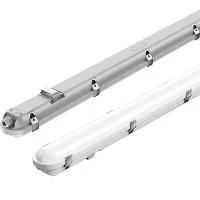
Over the years of working on lighting projects, we have received many inquiries from clients who installed standard panel lights or fluorescent tubes in damp garages, only to see them suffer from water ingress, discoloration, and flickering within six months. Switching to "tri-proof" lights-LED fixtures designed to be waterproof, dustproof, and corrosion-resistant-effectively eliminated these issues. These lights typically feature housings made of PC or ABS materials with silicone seals and usually carry an IP65 protection rating. However, there is a difference between a light simply "working" and being truly "suitable"; different environments have distinct requirements. This article discusses the ideal installation locations for tri-proof lights based on real-world scenarios and highlights key considerations for each setting.
Parking Lots and Underground Garages
Underground garages are among the most common applications for tri-proof lights, for very practical reasons:
High humidity often leads to condensation on walls and ceilings.
Vehicle exhaust contains mildly corrosive substances that can cause standard light housings to age and yellow.
Lighting must remain on for extended periods, necessitating fixtures with long lifespans and energy-saving capabilities.
For these areas, we recommend linear tri-proof lights equipped with microwave or radar sensors; the lights brighten when vehicles approach and dim when they leave, resulting in significant energy savings.
Warehouses and Logistics Centers
The primary challenges in warehouses are dust and moisture. Cargo handling and forklift operations kick up dust; if this accumulates inside standard fixtures, it impairs heat dissipation and reduces luminous efficacy. The sealed structure of tri-proof lights keeps dust out, requiring only a simple wipe-down of the exterior for maintenance.
Additionally, given the varying ceiling heights and racking layouts in warehouses, you can select fixtures in 0.6m, 1.2m, or 1.5m lengths to suit specific needs, while also considering wiring options that facilitate daisy-chaining (connecting lights in series) along aisles.
Food Processing Plants and Cold Storage
The food industry imposes two specific requirements for lighting: fixtures must withstand wash-downs, and the light covers must not shatter or shed debris. In processing workshops where floors and walls are frequently washed down with water, lighting fixtures require a higher waterproof rating-ideally IP65 or above.
Lamp covers should be made of polycarbonate (PC) to prevent glass breakage and potential food contamination.
For cold storage environments with low temperatures, it is essential to verify the fixture's operating temperature range and select a driver capable of stable startup in cold conditions.
Factory Workshops and Production Lines
Workshops involved in machining, electronics assembly, and packaging may be exposed to oil mist, dust, or mild chemical vapors. "Tri-proof" lights (resistant to water, dust, and corrosion) feature corrosion-resistant housings that are well-suited to these environments. Additionally, workshop lighting often requires high color rendering and low flicker to reduce worker eye strain and improve inspection accuracy; this is a key factor to consider during selection.
Note: If the workshop contains combustible gases or flammable dust, explosion-proof lights-not tri-proof lights-are required; these two types are not interchangeable.
Car Washes and Laundries
These facilities remain highly humid year-round and are exposed to water mist, detergent vapors, and even direct water spray. Poorly sealed fixtures can quickly accumulate internal moisture, leading to short circuits. Recommendations for selection include:
An ingress protection (IP) rating of at least IP65; consider IP66 for areas subject to direct wash-downs.
Choosing models with stainless steel or corrosion-resistant clips to prevent metal parts from rusting.
Tunnels and Underpasses
Tunnels and underpasses are consistently damp and subject to vehicle vibrations and exhaust fumes. Beyond waterproofing and dustproofing, structural strength and impact resistance are critical here. Fixtures must be securely mounted to prevent loosening or seal failure caused by vibration. Furthermore, as maintenance is difficult in these locations, fixtures should have a long service life.
Livestock Farms and Agricultural Greenhouses
The air in livestock farms often contains corrosive gases like ammonia, alongside high humidity and dust, posing a severe challenge for standard lighting fixtures. The corrosion-resistant housing and sealed structure of tri-proof lights can significantly extend their service life in these environments. Additionally, certain livestock and agricultural settings have specific lighting requirements-such as specific light colors or dimming capabilities. You can discuss these needs with suppliers during the procurement process to secure a customized solution.
Summary
Tri-proof lights are ideal for environments where standard lighting fails to hold up: damp underground parking garages, dusty warehouses, food processing plants requiring wash-downs, livestock facilities exposed to corrosive gases, as well as car washes and tunnels. Selecting the right environment and matching the model based on protection rating, materials, and installation method ensures peace of mind and minimizes maintenance costs.
If you are selecting products for a project and are unsure about the specifications, wattage, or protection rating required, please let us know the application site, installation height, and quantity. Our engineers will recommend a solution based on your specific needs and provide a quote and samples. Simply leave a message or send an inquiry, and we will typically respond within one business day.
https://www.benweilight.com/linear-lighting/tri-proof-led-light-ip67/high-lumen-waterproof-led-tri-proof-light.html