How to Choose the Right LED Light Tubes for Your Barn? – The Science of Lighting to Improve Animal Welfare, Milk Yield, and Operational Efficiency
In modern livestock farming, lighting is no longer just about "seeing clearly". Studies have shown that light intensity, photoperiod, light spectrum, and even flicker in barns directly affect cattle behaviour, stress levels, feed intake, and milk production. LED light tubes, with their tunable spectrum, long life, and high energy efficiency, are rapidly replacing traditional fluorescent or high‑pressure sodium lamps as the preferred choice for barn lighting. This article explains the key technical requirements and selection criteria from three perspectives: animal needs, environmental challenges, and performance indicators.
1. Why Do Barns Need Specialised LED Light Tubes?
Barn environments are very different from ordinary indoor spaces: high humidity, ammonia corrosion, dust, insects, and the risk of cattle impact. Ordinary light tubes fail quickly under these conditions, and poor light spectra can disturb cattle's natural rhythms. Specialised LED light tubes offer:
- Photoperiod simulation – automatic simulation of sunrise, daylight, sunset and night via timers or smart controls, maintaining normal hormone secretion
- Spectrum optimisation – the right balance of blue and red light has been shown to increase feeding activity and milk yield
- Very low flicker – cattle perceive flicker much more than humans; poor‑quality tubes cause restlessness and discomfort
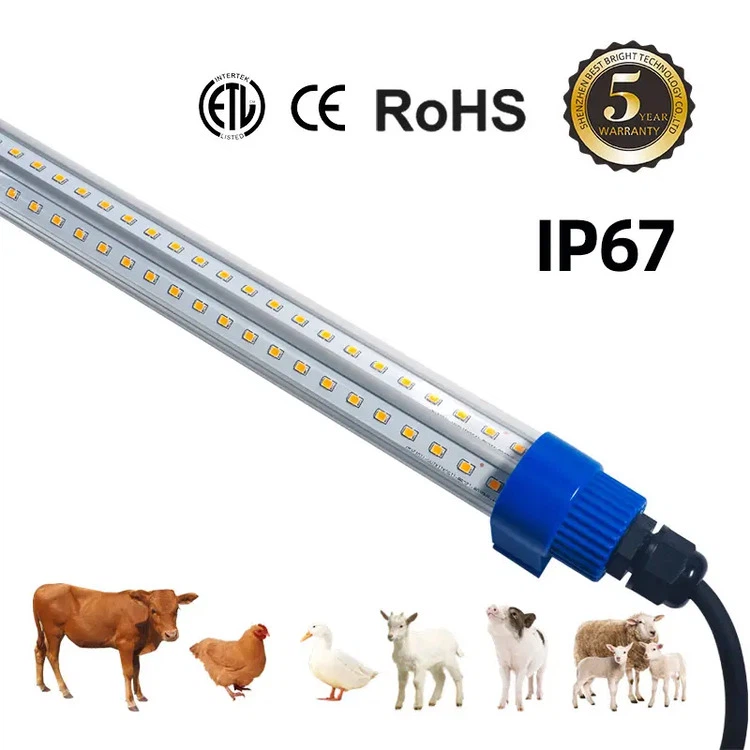
- Robust construction – impact resistant, corrosion resistant, waterproof and dustproof (IP65 or higher), suitable for washing and disinfection
2. Core Technical Specifications for Barn LED Light Tubes
When selecting barn lighting, do not look only at brightness (lumens). The following five parameters directly determine lighting performance and return on investment.
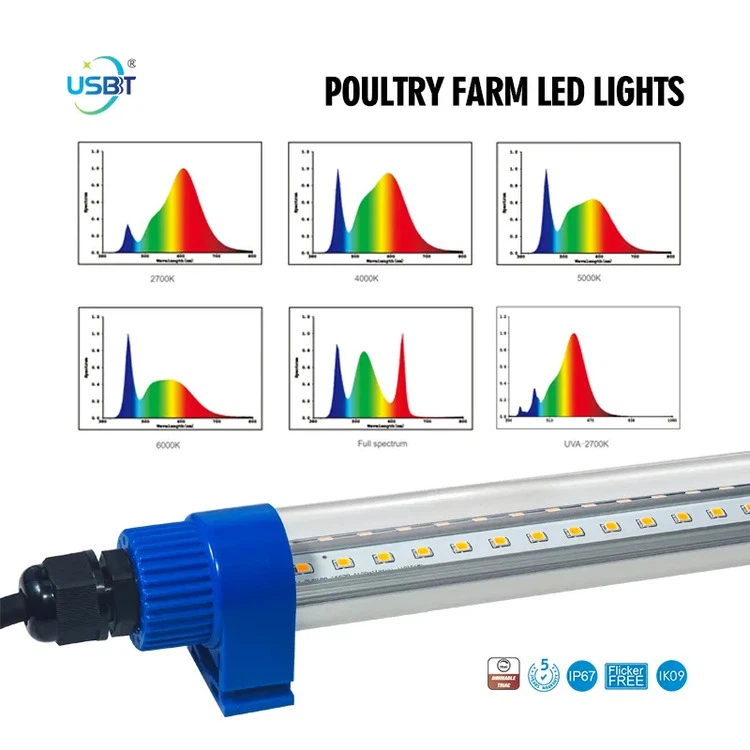
2.1 Spectrum and Colour Temperature – Affect Milk Yield and Behaviour
- Recommended spectrum:
Daytime (feeding & activity) – 4000K–5000K with enhanced blue band (around 450nm) to keep cattle alert and encourage feeding
Night (resting) – 1800K–2700K, predominantly red (>620nm) to avoid suppressing melatonin, while allowing night checks without disturbing the herd
- Research reference: In the milking parlour, 15‑30 minutes of blue‑enhanced white light at ~170 lux can significantly increase prolactin levels; continuous white light at night reduces milk yield.
- Professional approach: Use CCT‑tunable RGB+white LED tubes or dual‑white tubes to automatically switch day/night spectra.
2.2 Illuminance Uniformity and Glare Control
- Requirements:
Feeding alley: 150–200 lux (daytime)
Lying/resting area: 50–100 lux
Passageways: 100 lux
- Key point: Avoid alternating bright and dark spots, otherwise cattle will hesitate or crowd together. Choose wide beam angle (120°) or asymmetric distribution tubes, and calculate mounting height and spacing properly.
- Anti‑glare: Barns are often low‑ceiling (3–5 m). Tubes must have milky diffusers or micro‑prismatic optics to prevent direct glare to the animals.
2.3 Flicker Control – An Often Overlooked Animal Welfare Factor
- Standard: Flicker percentage < 5%; flicker‑free drivers (PWM frequency > 3000 Hz) are strongly recommended.
- Reason: Cattle have a higher flicker fusion frequency than humans. The typical 100–120 Hz PWM flicker of ordinary LEDs is perceptible to cattle, causing head tossing and reduced lying time.
- Verification: Ask suppliers for flicker test reports (IEEE 1789 standard).
2.4 Ingress Protection and Corrosion Resistance
- Minimum requirement: IP65 (dust‑tight and protected against water jets); connectors IP67
- Special challenge: High ammonia concentration in barns corrodes ordinary PC diffusers and aluminium substrates. Choose:
Ammonia‑resistant PC diffuser or tempered glass
Coated anti‑corrosion aluminium or full‑plastic housing tubes
Potting‑filled drivers to prevent gas ingress
- Temperature range: -25°C to +45°C (barns can be cold in winter).
2.5 Impact Resistance and Easy Cleaning
- IK rating: ≥ IK08 (2‑joule impact resistance) – protects against cattle collisions or cleaning tool strikes
- Smooth surface: Housing should have no exposed screws or crevices, allowing high‑pressure washing and disinfectant wiping.
3. Four Practical Selection Rules for Barn LED Light Tubes
3.1 Match Lighting Strategy to Barn Functional Zones
| Zone | Recommended Illuminance | Colour Temperature / Spectrum | Control Method |
|---|---|---|---|
| Feeding alley | 150–200 lux | 4500K, blue‑enhanced | Timer (04:00–22:00) |
| Lying / resting area | 50–100 lux | 2200K, red‑dominant | Continuous low‑level red at night |
| Milking parlour | 200–300 lux | 5000K, high CRI | 30 minutes before and during milking |
| Calf hutch | 100–150 lux | 4000K, soft | Independent control, avoid bright light |
3.2 Evaluate Smart Control Capability – Automatic Photoperiod
- Basic: Timer switch + dual‑white tubes (manual switching)
- Professional: DALI or 0–10V dimming system + astronomical clock – automatically simulates local sunrise/sunset, and supports "moonlight mode" (1% red light) at night.
- Advanced: Integrated sensors (ambient light, cattle activity) to dynamically adjust light output, saving an additional 5–15% energy.
3.3 Lifetime and Warranty – Maintenance Cost on the Farm is Critical
- In harsh barn environments, require rated lifetime ≥ 50,000 hours (L70) and 5‑year warranty.
- Caution: Many cheap tubes claim 50,000 hours but show >30% lumen depreciation after only 3 months in ammonia‑rich air. Ask for accelerated aging test data (ammonia + high temperature/humidity).
3.4 Installation and Wiring Safety
- Use stainless steel adjustable‑angle tube brackets to prevent rust;
- External vs. integrated driver? In dusty/ammonia environments, fully sealed integrated‑driver tubes are better than external driver boxes;
- All connections must use waterproof and UV‑resistant connectors, with rodent‑proof protection.
4. From Lighting to Returns: ROI Calculation for Barn LED Upgrades
Although high‑quality barn‑specific LED tubes cost 30–50% more initially than ordinary tubes, the following benefits typically recover the investment within 12–24 months:
- Increased milk yield – multiple peer‑reviewed studies show optimised photoperiod and spectrum increase milk production by 5–8%
- Better feed conversion – increased feeding activity improves weight gain (beef cattle)
- Reduced veterinary costs – lower stress, fewer lameness issues and less immune suppression
- Energy savings – 60–70% less energy than fluorescent lamps; 70–80% less than high‑pressure sodium lamps
- Reduced maintenance – 50,000 hours life means no lamp changes for about 7 years, saving labour and avoiding working at height.
5. Conclusion: Good Lighting is the Smartest Investment in Your Barn
Choosing LED tubes for a barn is not about buying "things that emit light" – it is about investing in a light environment system that improves animal welfare and production performance. Professional farm managers look at: Is the spectrum animal‑friendly? Does flicker meet standards? Can the tubes run stably for five years in an ammonia environment? – Those details determine whether your investment shows up on the electricity bill or on the profit side.
This article will help you better distinguish between high-quality and low-quality products. For more detailed technical specifications comparisons or barn lighting design templates, please contact our agricultural lighting consulting team-we provide professional consulting services.