
If you are renovating a retail store, showroom, or gallery with a high ceiling, you have probably asked yourself this question: "Why should I choose a hanging LED track light instead of a standard recessed downlight or surface-mounted track?" The answer is not simply about brightness-it is about whether the fixture can deliver measurable returns in energy savings, merchandise presentation, and long-term flexibility. This article breaks down the decision from a commercial buyer's perspective, using verifiable industry data rather than product brochures.

The Core Advantage: Directional Light Where It Matters
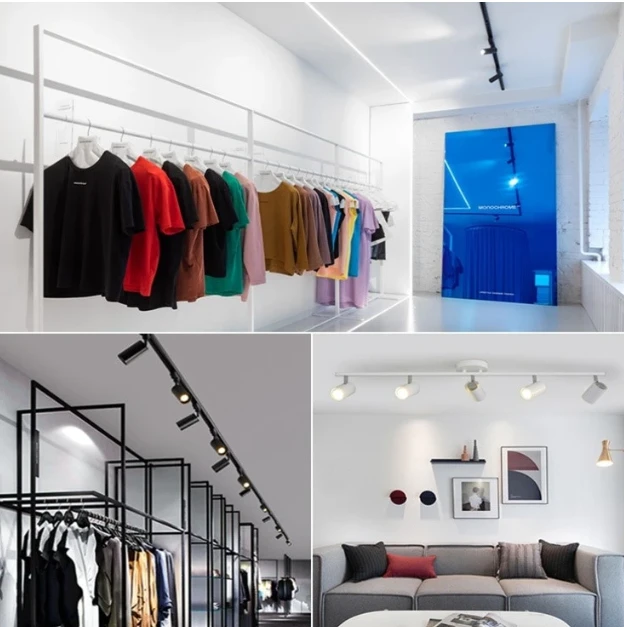
A hanging LED track light, such as the 30W modern track fixture from Benwei Lighting, suspends the light head closer to the display zone while keeping the track rail at ceiling height. This physical separation matters. Recessed downlights flood a space uniformly; a hanging track head can be aimed precisely at a mannequin, a feature wall, or a product shelf without over-lighting the aisles.
The practical implication is that less total wattage is required to achieve the same accent illuminance. Industry layout guidance confirms that general sales floors need only 300–500 lux, while feature displays require 500–1,000 lux or higher. A directional hanging fixture concentrates lumens on the high-value zone, whereas a downlight grid spends energy on circulation paths and ceiling surfaces.
The Numbers That Decide: Halogen vs. LED Track
The strongest argument for upgrading to a modern LED track system is the gap in luminous efficacy. The table below compares a legacy 50W halogen track spotlight with a 30W high-efficiency LED track head under identical operating assumptions.
| Parameter | 50W Halogen Track | 30W LED Track (165 lm/W class) |
|---|---|---|
| Luminous efficacy | ~16 lm/W | 165 lm/W |
| Light output | ~800 lm | ~4,950 lm |
| Annual energy per fixture (12 h/day) | 219 kWh | 131 kWh |
| Annual electricity cost @ €0.19/kWh | €41.6 | €24.9 |
| Annual saving per fixture | - | €16.7 |
| Lifespan | ~2,000 hours | ~50,000 hours |
Data source: Eurostat H1 2025 non-household electricity price and EVERFINE-certified LED efficacy data. For a 50-fixture retail installation, the annual energy saving alone reaches approximately €835, and when halogen replacement and labor are included, the total annual saving rises to €1,035–€1,235. The simple payback period on a €2,000–€4,000 retrofit typically falls between 18 and 36 months-and under 18 months in high-tariff markets such as Ireland.
This is not an isolated case. A separate analysis of European commercial retrofits reports 60–80% energy reduction for the same lumen output when switching from halogen to LED track, with connected lighting loads dropping from 2,500 W to 600 W for a 50-head installation. The ROI window of 1.5 to 5 years is consistent across multiple commercial segments.
Beyond Energy: The Metrics That Affect Sales
Energy savings justify the retrofit, but they do not explain why a hanging track configuration specifically outperforms fixed alternatives in retail environments. Two lighting-quality metrics matter more for merchandise presentation than raw wattage: CRI (especially R9) and UGR (glare control).
CRI and R9. A general LED with Ra 80 may render red-toned merchandise-beef, red garments, wood finishes-as dull or gray because the red spectrum is under-represented. For retail and display applications, CRI 90+ with R9 > 50 is the practical threshold; at this level, the color saturation and texture of the product become visibly distinguishable under the beam. A hanging track head aimed at the display surface makes full use of that color quality because the light is not diluted by distance or diffusion.
UGR and visual comfort. Glare is an "invisible killer" that drives down conversion rates. When customers encounter direct reflections of light sources on polished floors or countertops, their perception of the space's quality diminishes. Well-designed track spotlights-featuring deep reflectors and a shielding angle exceeding 30°-can keep the Unified Glare Rating (UGR) below 19 in most commercial environments; a UGR of less than 22 serves as the minimum threshold for comfort in indoor commercial spaces. Furthermore, the adjustability of pendant-mounted fixtures allows installers to tilt the light heads at an angle of 30°–45° from the side, ensuring that light sources remain outside the customers' direct line of sight.
Market Context: Track Lighting Is Not a Niche Bet
The commercial rationale gains further weight from market trajectory. The global track lighting market is projected to grow from US$2.59 billion in 2025 to US$4.11 billion by 2031, at a CAGR of 8.0%. Within that, the LED track light segment already accounts for approximately 50% of product share, and Asia-Pacific represents the fastest-growing regional demand. Separately, industry sourcing data shows 306.74% year-over-year buyer growth in the commercial track light category on Alibaba.com, signalling that B2B procurement is actively shifting toward modular, aimable LED fixtures.
For a buyer, this matters in two ways. First, track standards and accessories (connectors, dimmers, suspension kits) are becoming more interoperable, reducing the risk of proprietary lock-in. Second, the availability of high-efficacy (150–180 lm/W) LED modules is no longer confined to premium European brands; the specification tier that delivers the ROI figures above is now accessible through established export manufacturers.
What a Hanging Track Configuration Changes for Installation
The "hanging" aspect is often treated as a cosmetic detail, but it has functional consequences. Suspending the track from a high ceiling via rods or cables brings the light head within effective aiming distance of the display without requiring a full ceiling grid of recessed fixtures. This is particularly relevant in spaces with ceilings above 4 meters, where surface-mounted track at ceiling level would produce steep, harsh angles and poor vertical illuminance on merchandise.
The trade-off is that the suspension system must be mechanically compatible with the track profile. A quality hanging track kit should include the track rail, adjustable suspension cables or rods, and a canopy or ceiling anchor rated for the total fixture load. The fixture itself-in this case a 30W adjustable head with warm/cool white switching-should be treated as one component of that system, not a standalone bulb replacement.
A Decision Framework: When Hanging LED Track Pays Back Fastest
| Scenario | Recommended configuration | Why the ROI is strong |
|---|---|---|
| Retail store, 200–400 m², ceiling > 4 m | 30W hanging track heads, CRI 90+, 24°–36° beam | Directional accent light reaches display without over-lighting aisles; 18–36 month payback |
| Gallery / showroom, frequent display changes | Adjustable hanging track with 15°–60° interchangeable optics | Re-aiming replaces re-wiring; no ceiling patching between exhibitions |
| Grocery / fresh food zone | CRI 90+ (R9 > 50), 3000–3500K | Red-toned products retain visual freshness; reduced spoilage perception |
| Office or co-working accent lighting | UGR < 19, 4000K neutral, dimmable track | Glare control supports screen comfort; dimming adds 20–40% additional savings |
The scenarios where hanging track is least compelling are low-ceiling spaces (below 2.8 m) where a surface-mounted track or recessed adjustable downlight can achieve the same aiming geometry without suspension hardware. Above that height threshold, the directional advantage of dropping the light source closer to the merchandise becomes tangible in both lux delivered and wattage avoided.
The Bottom Line for Your Project
A hanging LED track light is worth the investment when three conditions align: the ceiling height is sufficient to justify suspension, the merchandise or displays benefit from directional accent lighting, and the project can capture the 40–80% energy reduction that LED track delivers over halogen. The market data and ROI cases above are not projections-they are drawn from completed commercial retrofits and verified efficacy measurements. The remaining variable is whether the specific fixture you specify matches the optical and thermal quality required for your space.
If you are evaluating a hanging track configuration for an upcoming retail, gallery, or hospitality project, the most efficient next step is to share your ceiling height, target illuminance, and display zone dimensions with a supplier who can run the layout calculation against real photometric data. Send your project parameters to Benwei Lighting to receive a fixture count estimate, a wattage comparison against your current halogen or fluorescent load, and a payback projection based on your local electricity rate.