Is Light in a Poultry House Really Just About "Brightness"?
The "light" chickens see is not the same as what humans see
Humans perceive light roughly between 400 and 750 nm, while chickens' visual range extends into the ultraviolet region. More importantly, chickens are far more sensitive to blue and red light than humans: sensitivity to 450 nm blue light is about 12 times that of humans, and sensitivity to 640 nm red light is about 4 times that of humans. Chickens not only sense light through their eyes, but also through photoreceptors in the pineal gland and hypothalamus, which directly participate in reproductive hormone secretion and circadian rhythm regulation.
This means a poultry house that looks "bright enough" to humans may be dim to chickens, or its spectrum may be seriously mismatched. Managing a poultry house by human lighting standards creates systematic bias from the start.

Light is a management tool, not just a lighting device
For layers and breeders, light's core function is to regulate the timing of sexual maturity and the laying cycle. Longer photoperiods stimulate reproductive hormone release, starting or maintaining egg production; during the growing period, if light duration increases day by day, it may lead to early laying, smaller egg weight, and lower egg production. For broilers, light mainly affects feeding behavior, activity level, and stress. In other words, every lamp in a poultry house is a "physiological control switch."
At different growth stages, lighting programs must be adjusted simultaneously across spectrum, intensity, and duration:
| Growth stage | Recommended light color/spectrum | Light intensity | Photoperiod | Core objective |
|---|---|---|---|---|
| Brooding (0–7 days) | White light (5000K) | 30–60 lx | 23L:1D | Promote feed intake and uniform development |
| Growing (2–14 weeks) | Blue-green light | 5–15 lx | Gradually reduce to 10–12L | Control sexual maturity, promote bone and immune development |
| Pre-lay (14–20 weeks) | Yellow-orange light (565–630 nm) | Gradually increase to 15–20 lx | Gradually increase to 12–14L | Promote oviduct and ovarian development |
| Laying period | Warm white + red light (2700–3000K) | 15–30 lx | Increase by 30 min/week to 16L, then hold | Maintain peak production, extend peak duration |
A study published by FAO AGRIS showed that layers on a two-stage "blue-green light + yellow-orange light" program had significantly higher serum immunoglobulin concentrations than a white-light-only group, significantly higher bone density, and an earlier age at 50% lay. For broilers, in a field trial of 8,000 birds in Japan, the group managed with a "blue LED + aqua LED" program reached an average market weight of 3,094 g, 73 g higher than the white-light-only control, with better feed conversion and overall production scores. In another comparative trial, mortality in the blue-green mixed LED group was only 0%, while the tungsten and fluorescent groups reached 6.7% and 5%, respectively.
Light uniformity is harder than "bright enough"
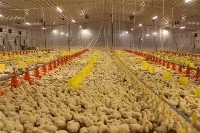
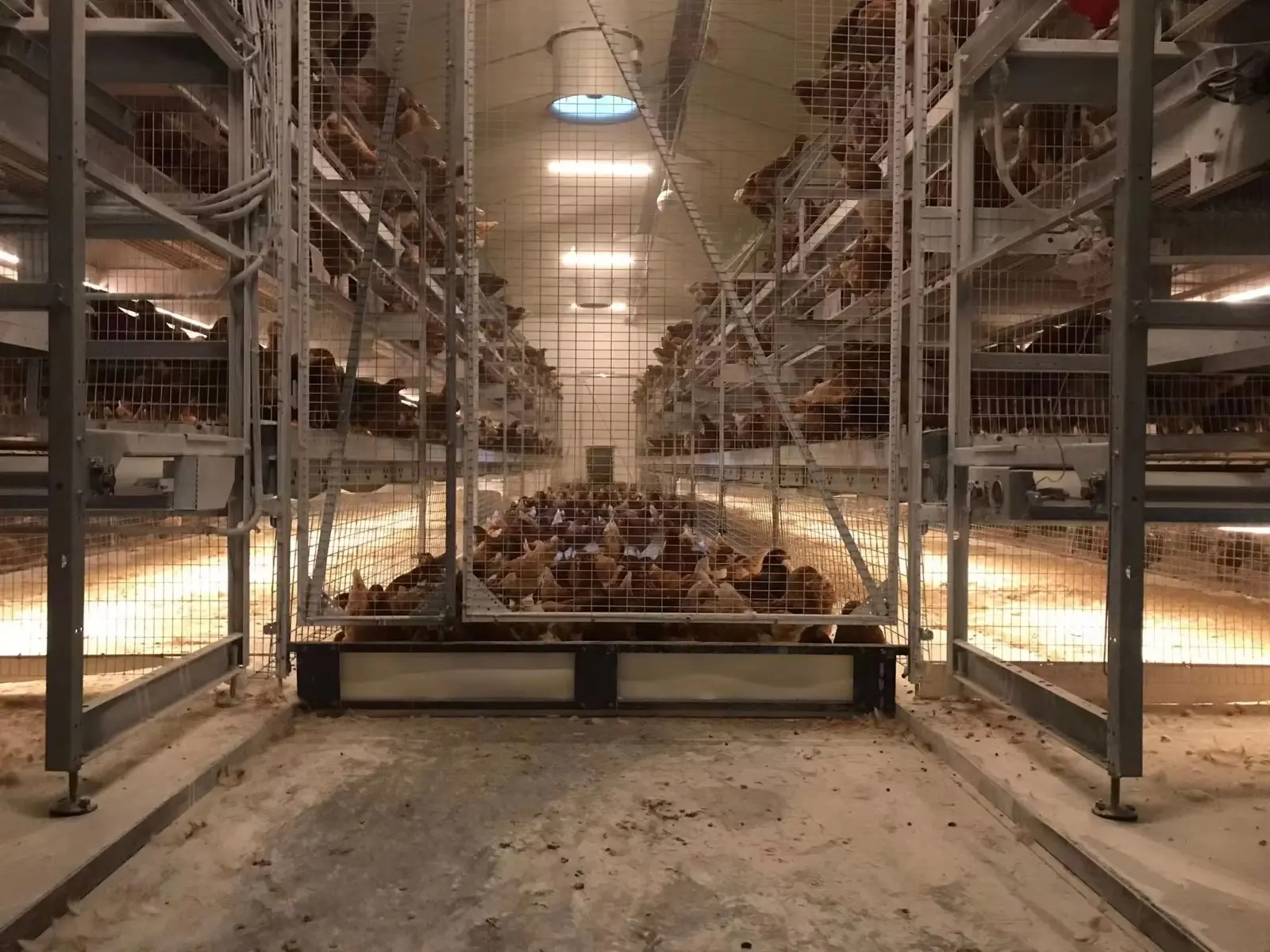
The problem in many poultry houses is not that the lights are not bright enough, but that light distribution is uneven. Cages near the tubes receive plenty of light, while distant cages remain in shadow for long periods. This difference leads to uneven flock development: some birds mature too early, others do not start laying, and the production peak is flattened or lowered.
In practice, traditional recommendations are to install bulbs at about 2 m above the floor, with 3 m spacing between lamps, multiple rows arranged in a cross pattern, and the distance from lamps to walls equal to half the lamp spacing. In modern cage houses, a more accurate approach is to measure light intensity at the feed trough of each cage, with measurement points no more than 50 cm apart between lamps, ensuring every tier and every row receives stable light. There is a difference between the light intensity chickens perceive and the lux reading from a human light meter. The same lamp may appear 50% brighter or more to chickens than the human reading suggests. Therefore, when choosing lamps, do not look only at lumens or color temperature numbers; pay more attention to whether the spectrum covers the red, blue, and green bands that chickens are sensitive to.
Before replacing lights, do the math
Poultry house lighting runs around the clock, and electricity and maintenance costs accumulate quickly. Data from the University of Arkansas Extension show that in a typical broiler house, lighting alone can account for 30%–40% of electrical operating costs. The luminous efficacy of LED tubes is about 100 lm/W, incandescent lamps only about 15 lm/W, and fluorescent lamps about 60 lm/W. A comparative study in a layer house showed that electricity consumption in a house equipped with LED tubes was 43.52% lower than in one using compact fluorescent lamps; in broiler houses, electricity costs fell by about 67% after switching to LED.
| Comparison dimension | Traditional light sources (incandescent/fluorescent) | LED tubes in poultry houses |
|---|---|---|
| Lighting share of poultry house electrical cost | 30%–40% | Can drop below 10% |
| Electricity cost change after broiler house retrofit | - | Down about 67% |
| Layer house LED vs. fluorescent electricity use | - | 43.52% lower |
| Routine maintenance | Frequent bulb replacement, cleaning dusty fixtures | Long life, less replacement and labor |
| Effect on flock behavior | Fluorescent flicker may cause stress | Flicker-free, quieter flocks |
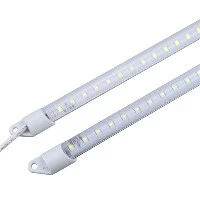
| Environmental adaptability | Easily damaged by high humidity, ammonia, washing | Waterproof/dustproof tubes better suited to washing and disinfection |
Take a layer house with 10,000 birds as an example. The lighting system runs 14–16 hours per day. If a fluorescent system is switched to LED, electricity savings alone can reach several thousand RMB per year, while the saved labor for bulb replacement and the hidden losses from flock stress caused by flicker are often even larger benefits.

In the end, the value of LED tubes in a poultry house is not about being "brighter." It is about integrating spectrum, duration, uniformity, and energy consumption into the flock's growth rhythm. If you are designing a lighting program for layers, broilers, or breeders, or want to assess whether your current tubes match the current stage, please send an inquiry through the product page: https://www.benweilight.com/professional-lighting/led-grow-light/t6-led-chicken-growth-light-tube-waterproof.html.
The Benwei team can provide stage-specific lighting recommendations and electricity cost estimates based on your poultry house type, cage layout, and production stage, helping you use every kilowatt-hour and every hour of light for flock performance.