Walk into any exhibition hall and the first thing you notice is the light. Not the artworks, not the architecture - the light. A painting that looks dull and flat under one beam can suddenly reveal depth and texture under another. A textile that appears grayish might actually be a rich crimson, hidden by a light source that simply cannot render reds. This is not a matter of taste. It is photobiology and color science, and the stakes are higher than most people realize.
The Quiet Damage: What the Lux Numbers Do Not Tell You
The most cited rule in museum lighting is the 50-lux threshold for sensitive works - watercolors, textiles, manuscripts. But lux is only half the story. The Bunsen–Roscoe reciprocity law states that photochemical damage equals illuminance multiplied by exposure time. A silk textile shown at 50 lux for 300 hours per year consumes its entire annual budget of 15,000 lux·h. Once that budget is spent, the damage is cumulative and irreversible.
What the lux rule does not capture is spectral quality. Short-wavelength blue light around 450 nm is roughly ten times more damaging per lumen than 600 nm light to the same dye. This is why conservation-grade LEDs are specified not only by lux but by their spectral damage function. Ordinary white LEDs, even at the correct lux level, can deliver a disproportionate dose of the exact wavelengths that fade pigments fastest.
| Sensitivity Class | Example Artefacts | Max Illuminance | Max Annual Exposure | UV Limit |
|---|---|---|---|---|
| Insensitive | Stone, ceramic, metal, glass | 300 lux | Unlimited | < 75 μW/lm |
| Low sensitivity | Oil & tempera paintings, undyed leather | 150–200 lux | 600,000 lux·h/year | < 75 μW/lm |
| Medium sensitivity | Textiles, watercolours, prints, manuscripts | 50 lux | 150,000 lux·h/year | < 75 μW/lm |
| High sensitivity | Silk, newsprint, fugitive dyes, photographs | 50 lux | 15,000 lux·h/year | < 10 μW/lm |
Data source: ICOM / CIE 157 sensitivity classification, as compiled in Museum Lighting Design 2026
The CRI Illusion: Why "90" Is Not Always Enough
Color rendering index is the most abused number in lighting specification. A luminaire rated CRI 80 will technically meet many commercial standards, but under that light, saturated reds look muted and brownish - the weakest point of any 80-CRI source. For an exhibition hall displaying oil paintings, textiles, or historical artifacts, that weakness is not cosmetic. It changes what the visitor perceives.
The jump from CRI 80 to CRI 90 is visually obvious to most observers, especially in skin tones and red-orange hues. The step from 90 to 95 is subtler in everyday settings, but it becomes critical in demanding applications: museums, art restoration, textile matching, and high-end retail. Professional museum lighting guidance places CRI 95+ in the same category as photography studios and color-matching laboratories - not because the human eye can always articulate the difference, but because the artifact is being judged against a reference standard that demands accuracy.
There is a second number that most specifiers ignore: R9, the specific rendering score for saturated red. A light can carry an overall CRI of 90 while its R9 sits at 30–60. At CRI 95+, R9 typically climbs to 70–90. For oil paintings, where the varnish layer and pigment-binder interfaces are the primary sites of photochemical change, red rendering accuracy is not an aesthetic preference. It is the difference between seeing the work as the conservator intended and seeing a compromised version of it.
The Glare Problem Nobody Measures Until the Opening Night
Uniformity ratio and glare rating are the parameters that appear on no sales sheet and yet determine whether a gallery is comfortable to walk through. EN 12464-1:2021 sets UGR ≤ 19 for general gallery circulation; conservation-grade exhibition zones target UGR < 16, and immersive black-box galleries push the limit down to UGR < 10.
Why does this matter for a track light? Because glare is not merely discomfort. In a space where the eye is constantly moving between a brightly lit object and a darker surround, uncontrolled glare compresses the pupil and reduces the perceived contrast of the very details the lighting was installed to reveal. A track head with a deep recessed reflector and a beam pattern that respects the UGR threshold is not a luxury accessory. It is the difference between a visitor lingering in front of a work and walking past it because their eyes feel tired.
For vertical surfaces - the primary plane in any exhibition - maintained illuminance on walls should reach at least 75 lux, and feature areas benefit from vertical illuminance of 50 lux or above with uniformity ≥ 0.6. These are not arbitrary numbers; they reflect the fact that human visual attention in a gallery is directed at vertical planes, not the floor.
Beam Angle Is a Conservation Tool, Not Just a Design Choice
The conventional way to specify a track light beam angle is by the "look" - narrow for drama, wide for general wash. But for exhibition lighting, the beam angle interacts directly with conservation physics. Quantitative studies on oil paintings show that when incident light strikes at an angle below 30°, specular reflection from the varnish layer can raise local reflectance to 8 to 10 times the painting's average brightness, washing out shadow detail. This is why professional practice controls illumination angles between 30° and 45°.
| Beam Angle | Category | Spread at 3 m | Best Exhibition Role |
|---|---|---|---|
| 24° | Narrow spot | 1.3 m | Framed works, sculpture detail, wall washing at controlled angles |
| 36° | Medium flood | 1.9 m | General accent, feature walls, flexible gallery layouts |
Beam spread data from Lightoem Beam Angle Calculator; exhibition role mapping based on conservation-angle research
A 24° optic places a tight, controllable pool of light exactly where the conservator wants it - and nowhere else. A 36° optic is forgiving across changing exhibition layouts, where wall positions and object heights shift from show to show. Neither is "better." The specification question is whether the fixture allows the angle and intensity to be adjusted without introducing glare or overshoot onto adjacent surfaces.
The Energy Story That Makes the Conservation Case Easier
There is a persistent assumption that conservation-grade lighting must be expensive to operate - that prioritizing spectral quality and glare control means accepting higher wattage. The data does not support that assumption. A DOE GATEWAY study of a museum LED retrofit found that 54 LED track heads consumed approximately 1,403 kWh per year for the same lighting effect that would have required an estimated 9,851 kWh with halogen lamps. In a separate three-gallery installation, 34 LED track heads used 920 kWh/year against 5,410 kWh for the comparable halogen system - an 83% reduction.
The savings compound when heat load is accounted for. Halogen accent lighting dumps the majority of its input energy into infrared radiation, which both damages artifacts and forces the HVAC system to work harder. LED retrofit paybacks in museum environments have been calculated at roughly 3.3 years on lighting energy alone, shrinking to 2.4 years when HVAC savings are included. For an exhibition hall operating year-round, the conservation case and the financial case point in the same direction.
What the Specification Sheet Should Actually Say
The question that opened this article - whether the lighting is protecting the art or slowly fading it - cannot be answered by a single wattage or lumen figure. It requires a luminaire whose spectral output is controlled at the wavelengths that cause damage, whose color rendering holds up in the R9 region where pigments live, whose optic delivers light at the angles conservation science demands, and whose glare control respects the fact that visitors need to see what they came to see.
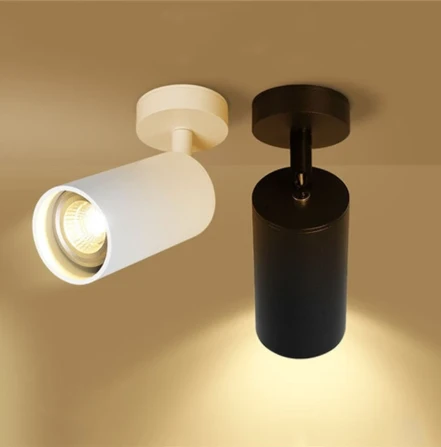
The Benwei LED track light for exhibition halls is built around that intersection. It delivers 140–160 lm/W from a COB source in a 10W–30W range, available in 3000K/4000K/5000K CCT and dimmable for scene-by-scene control across changing exhibitions. The deep housing and interchangeable optic options are designed for the vertical-plane, low-glare, angle-controlled geometry that gallery spaces require - not for the warehouse or retail floor where general-purpose track lighting is typically deployed.
If you are specifying or retrofitting an exhibition hall, the conversation should start with the spectral and glare requirements, not the price per fixture. Send us your gallery dimensions, the sensitivity class of your typical collection, and the mounting height - our team will return a layout with calculated UGR, beam-spread coverage, and a spectral damage estimate for the proposed configuration. The right light is not the brightest or the cheapest. It is the one that lets the work survive the viewing.