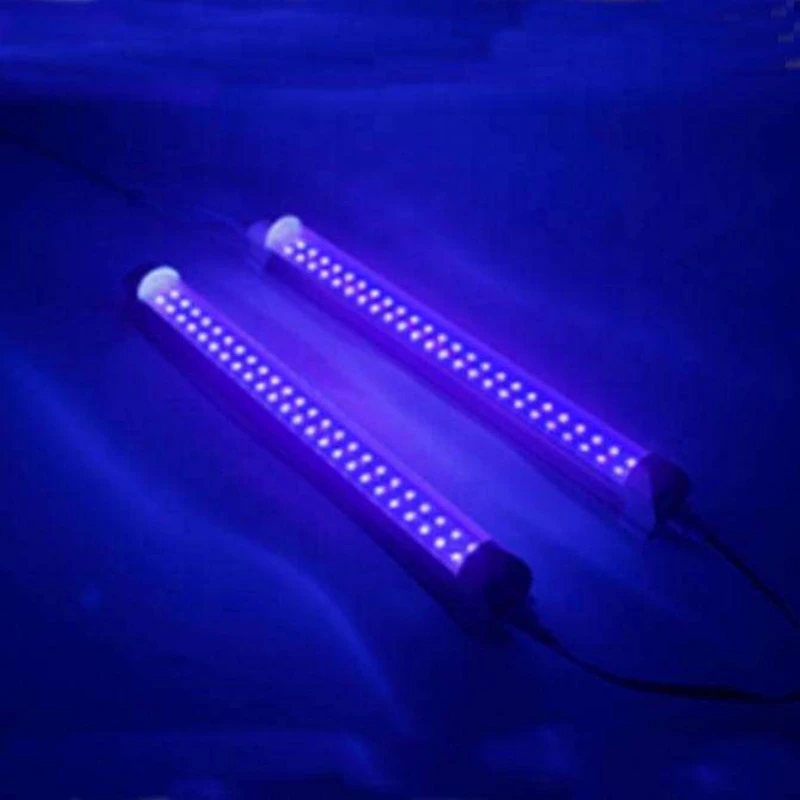
For those involved in fluorescent testing, stage design, or party decorations, choosing a T8 blacklight tube often leads to a common dilemma: should you go with 365nm or 395nm? Some argue that 365nm is more "professional," while others claim 395nm appears brighter and is more affordable. In reality, neither is strictly better or worse; they are simply suited for different applications. Below, we break down the differences from a practical standpoint to help you choose the right one for your specific needs.
Differences in Wavelength and the Mechanism of Fluorescence Excitation
Blacklight tubes emit long-wave UVA ultraviolet light. Fluorescent materials absorb this energy and re-emit it as visible light-this is what we perceive as "glowing."
365nm: Closer to pure ultraviolet light with almost no visible light component, resulting in more accurate, "true-to-life" fluorescent colors.
395nm: Situated near the violet edge of the visible spectrum, it emits a noticeable amount of visible purple light.
Different fluorescent materials have varying sensitivities to specific wavelengths; some react more strongly under 365nm, while others perform just as well under 395nm.
Perceived "Brightness": Why 395nm Often Appears More Striking
Many users find 395nm tubes "brighter" for two main reasons:
395nm tubes emit a distinct purple glow, which helps create a more pronounced "blacklight atmosphere" throughout the space.
Because the human eye can perceive this visible purple light, the tube subjectively appears brighter, and the illuminated area stands out more vividly.
It is important to note that this "brightness" is partly due to the purple light emitted by the tube itself, rather than solely the fluorescence produced by the illuminated objects.
Fluorescent Purity and Detail: The Advantage of 365nm
If your primary focus is the quality of the fluorescence itself, 365nm is generally the superior choice:
It provides a "cleaner" background, creating higher contrast between the fluorescent objects and their surroundings.
Fluorescent colors appear more vivid and are not "tinted" or "washed out" by the purple light. Suitable for observing subtle fluorescent traces, such as anti-counterfeiting marks, fluorescent residue, or the texture of minerals.
Visible Light Leakage: The Impact of Purple Light
Visible light leakage is the most obvious difference between the two.
When a 395nm lamp is turned on, white or light-colored objects take on a distinct purple hue, which can interfere with accurate observation.
With a 365nm lamp, the light source itself is barely visible; the environment remains darker, allowing the fluorescence to stand out more clearly.
This is a significant factor in scenarios requiring precise color identification, such as inspection or authentication.
Recommendations for Different Use Cases
Fluorescent inspection, anti-counterfeiting (e.g., verifying banknotes), mineral identification, and industrial flaw detection: 365nm is the preferred choice.
Parties, bars, stage productions, themed rooms, and Halloween decorations: 395nm creates a better atmosphere and offers better value for money.
Fluorescent posters, displays of fluorescent paint, and glow-in-the-dark art walls: Both work; choose 395nm for atmosphere, or 365nm for color purity.
Routine checks for pet urine stains, mold, or cleaning residue: 365nm makes it easier to see fine details.
Practical Differences: Price, Lifespan, and Installation
Price: 365nm lamps require more advanced manufacturing processes and specific phosphors, making them generally more expensive than 395nm versions.
Lifespan: For T8 tubes of comparable quality, the lifespan is similar; it primarily depends on the build quality and the operating environment.
Installation: Since both follow the T8 standard, the installation process is identical, provided the fixture type is compatible (e.g., matching ballasts or LED-compatible fittings).
When purchasing, check whether the tube is made of glass or plastic, and whether it features a light-filtering coating-these factors will also affect the final results.
Summary
For more authentic fluorescence and sharper contrast, choose 365nm.
For a more immersive atmosphere and a budget-friendly option, choose 395nm.
365nm focuses on the light emitted by the object itself, whereas 395nm includes the visible purple light from the lamp. Determining the wavelength based on your specific application-rather than simply comparing which light is brighter-is a more reliable approach.
Do you need selection advice or a bulk quote?
We offer T8 blacklight tubes in both 365nm and 395nm wavelengths, available in various lengths and power ratings, including direct LED replacement options. We can recommend the ideal solution for your specific use case, and we also support sample testing and bulk customization. Please leave a message or send us an email with your intended application and the required quantity; we will provide a quote and selection guidance as soon as possible.