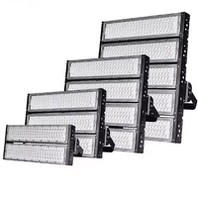
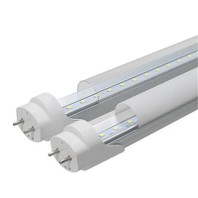
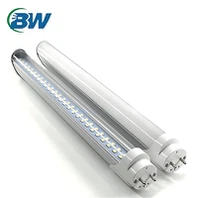
LED fluorescent tube structure, diameter and size
Divided into five parts: LED light source, aluminum substrate, LED fluorescent lamp power supply, aluminum tube, lampshade
1. LED light source
Use low-power LED patch light as the light source
1. Basic parameters (take SMD3014 as an example):
A. Power supply voltage: 3.4-3.5V
B. Size: 3.0mm*1.4mm
C. Life: 50000 hours (when the light decay reaches 30%, it will be used as the life evaluation standard)
D. Beam angle: 120°E, mainstream brightness: 11-12 lumens (LM)
F. Rated working current: 30MA (milliampere)
G. Rated power: 0.1W
H. Color rendering index: RA>75
2. The structure of lamp beads: The main components are: bracket, chip, glue, phosphor, and wire.
A. Bracket: Well-known brands in the market include Taiwan Yiquan, Jiale Electronics, and Huayi Microelectronics. The bracket is mainly used to hold LED chips.
B. Chip: Chip is the core device in the lamp bead, also called "chip", which is used to emit light. Commonly used chips in the market include: the United States: CREE, Bridgelux; Japan: Nichia, Toyoda Gosei; Osram, Germany; Taiwan: Epistar, Kellett (a subsidiary of Chi Mei Group), Guangzhou Jia, Taigou, Guanghong, New Century, Everlight, Baihong, Guanglei; Mainland China: Xiamen San'an, Shanghai Blu-ray, Silan Mingxin, Dalian Lumei…………. (Mainland China now mainly uses Taiwanese chips) The unit of chip size: mil.
Chip emission color: depending on the wavelength, common visible light classifications are roughly: dark red (700nm), deep red (640-660nm), red (615-635nm), yellow (580-595nm), yellow-green (565-575nm), Pure green (500-540nm), blue (450-480nm), purple (380-430nm) white light is mixed light, and white light is excited by blue light + yellow phosphor.
2. Aluminum substrate of LED fluorescent tube: There are two kinds of circuit boards of LED fluorescent tube: aluminum substrate and fiberglass board.
Aluminum substrate: Most fluorescent lamps on the market are made of aluminum substrate. Fiberglass boards are generally not used due to poor heat dissipation.
3. LED fluorescent lamp power supplies are divided into wide-voltage power supplies and narrow-voltage power supplies according to the power supply voltage;
According to input and output, there are: isolated power supply, non-isolated power supply;
Wide voltage power supply: The so-called wide voltage refers to the voltage that can adapt to the normal operation of most countries. Generally speaking, the range of wide voltage is: 85V-265V.
Narrow voltage power supply: The so-called narrow voltage is actually relative, and the narrow voltage range is mostly: 185-265V. It is also said that 85-180V.
Isolated power supply: Isolated power supply means that the mains is not directly connected to the original device of the power supply, but the original electronic device is supplied to the electronic device after the transformer is transformed. The safety performance is higher, but because the circuit is slightly more complicated, the conversion efficiency of the isolated power supply is lower than that of the non-isolated power supply. The conversion efficiency is generally about 85%.
Non-isolated power supply: In contrast to isolated power supply, non-isolated power supply is the direct connection between the mains and the original power supply, which is prone to the danger of electric shock. Compared with the isolated power supply, the safety performance is lower, but the conversion efficiency is higher. Generally, a conversion efficiency of 88% can be achieved, and a maximum of about 92% can be achieved.
The working principle of LED fluorescent lamp power supply: LED driving power mainly goes through the following 3 steps,
1. Step-down: Step-down the connected 220V (or 110V) mains power into AC low-voltage power.
2. Rectification: The low-voltage direct current after the step-down is transformed into an unstable direct current low-voltage through a diode (characteristic of the diode: unidirectional conductivity).
3. Filtering: It becomes a stable low-voltage direct current through capacitor and inductance after multiple filtering.
4. Power the LED
Explanation of several terms of LED fluorescent lamp power supply:
1. Power factor: Power factor is the cosine value of the phase difference between voltage and current. Because both current and voltage are wave graphs, one is a sine graph and the other is a cosine graph; because the two waveform graphs differ by 1/4 period (ie: 90 degrees), the PF value is formed. In order to increase the PF value, it is necessary A correction circuit is added to the power supply, so the cost of a power supply with a high PF value is relatively higher. The PF value without a PF correction circuit is generally around 0.6, and the PF value with a PF circuit can basically reach around 0.9 or even higher.
When the PF value is low, it will pollute the power grid of the entire power supply system. When the PF value is low, the utilization rate of power generation by the electrical equipment on the grid becomes lower. Therefore, the country has a PF value requirement for some high-power electrical equipment. For those below 50W, there is no clear requirement. The national requirement is that the PF value is greater than 0.6.
2. Conversion efficiency: The ratio of output power to input power, for example: 10W of electric power is consumed by a tube, but only 8W of electric power is used to emit light (also known as useful work), and 2W of electric power Then the heat loss on the power supply device (also known as: useless work), then the power conversion efficiency of this lamp is: 80%. The higher the PF value, the better for the national grid; the higher the conversion efficiency, the better for the individual, because more electricity is used.
4. LED fluorescent tube aluminum tube: the market lamp tube shell is mainly made of aluminum profile, and some people use PC plastic tube to make it. Its advantage is that it is cheap, but the disadvantage is that the heat cannot be dissipated, which will make the tube light faster. Decay and reduce life span.
Profiles also have many structures: C-type head, D-type head, 1/2 tube, 1/3 tube, oval tube...
C-type head: From the cross section of the aluminum tube, it looks like a C-shaped head. This structure can be called the middle layer of supporting aluminum plate to reduce the cost, and the circuit board is directly inserted and stuck. The heat of the product made with this structure is not easy to conduct to the aluminum profile, which will directly cause the temperature of the LED chip to be too high and affect the lifespan.
D-type head: From the cross section of the aluminum tube, it looks like a D-shaped head. This structure is also used by most manufacturers. The lamp we make now uses this type of head. This structure is the most suitable The heat dissipation structure can ensure that the heat is dissipated in the most timely manner.
1/2 tube: The so-called 1/2 tube means that the cross section of the aluminum profile is a complete half circle, so it is called 1/2 tube.
1/3 tube: The so-called 1/3 tube means that the aluminum profile is similar to the D-shaped structure, but the aluminum supporting the lamp board sinks to 1/3 of the entire tube. This structure is mainly to solve the problem of the dark area of the tube. Ensure the uniformity of light. However, the LED power supply of this structure must be external. In this way, the heat of the power supply is better dissipated, which can increase the overall life of the lamp.
Oval tube: Since the current 1/2 D tube is the mainstream lamp on the market, but the tube made of this kind of tube has more or less dark areas on both sides. In order to solve this drawback, the oval tube appears On the market now. The problem of dark areas is solved, and the light is even.
5. The outer covers of LED fluorescent tubes are all PC covers, which are processed and produced by PC particles (chemical name: polycarbonate) and matched with diffuser powder.
Divided into the following types: transparent cover, transparent stripe cover, diffusion stripe cover, milky white diffusion cover.
Transparent cover: The transparent cover is the transparent PC cover, you can see the lamp beads, it is very dazzling, easy to dizzy, and does not meet the human requirements for light. The light transmission performance is good, and the light transmission rate can reach 97%.
Transparent striped cover: This kind of cover is a semi-transparent cover, which can diffuse the light, but the light is not uniform enough and will not dazzle the eyes, and the light transmittance is about 88%.
Diffusion stripe cover: also known as thick stripe cover, the light transmittance of this kind of shell is about 86%, the product made of this shell does not seem to have the feeling of dark areas, and the influence of dark areas is cleverly avoided.
Milky white diffuser: The cover used by most manufacturers on the market. The general light transmittance of this housing is 83-85%; the light transmittance below 83 is completely invisible to the light spot of the lamp beads.
6. Diameter and size of led fluorescent tube: T8 diameter is 26mm, and there are many kinds of length, such as 0.6 0.9 1.2 1.5, etc.
T5 diameter is 16mm and there are many kinds of length, 0.6 0.9 1.2
The dimensions of the integrated aluminum tubes vary, so we will not describe them again.
After assembling, it becomes a finished LED fluorescent tube