LED Stadium Light Brightness Requirements for Sports

Lighting installations for sports facilities must meet specific brightness standards. These standards ensure optimal visibility for participants, officials, and spectators. They also define requirements for television broadcast quality. This document outlines the core brightness parameters and design methodologies for sports field lighting.
Understanding Illuminance Classifications and Standards
The Illuminating Engineering Society (IES) provides the primary framework for sports lighting. IES classifications are based on the level of play and spectator presence. Class I facilities host professional or major college events with over 5,000 spectators. Class II applies to competitive collegiate or high school venues with up to 5,000 spectators. Class III covers recreational leagues with limited seating. Class IV includes training and community fields with no permanent spectator provision.
Each classification has defined illuminance targets measured in footcandles (fc) or lux. Horizontal illuminance refers to light falling on the playing surface. Vertical illuminance is critical for player depth perception and television cameras. Uniformity ratios, such as U1 (minimum to average) and U2 (minimum to maximum), dictate the consistency of light spread. Poor uniformity creates shadows and visibility hazards.
Illuminance Targets by Sport and Competition Level

Required brightness levels vary significantly between sports and competition tiers. The following table presents key illuminance values for major sports under IES guidelines.
Table 1: Standard Illuminance Requirements for Selected Sports
|
Sport |
Competition Level |
IES Class |
Average Horizontal Illuminance (fc) |
Uniformity (U2) |
Vertical Illuminance (fc) for TV |
|---|---|---|---|---|---|
|
Football (American) |
Professional / TV Broadcast |
I |
100 fc |
0.7 |
140 fc (main camera) |
|
Football (American) |
Collegiate / High School Varsity |
II |
50 fc |
0.6 |
Not Required |
|
Soccer |
Professional / TV Broadcast |
I |
75 fc |
0.7 |
100 fc (main camera) |
|
Soccer |
Club / Amateur League |
III |
30 fc |
0.5 |
Not Required |
|
Baseball (Infield/Outfield) |
Professional / TV Broadcast |
I |
100/70 fc |
0.7 |
140 fc (main camera) |
|
Baseball |
High School |
II |
50/30 fc |
0.6 |
Not Required |
|
Tennis |
Professional Tournament |
I |
75 fc |
0.7 |
100 fc |
|
Tennis |
Recreational Club |
IV |
20 fc |
0.4 |
Not Required |
Facilities hosting multiple sports must design for the most stringent requirement. A multipurpose field used for nighttime soccer and football requires illumination meeting the higher football standard.
A Design Case Study: A Class II Collegiate Soccer Field
A photometric analysis validates compliance before installation. This case examines a regulation collegiate soccer pitch (360 ft x 225 ft) designed for IES Class II competition.
Project Parameters:
Sport: Soccer
Level: Collegiate (NCAA)
IES Class: II
Target Maintained Illuminance: 50 fc average horizontal
Target Uniformity (U2): > 0.6
Field Dimensions: 360 ft x 225 ft
Proposed Lighting System:
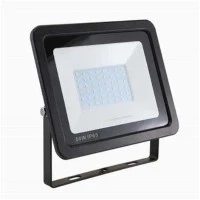
Fixture Type: 1000W LED asymmetric floodlight
Fixture Quantity: 48 units
Mounting: Six (6) poles, 80 feet high
Beam Distribution: Type V (for pole-mounted perimeter lighting)
Control System: Dimmable driver (0-10V) for multi-scene operation
Photometric Results Summary:
Average Horizontal Illuminance: 52.4 fc
Minimum Horizontal Illuminance: 36.7 fc
Uniformity (U2): 0.70
Maximum-to-Minimum Ratio: 1.43:1

The results confirm the design exceeds IES Class II targets. The system provides adequate vertical illuminance for regional broadcast. The dimming capability allows a reduction to 30 fc for practice sessions, conserving energy.
Key Technical Factors Influencing Brightness Achievement
Several hardware and design factors determine whether a system meets brightness standards.
Fixture Luminous Efficacy and Distribution: Fixture output is measured in lumens. Efficacy (lumens per watt) determines the electrical power needed. Optical distribution (NEMA beam type) directs lumens onto the field. Asymmetric optics (types III, IV, and V) are standard for perimeter pole designs to maximize field coverage and minimize spill light.
Pole Placement and Mounting Height: Pole location and height are derived from the field's geometry. Higher mounting heights (70-100 ft) improve uniformity for large fields but require fixtures with higher intensity. The layout must avoid glare for players and spectators. Standard designs use four or six poles placed beyond the field's sidelines.
Light Loss Factors and Maintenance Planning: Calculated illuminance targets are "maintained" values, accounting for future light depreciation. Designers apply factors for luminaire dirt depreciation (LDD), lamp lumen depreciation (LLD), and ambient temperature. An LLD factor based on the manufacturer's L70/L90 rating is critical. A system designed without proper maintenance factors will fail to meet standards within its operational life.
Compliance Verification and Professional Design Services
Facility managers must verify compliance with relevant standards. The IES RP-6 series is the principal guideline in North America. Other standards include UEFA guidelines for soccer and NCAA manuals for collegiate sports.
Engaging a professional lighting designer is necessary for any Class I, II, or III project. The designer will produce a photometric study using accredited software (e.g., AGi32, Dialux). This study is the definitive performance proof. It provides illuminance grids, uniformity calculations, and glare analysis. It also serves as the specification document for competitive bidding.
Glossary of Technical Terms
Footcandle (fc): A unit of illuminance on a surface. One footcandle is one lumen per square foot.
Lumen: A unit of measurement for the total quantity of visible light emitted by a source.
Uniformity (U1 & U2): Ratios describing the evenness of light on a surface. U1 = E_min / E_avg. U2 = E_min / E_max.
Vertical Illuminance: Illuminance measured on a vertical plane, crucial for camera operation and player facial recognition.
Photometric Study: A computer-generated lighting simulation predicting performance metrics for a proposed design.
NEMA Beam Type: A classification system for the light distribution pattern of a floodlight.

References and Industry Standards
Illuminating Engineering Society. *ANSI/IES RP-6-20: Sports and Recreational Area Lighting*. New York: IES, 2020.
National Collegiate Athletic Association. NCAA Sports Lighting Guidelines. Indianapolis: NCAA, 2019.
Fédération Internationale de Football Association. FIFA Football Stadiums: Technical Recommendations and Requirements. Zurich: FIFA, 2021.
International Commission on Illumination (CIE). CIE 150:2017 Guide on the Limitation of the Effects of Obtrusive Light from Outdoor Lighting Installations. Vienna: CIE, 2017.
https://www.benweilight.com/lighting-tube-bulb/78000lm-led-stadium-light-outdoor-400w-flood.html