Lighting Up Cultural Relics, or Harming Them?
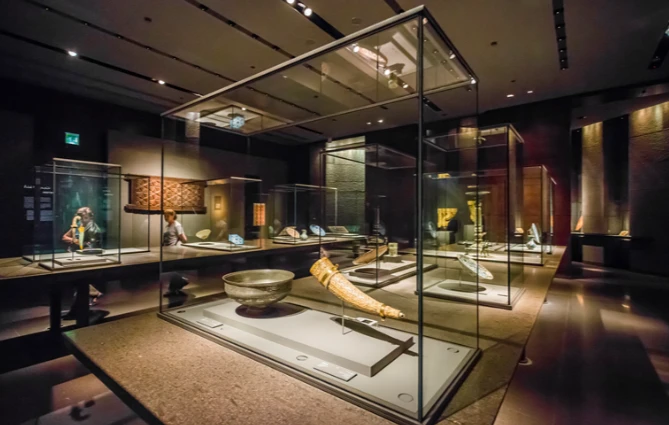
In museums and cultural relic exhibitions, lighting serves a dual purpose: it must allow visitors to see the exhibits clearly, and it must protect the exhibits as much as possible. Many people assume that ordinary LED lamps-energy-efficient, long-lasting, and low-heat-are already "safe enough." In fact, LED lamps specially designed for cultural relic exhibitions and ordinary LED lamps, although both are called LEDs, are products born from almost entirely different logics.
Ordinary LED lamps are designed to "illuminate spaces," with core metrics being brightness, luminous efficacy, lifespan, and cost. LED lamps for cultural relic exhibitions are designed to "protect cultural relics," with core metrics being spectral safety, color fidelity, and precision in light and heat control. They are more like precision optical instruments than ordinary lamps.
I. Different Design Goals: Lighting Tool vs. Conservation Equipment
Ordinary LED lamps are widely used in homes, shopping malls, and offices, pursuing comfortable and sufficiently bright lighting at a reasonable cost. They do not need to consider whether long-term exposure will yellow paper, make silk brittle, or fade pigments.
LED lamps for cultural relic exhibitions, by contrast, must put "cultural relic safety" first. Calligraphy and paintings, textiles, paper, polychrome objects, lacquerware, woodware, murals, and other cultural relics are highly light-sensitive. Light causes irreversible photochemical damage, manifested as fading, discoloration, and embrittlement. Therefore, LED lamps for cultural relics must strike a precise balance between "letting visitors see clearly" and "exposing cultural relics to as little light as possible."
II. Spectral Quality: Not Just "Bright," but "True" and "Safe"
This is the most essential difference between the two.
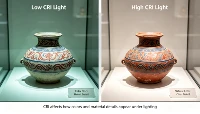
The spectra of ordinary LED lamps are often insufficiently continuous. Their color rendering index (Ra) may be only 70–80, and the special color rendering index R9 (red rendering) may be even lower. As a result, red cultural relics may look dull and dark, and colors may be distorted.
LED lamps for cultural relic exhibitions, however, require extremely high color rendering performance: usually Ra ≥ 90, or even Ra ≥ 95; R9 must also reach above 90 to faithfully render red-toned cultural relics. At the same time, they pursue continuous coverage across the entire visible spectrum, avoiding colors "going off" due to missing spectral components.
More importantly, LED lamps for cultural relics strictly limit ultraviolet and infrared components. Ultraviolet light accelerates fading and embrittlement; infrared light brings thermal radiation. Although ordinary LEDs are safer than traditional light sources, they may still contain trace amounts of harmful radiation. Cultural-relic-grade LEDs are designed from chip and phosphor to packaging around "reducing light damage," and they control the proportion of short-wavelength blue light to lower the risk of photochemical damage.
In addition, LED lamps for cultural relics require extremely low color tolerance, usually SDCM ≤ 2, ensuring that all lamps in the same exhibition hall are highly consistent in color and that there is no visual interference from "one patch of warm yellow, one patch of cool white."

III. Optical Control: From Flood Lighting to Precise Light Shaping
The optical design of ordinary LED lamps is relatively simple, with the focus on spreading light out. LED lamps for cultural relics emphasize precise light control.
They are often equipped with complete optical systems that can achieve zoom, wall-washing, stretching, elliptical, and other beam effects, accurately focusing light on the exhibits and reducing stray light and glare. This both highlights the exhibits and prevents light from falling where it should not. Their dimming systems are also more professional, supporting protocols such as 0–10V, DALI, and DMX, and enabling stepless dimming from 10% to 100% to meet the illuminance needs of cultural relics made of different materials.
Ordinary LED lamps rarely need such complex optical control, whereas in cultural relic lighting, a beam aimed off target may both affect viewing and increase the risk of damage to cultural relics.
IV. Thermal Management: Don't Let the Lamp "Roast" the Cultural Relics
The heat dissipation goal of ordinary LED lamps is mainly to ensure the lamp's own lifespan. The heat dissipation goal of LED lamps for cultural relic exhibitions is to protect the exhibits.
Even if LEDs are highly efficient, they still generate heat. LED lamps for cultural relics usually use independent heat dissipation systems, aluminum-based heat conduction, active cooling ducts, and even "cold channel technology" to discharge heat toward the back of the lamp or outside the display space, preventing heat from radiating forward or affecting cultural relics through thermal convection. If an ordinary LED lamp has poor heat dissipation design, prolonged exposure may also raise the temperature inside a display case, causing hidden harm to cultural relics.
V. Standards and Certification: A Professional Threshold with Rules to Follow
The design and performance of LED lamps for cultural relic exhibitions usually need to comply with standards such as the Code for Lighting Design of Museums (GB/T 23863). These standards have clear provisions for UV/IR radiation limits, illuminance, annual exposure, color rendering index, and so on. Ordinary LED lamps only need to meet general lighting standards and do not have to face these special requirements for cultural relic protection.
Therefore, choosing lamps for a museum is not simply "buying lamps"; it is a cultural relic conservation decision. Truly professional cultural relic lighting is not about being as bright as possible, but about letting visitors see the details clearly while exposing cultural relics to as little light as possible.
In Closing
Ordinary LED lamps are general lighting products, with core concerns of luminous efficacy, lifespan, and cost; LED lamps for cultural relic exhibitions are professional conservation equipment, with core concerns of spectral safety, color fidelity, and controllable light and heat. The difference between them lies not only in price but also in philosophy: one is born to "illuminate," the other to "protect."
In a museum, the best lighting is not the most dazzling light, but the light that allows cultural relics to be seen-and to remain.
If you are interested in professional LED lighting solutions for cultural relic exhibitions, please contact us for a quotation or further information. We look forward to hearing from you.