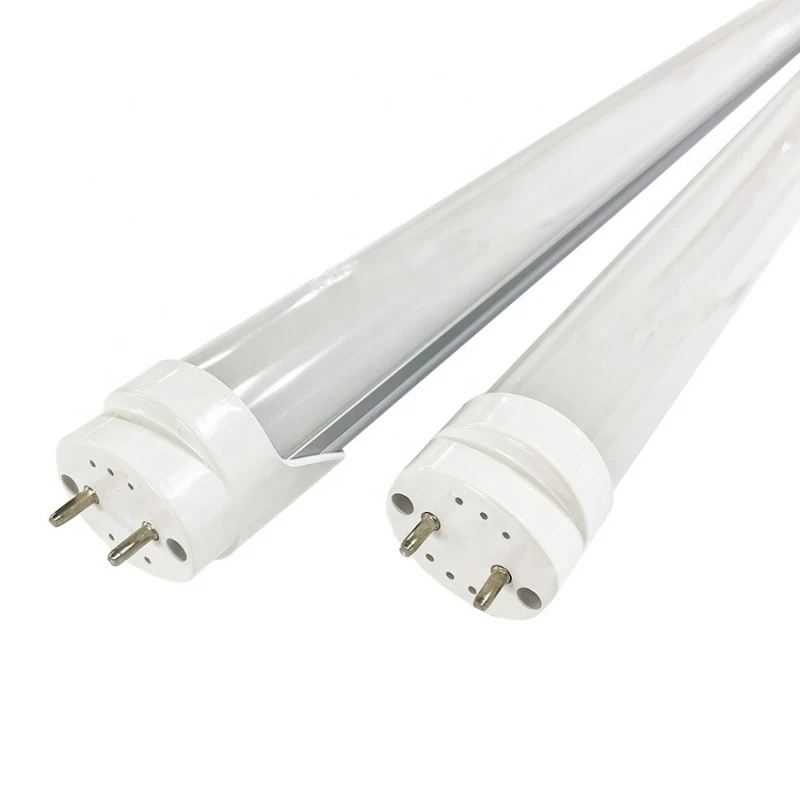
When replacing lighting in warehouses, offices, or workshops, many customers' first reaction is to ask, "Is the wattage high enough for sufficient brightness?" while often overlooking a more fundamental issue: the length of the tube. Although T8 tubes have a uniform diameter (1 inch), they come in various lengths-such as 2 feet, 4 feet, and 8 feet. Choosing the wrong length can lead to anything from a simple installation failure to the need for an entire order to be reworked. This article approaches the subject from a practical standpoint, helping you understand the ideal applications for these three common lengths and how to make the right choice based on your existing fixtures.
Why T8 Tube Length Matters
The length of a T8 tube directly determines whether it will fit into your existing lighting fixtures. Most T8 fixtures are designed with pin spacing based on standard lengths; for instance, a 4-foot tube requires a pin-to-pin distance of approximately 1198mm. If the wrong length is purchased, the tube simply won't fit into the sockets at either end. Furthermore, length affects lighting coverage and the distribution of brightness-even with a similar power rating (around 30W), the uniformity of the light and the illumination effect on the target area will differ significantly depending on whether that power is distributed across a 2-foot tube or an 8-foot one. Therefore, when selecting tubes, the length should usually be determined before the wattage.
2-Foot T8 Tubes: A Choice for Supplemental Lighting in Small Spaces
2-foot (approx. 60cm) T8 tubes are commonly found in space-constrained applications such as freezer lighting, under-shelf lighting, and internal equipment lighting. Their advantages lie in their compact size and installation flexibility, making them ideal for corners or areas that require linear lighting but cannot accommodate standard 4-foot tubes. With a power rating typically around 9W–10W, their total luminous flux may not be high, but they excel at precisely illuminating specific "dead zones" where light is otherwise lacking. Note that there are relatively fewer market options for 2-foot tubes; it is best to verify the pin type (e.g., G13) before purchasing to ensure compatibility with your fixtures.
4-Foot T8 Tubes: The Most Common Standard Specification
The 4-foot (approx. 120cm) tube is currently the most widely used T8 length. It is the standard specification for the vast majority of applications, including louvered ceiling lights in offices, suspended fixtures in supermarkets, and dual-tube fixtures in classrooms. It has become mainstream partly because it strikes an excellent balance between length and brightness, delivering nearly 2,000 lumens of output with a power draw of around 18W. Additionally, it is compatible with a vast number of existing legacy fluorescent fixtures; replacement requires no major rewiring-especially with "instant-start" compatible models, which are essentially plug-and-play. For customers upgrading from T8 fluorescent tubes to LED, the 4-foot model is almost always the top choice.
8-Foot T8 Tubes: An Efficient Solution for Large Spaces
8-foot (approx. 240 cm) tubes are primarily used in spaces with high ceilings and large floor areas, such as warehouses, factories, and gymnasiums. Their core advantage is that "one replaces two"-a single 8-foot tube can often substitute for a pair of 4-foot tubes plus a connector. This reduces the number of fixtures and wiring points during installation and simplifies long-term maintenance. With a typical power range of 36W–45W and a luminous flux exceeding 5,000 lumens per tube, they are ideal for scenarios requiring broad, uniform illumination without a high density of fixtures. However, note that 8-foot tubes place specific demands on the fixture's span; it is crucial to physically measure the usable length of existing fixtures before retrofitting.
Three Details to Confirm Before Purchasing
Regardless of the length you choose, it is advisable to do three things before placing an order: First, remove an existing tube to measure its exact length and pin spacing, rather than relying on visual estimation. Second, determine whether the fixture requires rewiring-such as removing or bypassing the existing ballast. Third, verify the supplier's specifications to ensure the length, wattage, and Color Rendering Index (CRI) match your site's requirements; this is particularly important for bulk orders, as specification mismatches can lead to high rework costs.
Summary
2-foot tubes are suitable for small spaces requiring localized supplemental lighting; 4-foot tubes are the most versatile choice for office and commercial lighting; and 8-foot tubes are best suited for large-scale environments like warehouses and factories. The first step in selecting a replacement tube is always to accurately measure the length of your existing fixture; by factoring in brightness requirements and the complexity of the retrofit, you can determine the correct model and avoid the inconvenience of purchasing a product that doesn't fit.
If you are selecting T8 tubes for a project or are unsure which length is compatible with your current fixtures, please feel free to send us photos or specific dimensions. Our technical team can verify the specifications for you at no cost and provide a quote based on your actual requirements. We welcome your inquiries at any time.
https://www.benweilight.com/lighting-tube-bulb/special-t8-led-tube/high-cri-t8-led-97ra-95ra.html