When upgrading lighting for warehouses, factories, or gymnasiums, the choice between UFO high-bay lights and linear high-bay lights is a dilemma faced by almost every procurement manager. While both fall under the category of industrial high-bay lighting, they differ significantly in terms of suitable applications, lighting performance, and installation requirements. A wrong choice can lead to anything from substandard illumination levels to costly rework, wasting both the budget and the project schedule. This article breaks down the differences across several dimensions-structure, lighting performance, application scenarios, installation/maintenance, and cost-to help you make a quick and informed decision.
Structural Differences: UFO vs. Linear High-Bay Lights
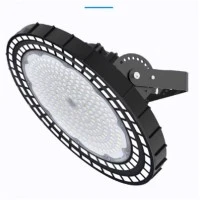
UFO high-bay lights (circular high-bay lights) feature a compact, round, or polygonal design. The light source and heat sink are integrated into a single disc-shaped unit; they are generally lightweight, and a single mounting point can illuminate a large area.
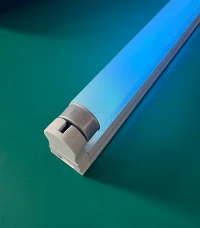
Linear high-bay lights, in contrast, have an elongated structure. They typically consist of modular LED boards connected in series, ranging in length from 0.6 to 2.4 meters, and can be linked together to extend the length as needed. They emphasize a "linear light strip" approach rather than broad coverage from a single point.
In short, one provides "point-source" illumination while the other offers "linear" illumination; this structural difference dictates all subsequent comparisons.
Comparison of Lighting Performance and Effects
UFO lights emit light radially in all directions, making them ideal for creating uniform ambient lighting. In open, unobstructed spaces, just a few UFO lights can illuminate the entire area quite evenly.
Linear lights offer more concentrated, directional illumination, making them particularly suitable for lighting along racking aisles, production lines, or elongated areas. At the same wattage, linear lights often provide better illuminance uniformity in narrow, long spaces because their light distribution pattern aligns better with the shape of the space.
It is worth noting that there is little difference between the two regarding Color Rendering Index (CRI) or color temperature options (commonly 5000K–6500K). The real differentiator is how well the light distribution pattern matches the space, rather than simply which one is brighter.
Comparison of Application Scenarios
UFO high-bay lights are best suited for:
Open-plan spaces without fixed aisle obstructions, such as large factories, sports arenas, and exhibition centers.
Facilities with ceiling heights generally ranging from 6 to 15 meters.
Projects requiring rapid installation and single-point coverage of large areas.
Linear high-bay lights are best suited for:
Long, narrow spaces like warehouse racking aisles and order-picking zones.
Scenarios requiring continuous, uniform light strips, such as production and assembly lines.
Environments with ceiling heights of 4–10 meters and limited aisle widths.
In warehouses with densely packed racks and narrow aisles, installing UFO lights can result in "bright aisles but shadowed racks"; this is where the directional lighting advantage of linear lights becomes apparent.
Comparison of Installation and Maintenance
UFO lights are relatively simple to install, requiring only single-point suspension or chain mounting; they are ideal for projects covering large areas with fewer mounting points, offering high on-site installation efficiency.
Linear lights require splicing and complex wiring, demanding more rigorous layout planning-especially when connecting multiple lights to a single power source. Power distribution and cable routing must be planned in advance, resulting in slightly longer on-site installation times.
Regarding maintenance, both types generally allow for the independent replacement of LED drivers and light modules without replacing the entire fixture. However, the modular nature of linear lights offers greater flexibility; a single faulty module can be replaced without affecting the rest of the light strip.
Cost Comparison
In terms of unit purchase price, UFO lights usually offer better cost-effectiveness. This is particularly true for large, open spaces, where fewer fixtures are needed, resulting in a lower overall cost.
Linear lights, due to their modular design and slightly higher installation complexity, may have a higher initial investment cost per unit area. However, in narrow aisle scenarios, using UFO lights might require a larger number of fixtures to compensate for uneven illumination; when calculated over the long term, the cost gap narrows, and linear lights may even prove more economical.
Therefore, cost comparisons should not rely solely on the unit price of the fixtures; one must calculate the total cost by factoring in the site layout and the actual number of fixtures required.
Summary
There is no absolute "better" option between UFO high-bay lights and linear high-bay lights; the key difference lies in whether the light distribution matches the shape of the space. UFO lights are preferable for large, open, unobstructed areas, whereas linear lights are better suited for narrow aisles or production lines. When making a selection, it is advisable to consider factors such as ceiling height, aisle width, racking layout, and illumination requirements. If necessary, a combination of both types can be used to create a customized lighting solution tailored to specific zones.
If you are selecting high-bay lights for a warehouse, factory, or sports facility project and are unsure whether UFO or linear lights are better suited to your specific site, please feel free to share details regarding the ceiling height, dimensions, and intended use. We can provide recommendations and price quotes based on your specific situation to help you avoid costly mistakes.