Lithium battery module design
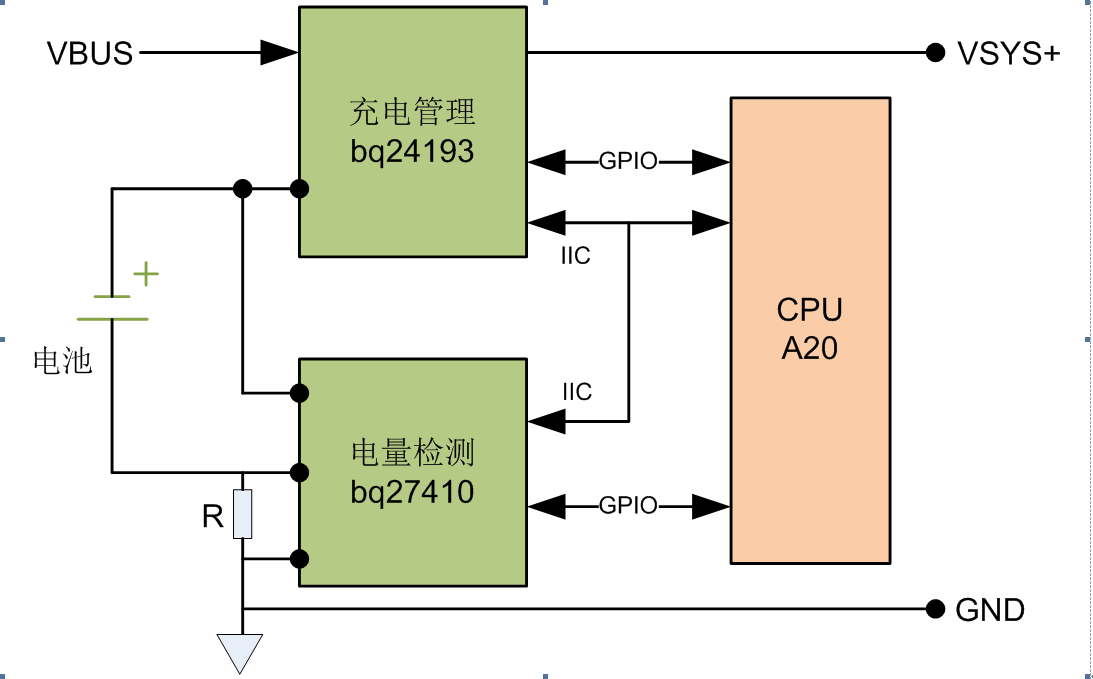
The battery module includes three parts: lithium battery, charge management, and power monitoring.
1. Lithium battery
The lithium battery adopts a single-unit, replaceable design, and needs to be packaged in an outer casing. Users can disassemble, install and replace the lithium battery from the device by themselves.
The battery interface adopts a 3-wire contact type, including power +, power -, and temperature detection points. The contact points need to be gold-plated.
The rated voltage of the battery is 3.8V, the working voltage range is 3.5~4.2V, the capacity is 6000~8000mAh, the rated discharge current is 5A, and the peak current reaches 8A.
The battery has a temperature sensing function, which can integrate a negative temperature coefficient thermistor inside the battery, and realize the internal temperature monitoring of the battery through the charge management chip.
2. Charging management
The charging management chip adopts TI's BQ24193, which integrates switch-mode battery charging management and system power path management, and supports a wide range of input sources, including standard USB host interfaces, USB charging ports, and high-power DC adapters.
Complete a charging cycle without software control, and realize three stages of charging by automatically detecting the battery voltage: pre-charging, constant current charging and constant voltage charging, when the charging current is lower than the preset value (10mA), the charger automatically termination.
The BQ24193 provides multiple safety features for battery charging and system operation, including dual NTC thermistor monitoring, charge safety timer, and overvoltage/overcurrent protection, and supports JEITA-compliant temperature profiles.
3. Power detection
The power detection chip adopts TI's BQ27410, based on TI's patented technology Impedance Track's easy-to-configure battery power monitoring, which can provide remaining battery capacity, charging status (progress), and battery voltage.
Modeled battery discharge curves accurately report state-of-charge, with automatic adjustments based on battery aging, battery self-discharge, and low rates of temperature/rate.
6. Lithium-ion battery charging module
The lithium-ion battery charging module is used to charge a single lithium battery or multiple lithium batteries in parallel. The lithium-ion battery universal charging module consists of a charging current sampling circuit, a charging switch tube, an integrated control circuit, and a charging voltage sampling circuit.
The charging sampling circuit can set the constant charging current of the charging module according to the capacity of the lithium battery to be charged; the voltage sampling circuit can set the constant charging voltage output by the general charging module according to the number of series batteries of the lithium battery to be charged; The function is to achieve the best charging of the lithium battery by controlling the switch. After the charging starts, the lithium battery is charged with a constant current. When the battery voltage reaches the set constant charging voltage, it will automatically switch to constant voltage charging to ensure the lithium battery is safe and fully charged.