Introduction: The Quiet Revolution Above Our Heads
From Functional Fixture to Intelligent Infrastructure
The Invisible Cost of "Good Enough"
For most of the last three decades, outdoor area lighting was treated as a line item rather than a strategic asset. A parking lot, a warehouse apron, a municipal road or an industrial yard needed light, and the cheapest fixture that satisfied a lux target was the one that won the purchase order. That logic held as long as energy was cheap, maintenance labor was abundant and nobody measured the consequences of poor light distribution.
None of those assumptions survive today. Electricity tariffs in most mature markets have risen faster than general inflation; skilled maintenance crews are scarcer and more expensive than the fixtures they service; and the safety, security and liability exposure created by uneven or failing illumination has become a documented cost, not an abstract worry. The traditional area light - a stamped aluminum housing, a magnetic or early electronic ballast, a glass envelope and a lamp that degrades from the very first hour - is now the most expensive option on the table, even when its unit price looks lowest.
Three Forces Reshaping Specification
Three structural forces are pushing the market toward smart LED area lighting simultaneously. The first is regulatory: minimum efficacy thresholds, bans on legacy lamp types and stricter photometric compliance have made non-LED retrofit increasingly non-viable in public procurement. The second is economic: a modern LED area light delivering 140–160 lm/W against a legacy HID system at 60–80 system lm/W collapses connected load by half or more, and that saving compounds every month for a decade. The third is operational: networked controls, photocells and dimming schedules turn a passive fixture into an addressable node on a facility network, enabling fault reporting, curfew dimming and energy attribution without a truck roll.
The result is a genuine category shift. Area lighting is no longer a commodity hardware purchase; it is a small infrastructure decision with a measurable return, an auditable compliance trail and a fifteen-year operating horizon.
Why "Area Lights" Are the New Battleground
The Application Is Bigger Than the Product Name
The term "area light" undersells the installed base. The same optical and thermal platform is specified across parking structures, distribution center yards, rail sidings, port aprons, fuel stations, school campuses, municipal roads, industrial parks, logistic hubs and highway interchanges. These are precisely the sites where downtime is most visible, where insurance and liability scrutiny is highest, and where the client - whether a facilities manager, an EPC contractor or a municipal engineer - has the strongest incentive to buy on total cost of ownership rather than sticker price.
Where Traditional Systems Actually Fail
A traditional area light fails on six dimensions at once: optical spill (light thrown where it is not needed, creating glare and wasted lumens), thermal decay (lumen depreciation accelerating as junctions run hot), power quality (driver failure being the single largest cause of field returns), moisture ingress (the quiet killer that corrodes drivers and lenses from the inside), zero intelligence (no photocell, no dimming, no diagnostics), and installation inflexibility (a bracket that fits one pole type and nothing else). Any credible upgrade argument must answer all six, not just wattage.
Anatomy of the Upgrade: Six Engineering Pillars
Optical Architecture: Putting Light Where It Is Needed
Lens-Level Precision
The single most under-appreciated component in an area light is the secondary optic. A high-quality PMMA lens array does more for perceived performance than a marginal bump in LED bin quality, because it determines how efficiently every emitted lumen reaches the target surface. On a well-engineered platform, each LED sits behind an individual molded lens with a defined beam profile, and the array is arranged so that overlapping distributions produce uniform illuminance rather than hot spots and dark bands.
Selecting the Correct Photometric Distribution
Professional platforms offer multiple distributions precisely because one beam cannot serve every geometry: Type II for narrow, long strips such as walkways and single-lane access roads; Type III for standard roadway and parking layouts where the pole sits at the edge of the lit area; Type IV for wider, asymmetric coverage such as wall-mounted or corner-mounted positions; and Type V for symmetric, full-surround illumination in yards, roundabouts and open lots. Optional 120°×50° and 145°×100° beam angles extend the same platform to flood-lighting and wide-area applications.
Choosing the right distribution is not a detail - it is the difference between a design that meets target lux at 12 meters mounting height with 200W and one that needs 260W to compensate for spill. For the buyer, this translates to fewer fixtures, lower connected load and a cleaner DIALux submission.
Thermal Engineering: The Real Determinant of Service Life
Die-Cast Aluminum and Deliberate Geometry
LEDs do not fail from age; they fail from heat. Every 10°C reduction in junction temperature roughly doubles the effective life of the semiconductor and the electrolyte inside the driver. This is why the housing in a serious area light is not a cosmetic shell but a thermal machine: die-cast aluminum with a high surface-to-volume ratio, fins oriented for convective chimney effect, and a thermal path engineered from the LED star through the PCB, through the housing and into the air.
A fashionable, sculpted housing design can and should coexist with real thermal performance. The distinguishing test is simple: ask for LM-80 data on the LED package, LM-79 data on the finished luminaire, and a documented L70/L90 projection at the actual drive current and ambient temperature of your site. A supplier who cannot produce an L70 figure at 50°C ambient is selling a warranty, not a product.
Lumen Maintenance as a Contract Term
Specifying "50,000 hours" in a tender is meaningless unless it is tied to a lumen-maintenance criterion. Insist on L90 at 50,000 hours or L70 at 100,000 hours, referenced to TM-21 extrapolation at the specified case temperature. This converts a marketing claim into an enforceable performance obligation and protects the owner against a system that is 30% dimmer in year four.
Power Electronics: Where Reliability Is Actually Won
Driver Provenance Matters More Than Any Other Line on the Datasheet
Field return data across the industry is remarkably consistent: the driver, not the LED, is the dominant failure mode. This is why brand-grade power supplies are the correct specification decision rather than an upsell. Meanwell, MOSO and Sosen driver options each carry distinct advantages - Meanwell for global service networks and recognized brand assurance in tender evaluation, MOSO for cost-optimized high-volume programs, Sosen for compact form factors and wide dimming ranges - but all three share the property that matters: documented electrolytic capacitor selection, proper thermal derating and consistent batch quality.
Five-Year Warranty as Evidence, Not Generosity
A five-year warranty on the driver is not a marketing gift; it is a statement that the manufacturer has validated thermal derating and burn-in. Buyers should read it as one leg of a three-part proof, together with the driver datasheet's case-temperature curve and the luminaire's internal cabinet temperature measurement under full load at rated ambient.
Ingress Protection: IP66 and the Driver Cabinet Solution
Why an Exposed Driver Is a Design Error
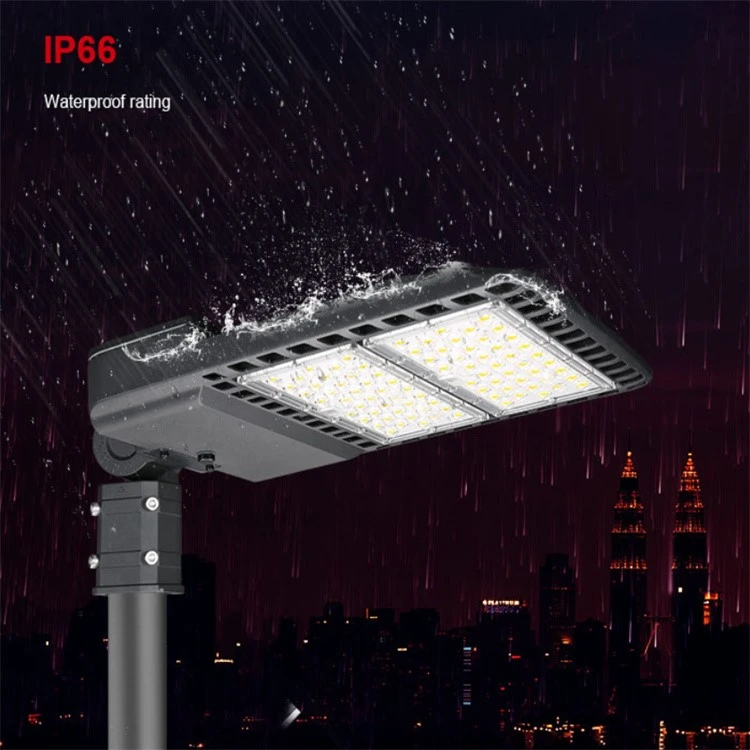
The most common failure point in outdoor luminaires is not the optical chamber but the driver compartment. A driver mounted on an open frame, protected only by a gasket at the lens, will eventually see condensation, dust bridging and corrosion. A dedicated driver cabinet with a rubber seal ring and an IP66-rated enclosure changes the risk profile completely: the electronics live in their own sealed, thermally managed box, isolated from the optical chamber and from direct water paths.
Field-Verified Water Resistance
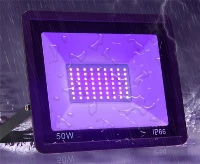
An IP66 rating should be demonstrated, not asserted. Rain-test imagery, IP test reports from an accredited laboratory (IEC 60529), and a housing designed so that water cannot pool on any sealing face are the three things a specifier should demand. For coastal and tropical markets - where driving rain arrives at an angle and salt fog accelerates corrosion - the same design should be paired with a documented salt-spray rating and marine-grade pretreatment on the die-cast surfaces.
The Intelligence Layer: Photocells, Dimming and Networked Control
Photocell Availability as the Entry Point to Smart Operation
The simplest, highest-return intelligence is a plug-in photocell with automatic on/off switching based on ambient lux difference. It eliminates the two most wasteful behaviors in outdoor lighting: lamps burning at noon because a timer drifted, and lamps off at dusk because nobody reset the schedule after a seasonal change. A properly specified photocell with hysteresis avoids nuisance switching from headlights, lightning or cloud edge, and its receptacle design allows field replacement without opening the luminaire.
From Autonomous to Networked
The upgrade ladder continues upward from there: integrated 0–10V or DALI dimming for curfew profiles (for example 100% until 23:00, 50% until 05:00, 100% at dawn), occupancy-based step dimming on low-traffic sites, and full networked control via NEMA 7-pin or Zhaga Book 18 interfaces for asset management, energy metering, fault alarms and OTA configuration. The commercial point is decisive: the incremental cost of a dimming-ready driver and control receptacle at the point of manufacture is a fraction of the cost of retrofitting controls later. Specifying "smart-ready" today is the cheapest decision in the entire project.
Mechanical Versatility: One Platform, Every Pole
The Multiple Bracket System
Installation cost is frequently 20–40% of a retrofit budget, and most of it is consumed by mounting adaptation. A platform offering a family of brackets - A, B, C, D and E types covering round pole, square pole and wall mounting - removes that friction entirely. The same luminaire can be dropped onto an existing 60mm round steel pole, a square concrete column or a masonry wall without fabrication, drilling or third-party adapters.
A Compact, Serviceable Footprint
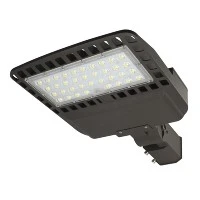
A footprint of roughly 310 × 311 × 72 mm for the mid-power variant means the fixture fits neatly onto existing davit arms, slip-fitter brackets and trunking without wind-load recalculation on most structures. Combined with tool-free or single-tool access to the driver cabinet, this design language supports a genuine one-truck, one-technician service model - the operational ideal for fleets of 200 or 2,000 units.
Traditional Versus Smart LED: A Comparative Framework
Performance Comparison
| Dimension | Traditional HID / Legacy Area Light | Smart LED Area Light |
|---|---|---|
| System efficacy | 60–85 lm/W | 140–165 lm/W |
| Optical control | Broad, uncontrolled spill | Lens-level Type II–V distribution |
| Lumen maintenance | 50–60% at 20,000 h | L90 at 50,000 h / L70 at 100,000 h |
| Driver location | Open frame, gasket-dependent | Sealed IP66 driver cabinet, rubber seal ring |
| Ingress protection | IP54–IP65 typical | IP66 verified |
| Control | None or external timer | Integrated photocell, 0–10V/DALI, smart-ready |
| Mounting flexibility | Single bracket type | A–E brackets, round/square pole, wall |
| Warranty | 1–2 years, lamp excluded | 5 years, driver and LED included |
| Failure mode | Lamp and ballast replacement cycles | Predictive, addressable diagnostics |
Total Cost of Ownership Over Ten Years
Take a representative 100-fixture parking and access-road site operating 4,000 hours per year at USD 0.15/kWh. A legacy 250W HID system draws roughly 285W at the wall and delivers acceptable uniformity only with a high fixture count. A 150W LED replacement delivering equivalent or better illuminance draws about 158W. The connected-load reduction is approximately 127W per fixture, or 50.8 MWh across 100 fixtures over ten years - around USD 7,600 in energy alone at the stated tariff, before any dimming schedule is applied.
Layer on maintenance: legacy HID lamps at 20,000-hour replacement intervals plus ballast failures imply roughly two to three lamp changes and one ballast change per fixture per decade, each requiring a bucket truck and two technicians. At a conservative USD 60 per service visit per fixture, 100 fixtures generate USD 12,000–18,000 in avoidable labor and materials over ten years. A five-year driver warranty and L90 performance eliminate most of that line item. The complete picture is a payback period typically between two and four years, followed by six to eight years of essentially free operation - a return profile no traditional system can approach.
Compliance, Risk and Insurability
Smart LED platforms also reduce non-financial risk. Compliance with CE, RoHS, ENEC where applicable, and photometric reporting to LM-79 and LM-80 standards provides an auditable documentation trail for tenders and incentive programs. IP66 verification reduces water-damage claims. Uniform illuminance reduces slip, trip and security incidents - a factor insurers increasingly recognize. And because the driver is serviceable and the photocell replaceable, the owner is not forced into premature whole-fixture replacement when a single component ages out.
Deployment Playbook: Transitioning Without Disruption
Site Audit and Photometric Design First
Never retrofit by wattage equivalence. Begin with a site survey recording pole spacing, mounting height, arm geometry, existing distribution type and obstruction patterns. Then run a DIALux or Relux model using the actual IES files of the proposed luminaire, targeting the applicable standard - EN 13201 for roads, or the owner's corporate lux and uniformity criteria for private sites. The output determines fixture count, wattage, beam type and mounting configuration before a single purchase order is issued.
Phased Retrofit Strategy
For large estates, phase the transition by risk and visibility: critical access roads and pedestrian zones first, then yards, then long-tail areas. Because the platform accepts multiple bracket types, each phase can reuse existing poles and arms, keeping civil works near zero. Retain a small inventory of complete fixtures plus driver and photocell spares to support the first two years; after that, warranty coverage and modular serviceability govern.
Commissioning and Control Configuration
At commissioning, verify three things explicitly: measured lux and uniformity at defined grid points against the design, actual connected wattage at the panel, and control behavior - photocell thresholds, dimming schedules and network addressing where applicable. Document all three in a handover file; this becomes the baseline for future energy reporting and warranty claims.
Operations and Maintenance Model
Adopt condition-based rather than calendar-based maintenance. With smart-ready fixtures, driver faults and photocell failures are reported as discrete alarms rather than discovered during an outage complaint. Cleaning cycles can be extended to 24–36 months in most environments, and group relamping disappears entirely from the budget.
The Commercial Case for Distributors and Specifiers
How to Write the Specification So You Win the Right Product
The most effective lever available to a distributor is the specification document. Draft it around measurable, non-negotiable criteria: minimum system efficacy at the luminaire level, L90 at 50,000 hours per TM-21, IP66 on both optical and driver compartments, named driver brands with a five-year warranty, plug-in photocell receptacle, 0–10V/DALI dimming readiness, and a mounting system covering round pole, square pole and wall. These clauses are neutral on their face but exclude low-grade product decisively, and they make the evaluation committee's job straightforward.
A Supplier Validation Checklist
Before committing volume, validate the supplier on seven points: accredited IP and photometric reports, LM-80 data on the actual LED package used, a driver datasheet with case-temperature derating curves, a documented burn-in and aging process, bracket drawings with pole-diameter ranges, a spare-parts program covering drivers and photocells, and a warranty document that names the responsible party and the claim process. A supplier that answers all seven in writing is a partner; one that answers five is a risk.
Positioning Language That Converts
Frame the offer in the buyer's own terms: "Same poles, same footprint, half the connected load, verified IP66 in both chambers, five-year driver coverage, and controls already built in." Avoid leading with wattage or lumens; lead with the six pillars - optics, thermal, driver, sealing, intelligence, mounting - because that is precisely the set of concerns a facilities engineer or consulting specifier is scored against.
Conclusion
The transition from traditional to smart LED area lighting is not a lamp swap. It is a platform decision that resolves, in a single purchase, six independent engineering problems that legacy systems were never designed to solve: uncontrolled optics, thermal decay, driver fragility, moisture ingress, zero intelligence and rigid mounting. Each pillar is individually defensible on cost; together they change the economics of the entire site for a decade or more.
For the owner, the case is measurable: half the connected load, a two-to-four-year payback, near-zero routine maintenance and an auditable compliance file. For the specifier, the case is professional: a design that meets target illuminance with fewer fixtures and a documented performance obligation instead of a marketing promise. For the distributor, the case is commercial: a platform that wins on total cost of ownership in every evaluation that is scored honestly.
The fixtures above our roads, yards and facilities are the last infrastructure most organizations think about and the first they notice when it fails. Upgrading them is therefore not a deferrable expense - it is the highest-return, lowest-disruption capital decision available in most facility portfolios. The ultimate upgrade is already engineered, already proven at IP66, already dimming-ready. The only remaining question is which site goes first.
How To Cooperate With Us?
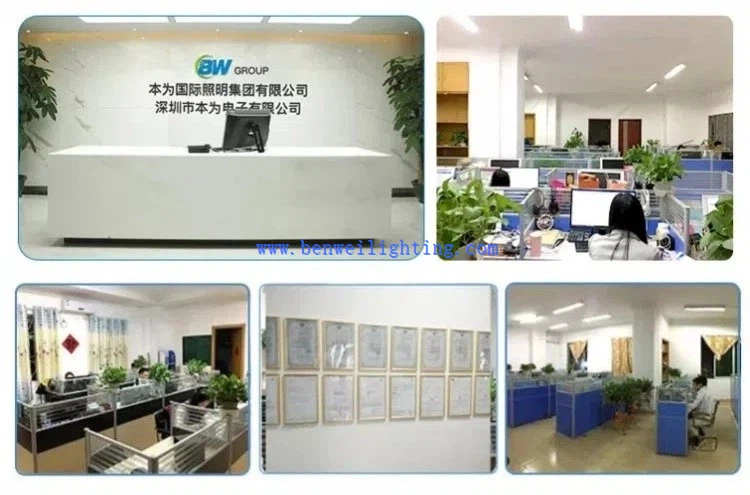
We are happy that we have total control over the manufacturing process and the quality of our products since we have our own facilities. Since we are producers rather than just brokers, we are dedicated to providing our customers with the best pricing. Since we are certain that the price and quality of our products are transparent, we advise customers to examine our samples first. Our commitment to quality and customer satisfaction drives us to continuously provide top-notch goods.
Our address
3rd Floor, 5th Building, Hebei Industrial Park, Hualian Community, Longhua District, Shenzhen, China