Lux and Kelvin: How to Match Brightness and Color Temperature for Perfect Room Lighting?
You replaced your outdated, warm lightbulbs with 5000K LEDs. There is undoubtedly more light in the room, yet something seems strange. It's harsh, clinical, and completely unsettling. This is a discrepancy between the bulb's brightness (measured in lux) and colour (measured in Kelvin), not a flaw in the bulb's quality. The difference between a room that feels right and one that doesn't is getting these two correct and realising why they need to work together.
The Kruithof Curve: The Key to Comfortable Lighting
You must understand the true meaning of the two phrases before you can solve the issue.
Brightness is measured by Lux, while colour is measured by Kelvin.
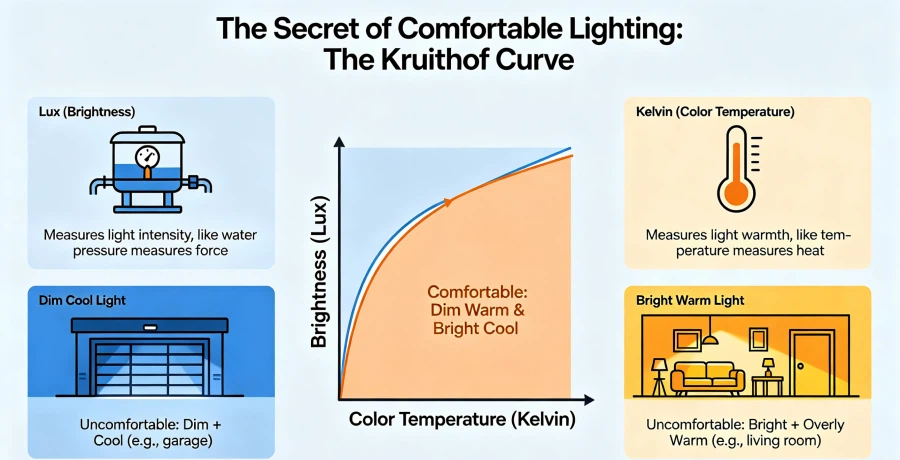
Consider a tap. Lux is the water pressure, or the amount of light that strikes a surface. The water's temperature, or the colour of the light, is measured in Kelvin. Similar to an incandescent, a 2700K bulb emits a warm, yellowish hue. A 5000K bulb emits a bluish-white, significantly colder light that resembles midday sun. They are not separate decisions, but they do describe different things.
Why They Can't Be Selected Individually
People find bright, cool light agreeable and dim, warm light pleasing, according to research that dates back to the Dutch scientist Arie Andries Kruithof. The Kruithof curve illustrates this. Things feel strange when you venture outside of this comfort zone. A cold 5000K bulb in a darkly lit space makes it appear sterile and depressing-imagine a parking garage. It can feel oppressively yellow and overstimulating in a brilliantly lighted room with a very warm 2700K lamp.
The conclusion is straightforward: higher illumination is required for a high colour temperature, and lower illumination is required for a low colour temperature. A cool, daylight-like atmosphere must also be supported by adequate brightness.
Your Room-by-Room "Recipe": A Cheat Sheet for Brightness and Color
The majority of guidelines fail to translate the science into useful decisions. This is a simple reference for typical residential areas. Make use of it as a foundation.
| Room | Recommended CCT | Target Illuminance (lux) | How It Feels |
|---|---|---|---|
| Living Room | 2700K – 3000K | 100 – 300 | Warm, relaxing, inviting |
| Bedroom | 2700K | 50 – 150 | Cozy, sleep-promoting |
| Kitchen | 3000K – 4000K | 300 – 750 (task areas) | Clean, functional, alert |
| Dining Room | 2700K – 3000K | 150 – 300 | Intimate, flattering |
| Bathroom | 3000K – 4000K | 200 – 500 | Crisp, accurate for grooming |
| Home Office | 3500K – 4000K | 300 – 500 | Focused, energetic |
These are not single numbers; they are ranges. Depending on your taste and the amount of natural light in the space, you can make adjustments within them.
Three Typical Lighting Errors
It's simple to make mistakes, even with a chart. These actual cases demonstrate the consequences of ignoring the link.
The "Hospital" Living Room. At a modest 150 lux, a homeowner installs 5000K downlights. It feels harsh, frigid, and unwelcoming. The solution is to add floor lamps to produce layers of warm, indirect light and change to 2700K or 3000K bulbs.
The "Dungeon" Kitchen. The ceiling light is dim, and the under-cabinet lights are 2700K. It's difficult to see what you're cooking in this dimly lit environment. The solution is to install 4000K LED strips behind cabinets and make sure the counter receives at least 300 lux from the main ceiling light.
The bathroom known as the "Interrogation Room." Light is blasted onto the mirror by a single high-lumen, 6500K lamp. The environment feels clinical, skin tones appear terrible, and the shadows are harsh. The solution is to replace the wall sconces on either side of the mirror with 4000K, high-CRI lights that have a total illumination of about 300 lux.
Why Different Lighting Is Needed in the Same Room at Different Times
For a single-purpose room, static illumination can function adequately. However, the majority of spaces are utilised in different ways during the day. When preparing meals and making coffee in the morning, your kitchen requires bright, cold light. However, when you're winding down in the evening, the same cool light might be startling. The Kruithof curve merely describes a single moment; it does not take time into consideration. A more recent strategy is helpful in this situation.
One Fixture, All Recipes for Tunable White
This issue is resolved by a white LED system that allows you to change both the brightness and the colour temperature. You can set it to 4000K at a high energy output in the morning. You can turn it down to a low output of 2700K at night to unwind. Any of the "recipes" from the chart can be delivered at any time of day by a single fixture. Setting up tunable white downlights or strips in the main living rooms allows you to choose the ideal light for each activity without requiring numerous sets of bulbs, whether you are planning a renovation or a new construction.
The Design of Good Light
It's not easy to find the ideal lighting in a room. It is the outcome of matching the appropriate lux and Kelvin for the given task. Describe the purpose of the space. Examine the chart. Think about a white system that can be adjusted to suit your changing needs throughout the day. When the relationship is right, you'll feel the difference rather than just see it.
FAQ
Q: What distinguishes lumens from lux?
A: The total amount of light produced by a source is measured in lumens. Lux quantifies the actual amount of light that strikes a surface. A 1000-lumen lightbulb can create 50 lux on a far-off wall or 200 lux on a desk. Always examine the task surface's lux rather than merely the box's lumens.
Q: Does brighter light have a greater Kelvin?
A: No, colour, not brightness, is what Kelvin characterises. Both 2700K and 5000K bulbs have an 800 lumen rating. It requires a greater illuminance level to feel comfortable, though, because a higher-Kelvin light may appear brighter to the eye.
Q: Why, despite the bright lights, does my room feel gloomy?
A: When the colour temperature is too low for the lux level, this frequently occurs. In a dark space, a 5000K bulb feels sterile and dreary rather than dazzling. The solution is to either switch to a warmer colour temperature or significantly increase the light level.
Q: What are white LEDs that can be adjusted?
A: Multiple LED channels are combined in tunable white LEDs to change the colour temperature, usually between 2700K and 5000K, and to enable dimming. This allows one fixture to maintain great colour accuracy while producing cool, bright light for daytime tasks and warm, dim light for evenings.