Optimizing Greenhouse Tomato Production with Smart LED Lighting Strategies

In modern greenhouse tomato cultivation, light management has emerged as a critical factor determining both yield and quality. According to comprehensive research by Shi Leilei (2025), inadequate lighting conditions-whether due to seasonal variations, weather patterns, or facility limitations-significantly constrain tomato productivity in controlled environments. This article explores evidence-based lighting strategies that can help growers overcome these challenges and maximize their returns.
The Critical Role of Light in Tomato Production
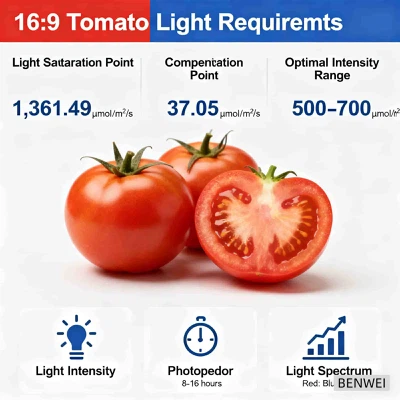
Tomatoes are light-loving plants with specific illumination requirements. Research indicates that tomatoes have a light saturation point of 1,361.49 μmol/m²/s and a light compensation point of 37.05 μmol/m²/s, with optimal growth occurring at 500-700 μmol/m²/s (Shi, 2025). When these requirements aren't met, plants experience elongated growth, poor flower bud differentiation, flower drop, and increased susceptibility to physiological disorders.
Light influences tomato production through three key parameters:
1. Light Intensity
Adequate light intensity ensures proper flower bud development, higher fruit set rates, and reduced flower drop. Insufficient intensity delays flowering, reduces flower numbers, and decreases fruit size.
2. Photoperiod
Although tomatoes are day-neutral plants requiring only 8-12 hours of light for normal flowering, extending photoperiods to 12-16 hours through supplemental lighting significantly enhances photosynthetic product accumulation.
3. Light Spectrum
Red light (600-700 nm) and blue light (400-500 nm) play particularly important roles. Red light drives photosynthesis and promotes flower formation and sugar accumulation, while blue light facilitates chlorophyll synthesis and enhances disease resistance. Studies show that specific red: Blue ratios offer distinct advantages:
5:1 ratio provides optimal protection against gray mold
6:1 ratio delivers the best results for leaf growth and yield quality
3-4:1 ratio is ideal during seedling stage

Greenhouse Lighting Challenges
Greenhouse tomato production typically faces several lighting limitations:
Natural light reduction of 30-40% compared to open fields
Uneven light distribution, with ground-level illumination reaching only 55% of external levels
Seasonal shortages during November-January production periods
Additional light loss from thermal insulation covers
Practical LED Lighting Solutions
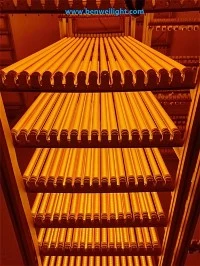
LED technology offers precise, energy-efficient solutions to these challenges. Modern LED grow lights provide cold illumination with surface temperatures below 45°C, energy savings exceeding 50% compared to traditional HPS lamps, and lifespans of 30,000-50,000 hours.
Implementation Guidelines:
Installation Setup
Install 80-100 fixtures per acre (50 W each)
Position along planting rows with adjustable heights
Combine overhead and inter-row lighting
Daily Operation
Extend photoperiod by 4-6 hours daily
Operate 2-3 hours before cover removal and 2-3 hours after covering
Maintain total daily light duration of 10-14 hours
Growth-Stage Specific Spectra
Seedling stage: Red:Blue 3-4:1, 100-150 μmol/m²/s, 12-14 h/day
Flowering & fruit set: Red:Blue 5-7:1, 150-200 μmol/m²/s, 12-14 h/day
Fruit expansion: Red:Blue 6-8:1, 200-300 μmol/m²/s, 12-14 h/day
Fruit maturation: Red:Blue 4-5:1, 150-200 μmol/m²/s, 10-12 h/day
Environmental Coordination
Maintain temperatures of 25-28°C (day) and 15-18°C (night)
Increase irrigation by 15-20% during supplemental lighting
Maintain CO₂ levels at 800-1,000 mg/kg

Recommended LED Solution
For growers seeking to implement these research-backed strategies, Benwei Lighting offers advanced programmable LED systems that can deliver the exact spectra and intensities recommended for each growth stage. Their energy-efficient, full-spectrum solutions are specifically designed for greenhouse tomato production.
Contact Information:
Email: bwzm15@benweilighting.com
Website: http://www.benweilight.com/
Conclusion
Strategic LED lighting represents a powerful tool for optimizing greenhouse tomato production. By implementing stage-specific lighting regimens with precise spectral control, growers can significantly enhance both yield quantity and fruit quality while maximizing resource efficiency.
References:
Shi, L. (2025). Effects of Light on Greenhouse Tomatoes and Light Regulation Efficiency Measures. Cultivation Techniques, 2025(08), 24-26.
FAQ
Any questions or want to send an inquiry?
Q1. How soon is the lead time?
A: For sample orders, 7-17 days if no stock. For bulk orders, 15-30 days.
Q2. Can your products' label, packaging, and design be customized?
A: Yes, we offer customization service on these.
Q3. How can we guarantee quality?
A: Always a pre-production sample before mass production; always a final inspection before shipment.
Q4. How do you ship the goods, and how long does it take to arrive?
A: We usually ship by DHL, UPS, FedEx, or TNT. It usually takes 3-5 days to arrive. Airline and sea shipping are also optional.
Q5. What is your payment method?
A: PayPal / Visa / Western Union / online transfer / Apple Pay / T/T all work for us for payment.