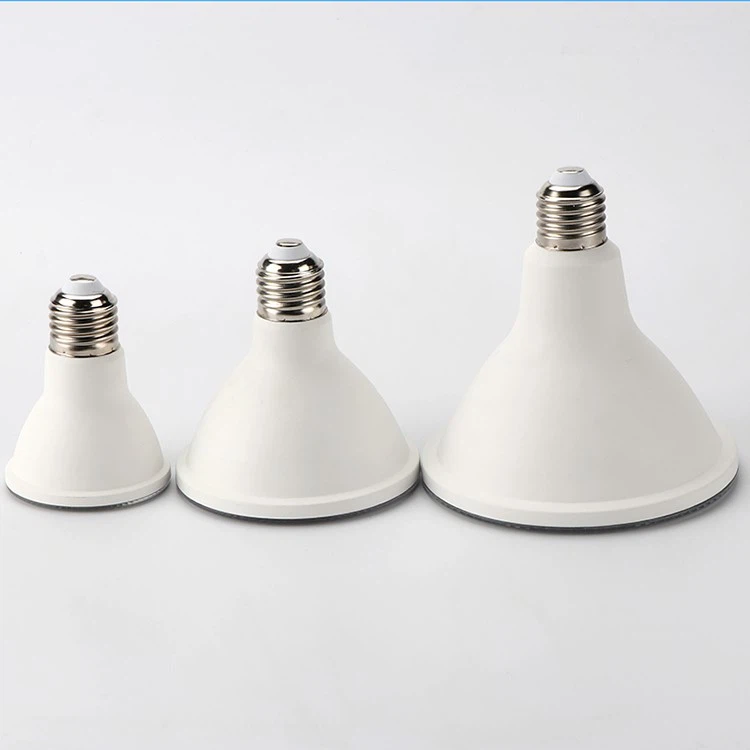
PAR16, PAR20, PAR30 and PAR38 LED Bulbs
A PAR light bulb's definition
A PAR light bulb is a type of directed lamp with a parabola-shaped reflector. Light may be accurately and more uniformly reflected directly out of the bulb cavity thanks to the reflector's explicit parabolic shape. A huge family of reflector lamps known as PAR light bulbs are used in a wide variety of settings, including recessed and track lighting, auto lighting, aeroplane landing lights and stage lighting. Small-sized PAR lamps (PAR16, PAR20, PAR30, and PAR38) are utilised to provide general track and recessed lighting for home applications in kitchens, living rooms, and dining rooms as well as for commercial uses in eateries, retail, offices, and hospitality settings.
Name of the lamp
The letters PAR16, PAR20, PAR30, and PAR38 stand for the reflector's design and total circumference diameter, respectively. Parabolic aluminized reflector is referred to as PAR. In eighths of an inch, the second nomenclature specifies the lamp diameter. A PAR16 lamp has a diameter of 2 inches, or 16/8 inches. The diameter of a PAR20 lamp is 20/8 inches, or 2 12 inches. The diameter of a PAR30 lamp is 30/8 inches, or 3 34 inches. A PAR38 lamp has a diameter of 4 3/4 inches, or 38/8 inches. The E26/E27 medium screw base is the base type that is most frequently used for these PAR lamps. Although PAR16 bulbs are also compatible with GU10 bases, they are more frequently referred to as GU10 bulbs. Additionally, there are long neck and short neck versions of PAR30 bulbs. The maximum overall length of the long neck PAR30 bulb ranges from 4.2 to 5 inches. The short neck version has a length that varies from 3.4 to 4.72 inches. Recessed cans often employ long neck PAR30 bulbs, while track lighting systems more frequently use short neck PAR30 lights.
Antiquated lighting techniques
Tungsten filaments were initially used in PAR lights. A heat-resistant, pressed glass with an internal reflective coating that is sealed to a different glass lens makes up an incandescent PAR lamp. The half peak spread of the parabolic reflector determines the beam angle of the directional emission. By incorporating more energy-efficient CFL and metal halide technologies into the reflector lights, efforts had been made to increase efficacy. The operating features of these lamps, such as their lengthy warm-up and restrike times, limited sizes, poor colour rendition, high flicker rates, and poor dimming performance, make them less acceptable for use in directional lighting applications. Nevertheless, these lamps' efficacy is far from flawless.
LED illumination
Today's PAR lamps feature LED technology for highly efficient and adjustable lighting. LEDs' enormous energy savings, lower maintenance costs, and longer lifespan provide PAR LED lamps an excellent payback advantage over traditional lamps. Since LEDs are direct, highly controllable optical systems are produced, giving LED sources much greater control over the light dispersion for a powerful punch and efficient optical delivery. LED lamps are perfect for emphasising and enhancing goods or artwork because they don't emit UV or IR radiation, which minimises material fading and discolouration.
Retrofit LED lighting
An integrated LED lamp with the same form factor as vintage incandescent PAR lamps is known as a PAR LED light bulb. A driver that can supply the LEDs with a constant, regulated current, optics that control the light source's flux, a heat sink that can be separate from or built into the housing, and other electrical and mechanical parts are included in an integrated lamp. A high power LED, a COB LED, or a collection of mid-power packages can be used as the LEDs. Luminous effectiveness is extremely high in mid-power packages. High centre beam candlepower (CBCP) can be produced using high power LEDs. COB LEDs have a large light emission surface (LES) that emits light in a very uniform manner.
Shade quality
The most often used PAR16, PAR20, PAR30, and PAR38 lights are used to emphasise and emphasise the texture, shape, finish, and colour of goods, displays, historical objects, contemporary art, 2D paintings, and 3D sculptures. As a result, when assessing these products, colour quality is a crucial factor to take into account. Correlated colour temperature (CCT), colour rendering index (CRI), and various colour rendition evaluation systems like TM-30 (Technical Memorandum TM-30-18) and colour quality scale (CQS) can all be used to describe an LED light source. LEDs come in chromaticities ranging from warm white to cool white along the planckian curve. A crucial component of commercial showrooms, retail stores, museums, and galleries is colour uniformity. Colour temperatures of LEDs for directed lighting should preferably be adjusted with a 3 to 5 step MacAdam ellipse tolerance to ensure fixture-to-fixture homogeneity and colour divergence is undetectable by human vision. A key colour quality for PAR lamps is the capacity of a light source to faithfully replicate colour. A minimum CRI of 90 and R9 of 50 should be carried by the light source in order to display items in a realistic manner. A light source's spectral power distribution (SPD), which plots the amount of radiant energy present at each wavelength across the visible spectrum, reflects both the colour appearance and colour rendition of the light source.
Beam efficiency
The specification of PAR lamps, which are frequently employed to produce visual excitement, is typically based on the properties of the luminous intensity distribution, more specifically the CBCP and beam angle. The term "CBCP" refers to a lamp's maximum beam intensity, which is found at the nadir (0°) of a directional lamp's beam. Both the light output and the beam angle of the directional lamp have an impact on CBCP readings. A narrow beam angle lamp will have a higher CBCP than a wide dispersion lamp. The angle between the two directions where the intensity is half that of the centre beam is known as the beam angle. The range of beam angles available with PAR lights is less than 10° (narrow spot) to more than 60° (broad flood). The field angle of a directional lamp is also the angle at which the beam intensity is 10% of the CBCP. Both beam lumens and field lumens are useful light, and whether a beam is "soft" or "hard" depends on the field-to-beam ratio. The directionality of LED emission enables PAR lights to do away with massive reflectors, in contrast to incandescent and fluorescent sources that produce a diffuse glow and rely on them to govern the light distribution. To regulate the light precisely and with the least amount of light loss, small optics can be employed, like a TIR lens.
Driven LEDs
A line-powered LED driver for AC mains applications is used in a PAR lamp. In order to meet the power factor (PF) and total harmonic distortion (THD) requirements, the driver often contains a switch mode power supply (SMPS), which is connected to the AC mains through a power factor correction circuit (PFC). In order to carry out sub-tasks such input/output voltage detection and handling, switching mode control, current regulation, dimming control, and output filtering sequentially or simultaneously, the driver may also comprise various electrical circuits. However, because PAR lamps have a compact form factor, it is difficult to incorporate more complex circuitry, which could result in compromises in efficiency, flicker removal, dimming performance, and reliability.
Feature:
● Long lifespan reduces replacements
● High 90+ CRI
● High R9 renders richer red hues
Specification:
| Product Name | LED PAR30 Short Neck Lamp |
| Wattage | 11 Watt |
| Lighting Technology | LED |
| Dimmable | Yes |
| Bulb Shape | PAR30 |
| CRI | High CRI (90 and Up) |
| Color Temperature | 3000 Kelvin |
| Lumens | 990 |
| Voltage | 120 |
| Beam Angle | 15 Degree |
| Base Type | Medium (E26) |
| Warranty | 5-Year Limited |