Portable Flood Light Rechargeable:2025 Buyer's Guide

In 2025, the demand for portable, rechargeable floodlights has soared – driven by homeowners, outdoor enthusiasts, contractors, and emergency responders who need reliable, on-the-go illumination. Unlike traditional corded flood lights that tie you to power outlets, portable rechargeable flood lights offer unmatched flexibility: they work for backyard parties, construction sites, camping trips, storm power outages, and even roadside repairs. But with hundreds of models on the market – each boasting different specs, features, and price tags – how do you choose the right one for your needs in 2025?
This buyer's guide breaks down everything you need to know: from key technical specs to 2025's latest trends and from use-case recommendations to tips for avoiding common pitfalls. Whether you're a DIYer looking for a light for home projects or a business owner equipping a team, this guide is tailored to global audiences, with insights into regional preferences (e.g., U.S. vs. EU voltage and weather-resistant needs) and compliance with 2025's sustainability standards.
Why Portable Rechargeable Flood Lights Are a Must-Have in 2025
Before diving into purchasing details, let's first explore why these lights have become essential in 2025:
1. Unmatched Portability
2025's lifestyle trends-like remote work (think outdoor home offices), frequent camping trips, and pop-up events – demand lighting that moves with you. Portable rechargeable flood lights weigh as little as 2 pounds (for compact models) or up to 15 pounds (for heavy-duty industrial ones), with handles, straps, or even wheeled bases for easy transport. No cords, no generators (unless you need extended runtime)-just grab and go.
2. Energy Efficiency & Sustainability
With global focus on reducing carbon footprints, 2025's top portable rechargeable flood lights use LED technology, which is 80% more energy-efficient than incandescent or halogen bulbs. LEDs also last 25-50 times longer (50,000+ hours vs. 1,000 hours for incandescents), cutting down on waste. Many models also use lithium-ion batteries (the most eco-friendly rechargeable option) and are made with recycled materials, aligning with 2025's sustainability goals (e.g., the EU's Circular Economy Action Plan).
3. Reliability for Emergencies
Extreme weather events-hurricanes, wildfires, winter storms-are more frequent in 2025, making backup lighting a necessity. Portable rechargeable flood lights can run for 4-24 hours on a single charge, providing critical illumination during power outages. Some 2025 models even include emergency features like SOS flash modes or USB ports to charge phones-lifesavers in crisis situations.
4. Versatility Across Scenarios
One light, multiple uses: That's the appeal of portable rechargeable flood lights in 2025. They work for:
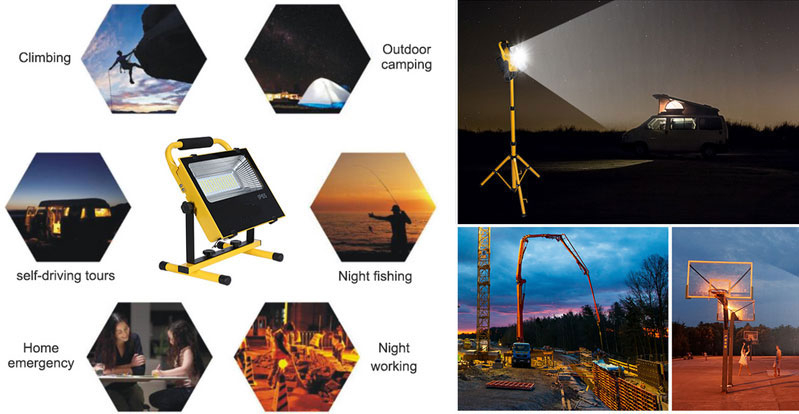
Home: Backyard barbecues, garage projects, attic cleaning, or power outages.
Outdoor: Camping, hiking, fishing, boating, or RV trips.
Work: Construction sites, road repairs, event setups, or warehouse inspections.
Emergency: Search-and-rescue, disaster response, or roadside breakdowns.
Key Specs to Consider When Buying a Portable Rechargeable Flood Light (2025)
Not all portable rechargeable flood lights are created equal. To find the best one for your needs, focus on these non-negotiable specs:
1. Brightness (Lumens)
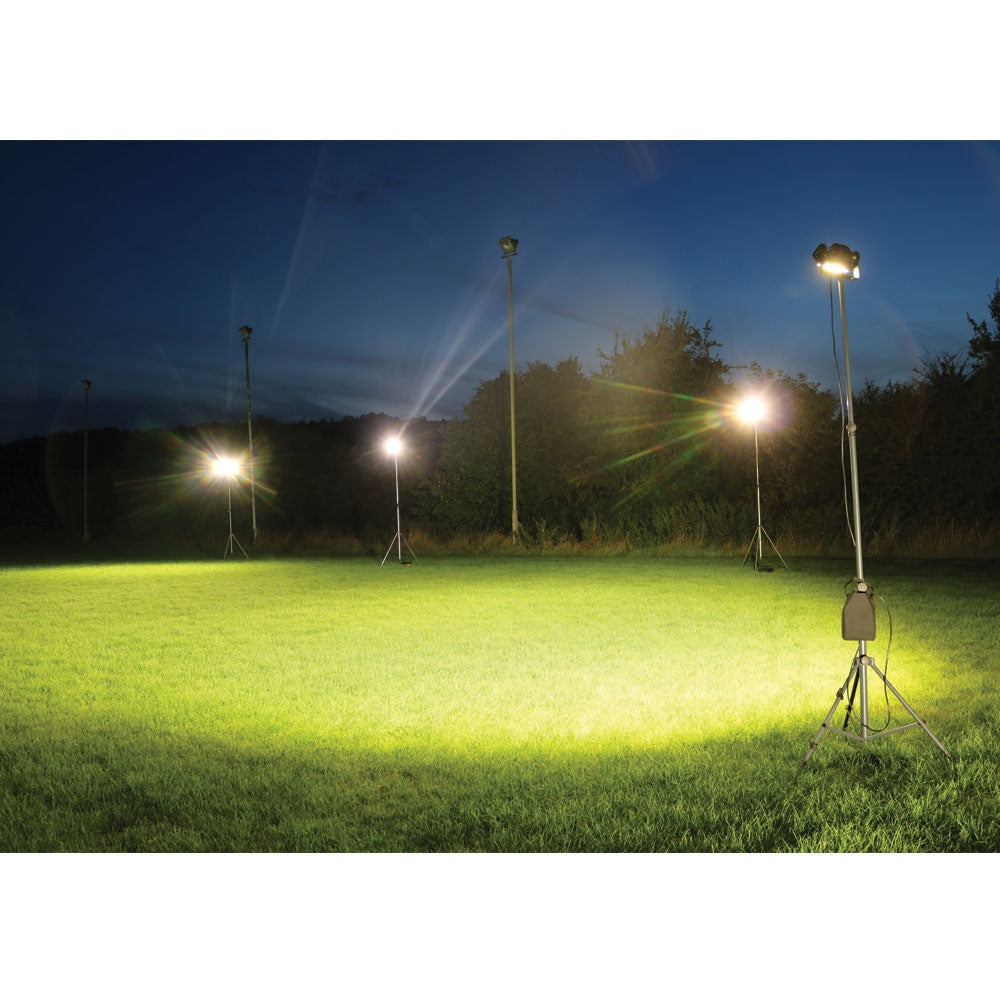
Brightness is measured in lumens (lm)-the higher the lumens, the brighter the light. In 2025, models range from 500 lm (compact, personal use) to 20,000 lm (heavy-duty, industrial use). Choose based on your scenario:
500-2,000 lm: Ideal for personal use-camping, backyard gatherings, or small home projects. A 1,000 lm light can illuminate a 10x12ft area clearly.
2,000-5,000 lm: Great for work or medium-sized spaces-garage repairs, construction site tasks, or large backyard events.
5,000+ lm: Reserved for heavy-duty use-industrial sites, search-and-rescue, or lighting up large outdoor areas (e.g., a sports field).
Pro tip: Look for lights with dimmable brightness (a top 2025 feature). This lets you adjust lumens to save battery life-e.g., 500 lm for reading in a tent, 5,000 lm for fixing a car at night.
2. Battery Life & Charging
Battery performance is make-or-break for portable lights. In 2025, the best models use lithium-ion (Li-ion) batteries-they're lightweight, hold a charge longer, and have no "memory effect" (unlike older nickel-cadmium batteries). Key battery specs to check:
Capacity (mAh): Higher mAh = longer runtime. For example:
5,000-10,000 mAh: Runs 4-8 hours at full brightness (good for personal use).
10,000-20,000 mAh: Runs 8-16 hours at full brightness (great for work or emergencies).
20,000+ mAh: Runs 16-24+ hours at full brightness (industrial or extended emergency use).
Charging Time: 2025's top models support fast charging-charge from 0-100% in 2-4 hours (vs. 6-8 hours for older models). Look for USB-C charging ports (the global standard in 2025) or even solar charging (more on that later).
Charge Indicators: A must-have in 2025-LED lights that show battery level (e.g., 100%, 75%, 50%, 25%) so you never run out of power unexpectedly.
3. Durability & Weather Resistance
Portable flood lights are meant to be used outdoors or in rough environments-so durability is key. In 2025, look for:
IP Rating: As with bathroom lights, IP (Ingress Protection) ratings measure resistance to dust and water. For most users, IP65 is ideal-it's fully dustproof and protected against low-pressure water jets (rain, splashes). For extreme conditions (heavy rain, snow, or construction sites), choose IP67 (can withstand temporary submersion in 1m of water for 30 minutes) or IP68 (waterproof for longer periods).
Build Material: Aluminum or reinforced plastic is best-they're lightweight yet resistant to drops and impacts. Many 2025 models have a "drop test" rating (e.g., "survives 10ft drops")-critical for work sites.
Temperature Resistance: If you live in a region with extreme weather (e.g., -20°F winters in Canada, 120°F summers in Arizona), check the operating temperature range. 2025's top models work from -4°F to 122°F (-20°C to 50°C), ensuring performance in harsh conditions.
4. Design & Portability Features
In 2025, portability isn't just about weight-it's about how easy the light is to use and store:
Weight: For personal use, aim for 2-5 pounds (easy to carry in a backpack). For work, 5-10 pounds is manageable with a handle or strap. Wheeled bases are great for 10+ pound industrial models.
Mounting Options: Look for lights with multiple mounting ways-tripod stands (included or compatible), magnetic bases (to stick to metal surfaces like cars or toolboxes), or hooks (to hang from tents or ceilings). 2025's innovative models even have foldable designs for compact storage.
Ergonomics: A comfortable handle, non-slip grip, and balanced weight distribution make the light easy to hold for long periods (e.g., when fixing a roof at night).
5. Extra Features (2025 Trends)
2025's best portable rechargeable flood lights come with smart or convenient extras that elevate usability:
USB Charging Ports: Let you charge phones, tablets, or other devices-perfect for camping or emergencies. Look for 2+ ports (USB-A and USB-C) for versatility.
Smart Controls: Some models connect to phone apps via Bluetooth or Wi-Fi, letting you adjust brightness, set timers, or turn the light on/off remotely. Voice control (Alexa/Google Home) is also emerging in 2025 for home-use models.
Color Temperature Adjustment: Beyond bright white light, 2025 models offer warm white (2700K) for ambiance or cool white (6500K) for task lighting-great for backyard dinners (warm white) or work projects (cool white).
SOS/Flash Modes: Emergency flash modes (strobe or SOS) help signal for help in crises-required for outdoor enthusiasts or first responders.
2025 Trends in Portable Rechargeable Flood Lights
To stay ahead of the curve, consider these 2025 trends when shopping:
1. Solar-Powered Charging
Sustainability is a top priority in 2025, so solar-powered portable flood lights are gaining popularity. These models have built-in solar panels that charge the battery during the day-no need for electrical outlets. They're perfect for camping, remote work sites, or areas with limited power access. 2025's solar models charge 2-3x faster than older versions (thanks to more efficient panels) and can run for 8+ hours on a full solar charge.
2. Ultra-Long Battery Life
With advances in Li-ion battery technology, 2025's portable flood lights offer longer runtimes than ever. Some industrial models with 30,000 mAh batteries can run for 30+ hours at 50% brightness-ideal for multi-day construction projects or extended power outages.
3. Compact, High-Brightness Models
In 2025, manufacturers are shrinking the size of portable flood lights without sacrificing brightness. You can now find 2,000 lm models that fit in a backpack (weighing just 2 pounds)-perfect for hikers or urban dwellers who need emergency lighting but have limited storage.
4. Eco-Friendly Materials
More brands in 2025 are using recycled plastics and aluminum in their flood lights, and offering battery recycling programs. Some models even have detachable, replaceable batteries-so you can swap out a dead battery instead of buying a new light, reducing e-waste.
How to Choose the Right Portable Rechargeable Flood Light for Your Needs (2025)
Use this scenario-based guide to narrow down your options:
1. For Home & Personal Use
Needs: Compact, affordable, easy to store, good for backyard events or power outages.
Specs to Aim For: 500-2,000 lm, 5,000-10,000 mAh battery (4-8 hours runtime), IP65 rating, USB port for phone charging.
Top Features: Dimmable brightness, foldable design, magnetic base (to stick to fridges or garage doors).
Example 2025 Model: "EcoLight Mini 1500" (1,500 lm, 8,000 mAh, 6-hour runtime, IP65, weighs 2.5 pounds).
2. For Outdoor Adventures (Camping, Hiking, Boating)
Needs: Lightweight, durable, long battery life, weather-resistant, easy to carry.
Specs to Aim For: 1,000-3,000 lm, 10,000-15,000 mAh battery (8-12 hours runtime), IP67 rating, solar charging option.
Top Features: SOS mode, USB-C fast charging, hook for hanging in tents, low-weight (3 pounds or less).
Example 2025 Model: "AdventurePro Solar 2500" (2,500 lm, 12,000 mAh, 10-hour runtime, IP67, solar charge in 4 hours, weighs 2.8 pounds).
3. For Work (Construction, Repairs, Events)
Needs: Bright, durable, long runtime, versatile mounting, heavy-duty.
Specs to Aim For: 3,000-8,000 lm, 15,000-25,000 mAh battery (12-20 hours runtime), IP65/IP67 rating, tripod-compatible.
Top Features: Dimmable, magnetic base, rugged aluminum build, drop-resistant (10ft+), multiple brightness modes.
Example 2025 Model: "WorkMaster Pro 6000" (6,000 lm, 20,000 mAh, 16-hour runtime, IP67, tripod included, weighs 8 pounds).
4. For Emergencies (Power Outages, Disaster Response)
Needs: Reliable, long runtime, emergency features, easy to charge.
Specs to Aim For: 2,000-5,000 lm, 20,000+ mAh battery (16+ hours runtime), IP67 rating, fast charging.
Top Features: SOS/strobe mode, USB ports (2+), charge indicator, durable build (survives extreme temperatures).
Example 2025 Model: "EmergencyReady Max 4000" (4,000 lm, 25,000 mAh, 20-hour runtime, IP67, fast charge in 3 hours, 2 USB ports).
Common Mistakes to Avoid in 2025
Choosing Brightness Over Battery Life: A 20,000 lm light is useless if it dies after 2 hours. Balance lumens with battery capacity-opt for dimmable models to extend runtime.
Ignoring IP Rating: A light with IP44 won't survive heavy rain-always choose IP65 or higher for outdoor use.
Buying Cheap, Low-Quality Batteries: Off-brand batteries may be cheaper, but they're prone to overheating or dying quickly. Stick to lights with branded Li-ion batteries (e.g., Samsung, LG) for safety and longevity.
Overlooking Charging Options: In 2025, USB-C is standard-avoid lights with only USB-A ports (they charge slower). Solar charging is a bonus for remote use.
Forgetting Portability: A 15-pound light is great for a construction site, but it's not ideal for camping. Choose weight and size based on how you'll carry it.
Conclusion
In 2025, a portable rechargeable flood light is more than just a tool-it's a versatile solution for home, work, and emergencies. By focusing on key specs (brightness, battery life, durability) and aligning with your specific needs, you can find a model that delivers value and reliability for years. Whether you're camping under the stars, fixing a leaky roof, or preparing for a storm, the right portable rechargeable flood light will keep you illuminated-no cords, no limits.
As 2025's technology evolves, look for models that prioritize sustainability (solar charging, recycled materials) and smart features (app control, USB ports) to get the most out of your investment. For more personalized recommendations or help comparing 2025's top models, contact our team of experts-we're here to help you find the perfect light for your lifestyle.
Shenzhen Benwei Lighting Technology Co.,Ltd
Telephone: +86 0755 27186329
Mobile(+86)18673599565
Whatsapp :19113306783
Email:bwzm15@benweilighting.com
Skype: benweilight88
Web: www.benweilight.com