Say Goodbye to Oppressive Spaces: The Secret to Eliminating the "Cave Effect" with Scientific Lighting

Neat rows of downlights cast cold beams in an open-plan office, yet employees often feel the space is oppressive and their productivity suffers-this could be the "cave effect" at play in lighting design.
Plato's Allegory of the Cave depicted prisoners who saw only shadows on a wall, mistaking them for reality. Modern commercial lighting design can sometimes unintentionally trap people in a similar "cave."
The so-called "cave effect" refers to the feeling of oppression and spatial confinement caused by insufficient light on the ceiling. This phenomenon can induce claustrophobia and may trigger negative emotions in occupants.
 01 The Hidden Pitfall in Lighting Design
The cave effect is particularly pronounced in spaces with dark finishes and flooring. When people spend extended periods in such environments, not only does visual comfort decrease, but mood and work efficiency can also be adversely affected.
Traditional downlights or recessed fixtures barely illuminate the ceiling. Although some downlights have trim rings that provide minimal uplight, it's far from sufficient to create a comfortable spatial light environment.
Modern lighting design requires a re-evaluation of the science behind spatial light distribution. The core of commercial spatial lighting design lies in balancing the relationship between direct and indirect illumination.
02 What's the Antidote? The Power of Bi-Directional Lighting
To eliminate the cave effect, increasing indirect lighting is the most direct and effective solution. Suspended luminaires that provide this dual lighting, also known as indirect/direct lighting, are key.
These fixtures not only cast light directly downward but also reflect it onto the ceiling, comprehensively enhancing ambient brightness. Architectural LED linear fixtures exemplify this approach, offering both direct and indirect light from a suspended position.
Such indirect-direct luminaires are particularly suited for commercial spaces like offices, retail stores, and schools that value both design and functionality, effectively tackling the cave effect.
03 Technical Nuance: Balancing Distance and Uniformity
When using any indirect lighting, the distance between the fixture and the ceiling is crucial. If placed too close, "hot spots" can occur-areas where light concentrates into an overly bright patch.
For fixtures mounted close to the ceiling, or when aiming for maximum ceiling uniformity, selecting luminaires with a wide beam distribution, known as "batwing" distribution, is essential.
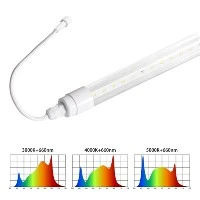
A 4-foot linear fixture is an excellent choice for evenly illuminating large industrial spaces. It provides both up and down light, boasts a lifespan of up to 60,000 hours, offers high efficacy up to 123 lumens per watt, and is competitively priced.
04 New vs. Old: A Comparison of Three Solutions
For existing spaces suffering from the cave effect, several methods can improve the lighting environment. The following table compares three primary solutions:
| Solution | Working Principle | Implementation Difficulty | Effectiveness Against Cave Effect | Ideal Use Case |
|---|---|---|---|---|
| Downlights/Recessed Lights | Direct downward light only, minimal ceiling reflection | Simple, standard practice | Poor, may worsen the effect | Temporary solution for tight budgets |
| Suspended Bi-Directional Luminaires | Provides both direct and indirect lighting simultaneously | Moderate, requires professional design | Excellent, fundamental solution | New construction or comprehensive renovation projects |
| Adding Independent Indirect Lighting | Supplementing with uplighting sconces, floor lamps, etc. | Flexible, can be implemented gradually | Good, offers noticeable improvement | Gradual optimization of already furnished spaces |
05 Optical Analysis: The Science Behind "Batwing" Design
Why do "batwing" luminaires provide more uniform ceiling illumination? This involves the basic principles of optical design.
The light intensity distribution of traditional luminaires typically follows a Gaussian curve, brightest at the center and fading rapidly towards the edges. Batwing optical design uses special components (like micro-prism lenses, reflectors, or diffusers) to redistribute light, creating a flatter central curve with wider side spread.
This design distributes light in a very wide pattern, helping to eliminate hot spots and ensuring even ceiling wash. For improving ceiling illuminance uniformity, this technical approach is more efficient and energy-saving than simply increasing the number of fixtures.
06 Flexible Adaptation: Strategies When Fixture Replacement Isn't an Option
Replacing existing fixtures with bi-directional ones is the most thorough method to eliminate the cave effect. But what if replacement isn't feasible? Indirect lighting can still be added in various ways to mitigate the issue.
Alternative solutions include installing wall sconces that tilt upward to wash the ceiling, adding floor lamps that cast a wide spread of light upward, and reconsidering interior design choices. Replacing dark colors with lighter ones helps reflect more existing light upward, brightening the ceiling.
Dark surfaces absorb most light, while light-colored surfaces can reflect 70-90% of incident light. By optimizing surface reflectivity within a space, the effect of indirect lighting can be enhanced, reducing the cave effect.
When employees feel uncomfortable in an office, when students struggle to focus in a classroom, or when customers are reluctant to linger in a store, the problem might be the "cave effect." The choice and layout of luminaires, the color of ceilings and walls, and even furniture placement all silently influence the space's light environment.
Lighting design has long moved past the elementary stage of "bright enough." Creating a scientific and rational light environment has become a key standard for measuring spatial quality. Fortunately, the methods to solve the cave effect are both diverse and practical.
Truly excellent lighting design should be like natural light-both bright and soft, meeting functional needs while enhancing spatial quality. Most importantly, it should make the people within the space feel comfortable and at ease.
FAQ
Q1: How can I tell if my space has a noticeable "cave effect"?
A simple test is to turn off all artificial lights during the day and observe the space's brightness. Then, at night, turn on the regular lighting and compare the brightness of the ceiling area under both conditions. If the ceiling is significantly darker at night, even creating a strong contrast with the walls, a cave effect is likely present. A professional method involves using a light meter; ceiling illuminance should not be less than 30% of the work plane illuminance.
Q2: If my existing space already has many installed downlights, do they all need to be replaced?
Not necessarily. A phased improvement strategy can be adopted: First, replace some downlights in key areas (like the center of work zones, conference rooms) with suspended bi-directional luminaires. Second, add independent indirect lighting devices, such as uplighting sconces or floor lamps. Finally, optimize surface reflectivity by changing dark ceilings and walls to lighter colors. Combining these three methods can significantly improve the cave effect without a full fixture replacement.
Q3: What are the key specifications to focus on when selecting indirect lighting fixtures?
Beyond standard metrics like color temperature, CRI, and efficacy, pay special attention to two indicators: First, the Upward Light Output Ratio (ULOR)-the proportion of total luminous flux emitted upward by the luminaire, which should generally be no less than 30%. Second, the beam angle; fixtures with wide beam angles (greater than 100°) are more suitable for ceiling washing. Additionally, the fixture's mounting height and spacing affect the outcome; a suspension height of no less than 15% of the ceiling height is often recommended.
In corners where sunlight cannot reach, the scientific layout of light is quietly rewriting the rules of spatial perception. When light is liberated from a single direction and learns to flow freely between the ceiling and walls, the metaphor of the cave loses its shadow in modern lighting design.
References & Notes:
Plato. The Republic (Book VII). Circa 380 BCE.
Commission Internationale de l'Éclairage (CIE). Lighting of Indoor Work Places. CIE S 008/E:2001.
Illuminating Engineering Society (IES). The Lighting Handbook. 10th Edition. 2011.
Boyce, P. R. Human Factors in Lighting. 3rd Edition. CRC Press. 2014.
Note: Any lighting renovation involving electrical work must be performed by a qualified professional in compliance with local electrical codes and standards.