Smart RGB Downlight Buying Guide: The Professional's Five‑Point Checklist
1. Why Do You Need a "Professional‑Grade" Checklist?
In 2026, the global smart lighting market has entered a period of rapid growth – the market for smart luminaires alone is expected to reach USD 6.42 billion in 2026, with a CAGR of 18.2%. However, market prosperity also brings product inconsistency. For professional users such as contractors, designers, and project purchasers, facing a dazzling array of smart RGB downlights, marketing phrases like "dimmable and colour‑changing" are far from enough.
What truly determines the long‑term user experience and project reliability of a smart lighting system are the technical details hidden deep in the specification sheets: Does the wireless protocol support local control? Are the colour rendering index and R9 value up to standard? Does the light flicker when dimmed to the lowest level? Is there colour inconsistency among batch products? Does the product carry internationally recognised third‑party certifications?
This article expands on these five dimensions to provide a professional checklist that can be used directly for evaluating smart RGB downlights.
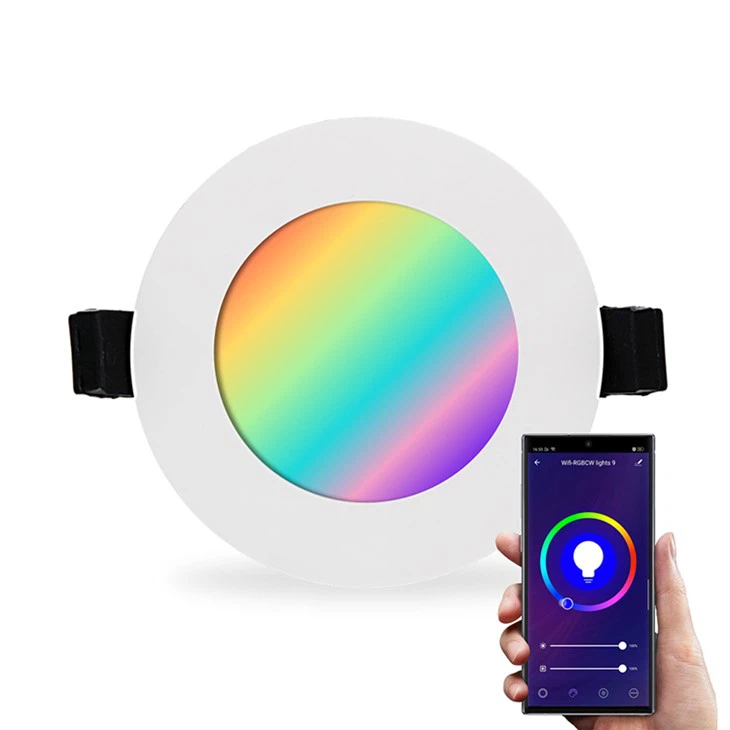
2. Overview of the Five‑Point Checklist
| No. | Dimension | Key Evaluation Points | Common Pitfall |
|---|---|---|---|
| 1 | Wireless protocol & ecosystem | Local control support, multi‑platform compatibility, OTA upgrade | Wi‑Fi only – unusable without internet |
| 2 | Light quality | CRI ≥ 80 (≥90 recommended), R9 > 0, RGB purity | Ignoring R9 – red colours appear dull |
| 3 | Dimming smoothness | 0‑100% smooth dimming, no flicker at minimum level | Flicker or step changes at low brightness |
| 4 | Installation & consistency | Cut‑out size matching, batch colour difference ΔE < 3 | Obvious colour temperature variation between batches |
| 5 | Certifications & compliance | CE, RoHS, DLC (North America), ERP (Europe) | No certification or counterfeit marks |
3. Item 1: Wireless Protocol Compatibility & Ecosystem Openness
3.1 Why is this critical?
A smart RGB downlight is different from an ordinary luminaire – its "smartness" entirely depends on the wireless communication protocol and the control ecosystem above it. Choosing the wrong protocol may result in the device being unable to connect to your existing smart home system, being unusable without internet, or lacking the ability to support future features.
3.2 Three core checkpoints
Checkpoint 1: Does it support local control?
Many low‑cost smart lights rely only on Wi‑Fi direct connection. If the home network goes down or the cloud server fails, the App cannot control the light. Professional users should prefer products that support Bluetooth Mesh or Zigbee local control – even without an internet connection, the phone can still turn the light on/off and dim it via direct Bluetooth or a local gateway.
Checkpoint 2: Is it compatible with mainstream ecosystem platforms?
Current mainstream smart ecosystems include: Tuya, Amazon Alexa, Google Home, Apple HomeKit (usually requires Matter support), Xiaomi Mi Home, etc. It is recommended to choose products compatible with at least two platforms to avoid being locked into a single ecosystem.
Checkpoint 3: Does it support OTA firmware upgrades?
Over‑the‑air firmware upgrades can fix bugs and add new features (e.g., new lighting scene modes). Products without OTA may not be able to adapt to new standards like Matter in the future.
3.3 Protocol Comparison Table (Professional Edition)
| Protocol | Local Control | Gateway Required? | Device Capacity | Power Consumption | Suitability for Lighting (Score) |
|---|---|---|---|---|---|
| Wi‑Fi | No (depends on router & cloud) | No | Limited by router (typically ≤30) | Higher | ★★☆☆☆ |
| Bluetooth Mesh | Yes (direct phone connection) | Optional (remote control needs gateway) | Thousands | Low | ★★★★★ |
| Zigbee | Yes | Required | Hundreds | Very low | ★★★★☆ |
| Thread/Matter | Yes | Border router needed | Hundreds | Low | ★★★★★ (future trend) |
4. Item 2: Real Light Quality
4.1 Evaluation dimensions beyond "lumens"
For RGB downlights, light quality includes not only the colour rendering index under white light, but also the saturation and uniformity of coloured light. Professional users should focus on the following indicators:
- Colour Rendering Index (CRI) : For home use, ≥80 is recommended; for commercial display, photo studios, and high‑end hotels, ≥90 is recommended.
- R9 value: R9 is the special colour rendering index for red. Many low‑cost lights claim CRI ≥80 but have a negative R9, causing red objects to appear grey. Professional applications require R9 > 0, with R9 ≥20 recommended.
- Colour temperature control accuracy: For a product rated 2700K‑6500K, does the actual colour coordinate at the two extremes deviate from the black body locus? Too much deviation can make 2700K appear greenish or pinkish.
- RGB primary colour purity: Ideal red, green and blue should be close to the pure colour boundaries on the CIE chromaticity diagram. Poor‑quality RGB lights often make red look orange‑red and blue look cyan.
4.2 Light Quality Parameter Reference Table
| Parameter | Entry Level | Engineering Grade | Professional Grade |
|---|---|---|---|
| CRI (white light) | ≥80 | ≥90 | ≥95 |
| R9 | Not specified | >0 | ≥20 |
| Colour temperature tolerance (MacAdam ellipse) | <7 SDCM | <5 SDCM | <3 SDCM |
| RGB primary saturation (relative to NTSC) | 70%‑80% | 80%‑90% | >90% |
5. Item 3: Dimming Smoothness & Minimum Brightness Performance
5.1 The overlooked user experience killer
Many users complain: "my smart light suddenly turns off when I dim below 10%" or "the brightness jumps in steps". This is caused by poor matching between the LED driver and the dimming protocol. A good smart RGB downlight should achieve 0‑100% smooth dimming without flicker or visible steps across the entire range.
5.2 Professional test methods (no instruments required)
- Minimum brightness test: Slowly dim the light to 1% or the lowest setting and observe whether it still emits a very faint, stable light. High‑quality products remain stable even below 5% without flickering.
- Linearity test: Slowly increase from 0% to 100% and check whether brightness increases evenly, without a period that is too dark followed by a sudden jump.
- Flicker detection: Point a smartphone camera at the light and use slow‑motion mode. If obvious bright‑dark stripes appear on the screen, there is visible flicker (which may cause eye fatigue).
5.3 Dimming Performance Grading
| Grade | Dimming Range | Performance at Minimum Level | Flicker | Suitable Scenarios |
|---|---|---|---|---|
| Acceptable | 10%‑100% | Stable, no flicker | Slight flicker | Basic home use |
| Good | 5%‑100% | Very faint but stable | No visible flicker | Living room, dining room |
| Excellent | 1%‑100% | Extremely faint, no jitter | No flicker even under high‑speed camera | Bedroom, home theatre, professional shooting |
6. Item 4: Installation Compatibility & Product Consistency
The hidden killer in projects
For bulk‑purchase projects, even if a single sample performs well, it does not guarantee batch consistency. Professional users must pay attention to two details:
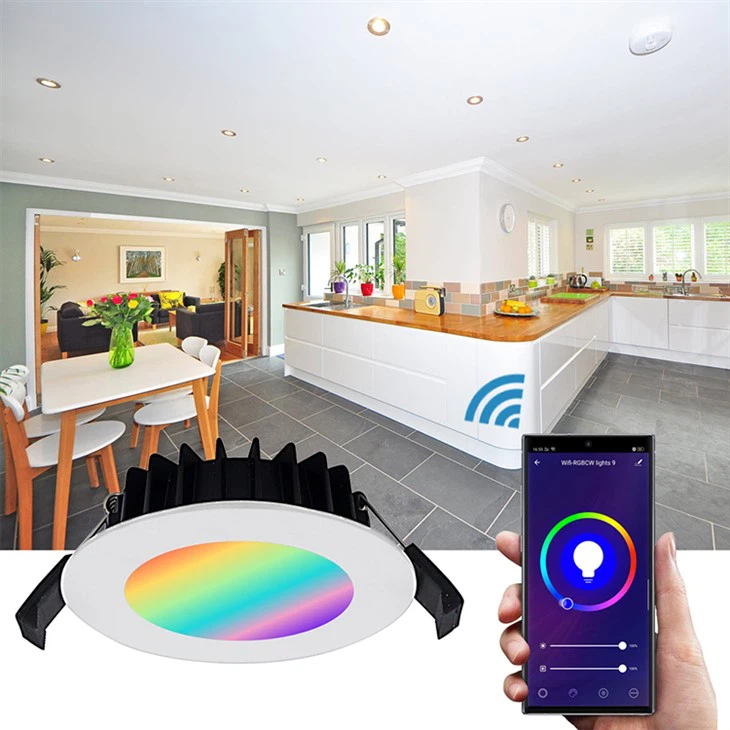
- Cut‑out size & luminaire height: Different brands – and even different batches of the same brand – may have slight differences in size. Before purchase, obtain the product's cut‑out dimension drawing and overall height drawing, and compare them with the on‑site hole size and ceiling depth.
- Batch colour consistency: Colour temperature differences among multiple downlights in the same space should be controlled within 3 MacAdam ellipses (SDCM) – barely perceptible to the human eye. For projects with high quality requirements, ask the supplier to provide a batch‑by‑batch chromaticity test report.
7. Item 5: Certifications & Compliance – The "Hard Passport" of Quality
7.1 Why certifications are non‑negotiable
In the smart lighting field, certifications are not only market access requirements, but also objective proof of product safety, electromagnetic compatibility, energy efficiency, and environmental compliance. Products without certification or with counterfeit certification may present risks such as electric shock, radio interference, or falsely claimed lifetime.
7.2 Overview of certifications required by different markets
| Market | Mandatory / Recommended Certification | Coverage |
|---|---|---|
| European Union | CE (mandatory), RoHS (mandatory), ERP (mandatory) | Safety, EMC, hazardous substances, energy efficiency |
| United States | UL (safety), DLC (efficiency recommended), FCC (EMC) | Safety, energy efficiency, RF interference |
| Global (general) | IEC standards (not mandatory but recommended) | Comprehensive safety & performance |
| China | CCC (mandatory), CQC (voluntary efficiency) | Safety, EMC, energy efficiency |
7.3 Quick tips to verify authenticity
- Genuine CE marks have a specific height ratio (usually ≥5mm) and are not printed in a generic font. Counterfeit CE marks often use arbitrary fonts.
- Request third‑party test reports (e.g., TÜV, SGS, Intertek) rather than manufacturer self‑declarations.
- DLC‑listed products can be searched on the official DLC website by model number.
8. Inference: Use the Five‑Point Checklist to Avoid 90% of Selection Risks
Selecting smart RGB downlights is essentially a balance between "rich functionality" and "system reliability". For professional users, rather than being attracted by fancy App interfaces or dazzling colour modes, it is better to return to the five basic checkpoints:
✅ Does the wireless protocol support local control and mainstream ecosystems?
✅ Does light quality (CRI, R9, RGB purity) meet project requirements?
✅ Is dimming smooth and stable, with no flicker at minimum brightness?
✅ Are size, colour consistency, and installation space fully matched?
✅ Does the product carry genuine, valid international certifications?
Keep this checklist in mind, and you will be able to quickly identify high‑quality products in most selection scenarios, delivering a smart lighting experience that truly stands the test of time for your clients or projects.
📌 One‑sentence summary: Choosing a smart RGB downlight is not about picking the brightest or most colourful – it is about picking the one with the most reliable protocol, most accurate light quality, smoothest dimming, best installation fit, and most complete certifications – the five‑point checklist is your "protective talisman" for professional selection.
Should you have any demands for bulk purchase or customized lighting solutions, feel free to contact us for a detailed quote.