The "Eye‑Protection Code" Above the Classroom Ceiling: A Complete Guide to LED Lighting in Educational Spaces
Walk into any classroom and look up – you'll see neatly arranged luminaires mounted on the ceiling. These seemingly ordinary lights are backed by a rigorous set of industry standards and technical know‑how. Today, we'll explore this niche but critically important field – classroom LED lighting – which directly affects the vision health of hundreds of millions of young students.

1. Why Does Classroom Lighting Deserve Serious Attention?
Let's start with some numbers: in recent years, the prevalence of poor vision among primary and secondary school students in China has remained alarmingly high and continues to rise. Substandard classroom lighting is one of the major contributing factors to this trend.
A classroom is where children spend most of their daytime hours. Lighting is their constant companion – it supports their reading, writing, and thinking. Good lighting and a well‑designed lighting environment directly impact students' visual comfort, learning efficiency, and long‑term eye health. That's why national regulations on classroom lighting have been continuously updated and strengthened.
2. The Core Standard: GB 7793‑2025 – A New National Mandate
Currently, the most authoritative mandatory standard for classroom lighting in China is "Hygienic Standard for Daylighting and Lighting of Primary and Secondary School Classrooms" (GB 7793‑2025) . This standard was developed under the leadership of the National Disease Control and Prevention Administration, issued on October 5, 2025, and will take effect on November 1, 2026, replacing the 2010 version.
This revision is significant. The 2010 standard had been in place for over 15 years, during which time school building designs, teaching methods, and lighting technologies have changed dramatically – LED luminaires have completely replaced fluorescent tubes, multimedia teaching equipment is now ubiquitous, and myopia rates among children and adolescents have remained persistently high. The underlying logic of the new standard represents a fundamental shift: from "meeting minimum lighting requirements" to "comprehensive control of visual health risks."
The key changes in the new standard can be summarised in three words: more comprehensive, more scientific, and more flexible.
- More comprehensive – New indicators have been added, including daylighting uniformity, winter solstice sunlight duration, glass colour transmittance index, independent control for blackboard lighting, retinal blue‑light hazard limits, fluctuation depth, flicker index, and stroboscopic effect visibility measure (SVM).
- More scientific – Glare control measures have been refined, reflectance ratios for all classroom surfaces are now specified, and parameters for correlated colour temperature (CCT) and colour rendering index (CRI) are standardised.
- More flexible – Restrictive requirements such as "use tri‑phosphor fluorescent lamps with energy‑efficient inductive or electronic ballasts" have been removed, leaving room for new lighting technologies like LEDs to be applied in classrooms. This encourages innovation while better accommodating the diverse needs of different schools.
3. Five Core Technical Indicators for Classroom LED Luminaires
The new standard sets scientifically grounded minimum requirements for classroom lighting across multiple dimensions. Here are the key indicators that every purchaser and school administrator must understand:
3.1 Illuminance and Uniformity – Is the light bright enough, and is it evenly distributed?
- Maintained average illuminance on the desktop: not less than 300 lx (lux)
- Uniformity of illuminance on the desktop: not less than 0.7
- Maintained average illuminance on the blackboard: not less than 500 lx
- Uniformity of illuminance on the blackboard: not less than 0.8
In plain language, this means that every desk in the classroom should receive sufficient light for reading and writing, and the blackboard should be clearly legible without straining the eyes. At the same time, the difference between the brightest and darkest areas should be controlled to prevent "half‑bright, half‑dim" conditions.
3.2 Correlated Colour Temperature (CCT) – Warm or cool light?
The standard requires that the CCT of light sources be kept within 3300K~5300K.
If the CCT is too low (warm/yellowish), students may feel drowsy. If it's too high (cool/bluish), prolonged exposure can cause eye fatigue. Currently, many schools opt for classroom LEDs with a CCT around 5000K±200K – a scientifically balanced range that promotes alertness without causing discomfort.
3.3 Colour Rendering Index (CRI) – How accurately are colours reproduced?
- General colour rendering index (Ra): should not be less than 80, and ≥90 is recommended
- Special colour rendering index for red (R9): for LED luminaires, it should be greater than 0
A high CRI ensures that textbook colours are rendered faithfully, reducing visual burden. Many school procurement specifications now demand Ra≥90 and R9>50.
3.4 Blue‑Light Hazard – The invisible threat to retinal health
The new standard for the first time makes retinal blue‑light hazard a mandatory control requirement. For general classroom lighting, the blue‑light hazard group should be RG0 (exempt) .
3.5 Flicker – The hidden cause of eye strain
The new standard introduces quantitative flicker evaluation metrics:
- Flicker index (P_st^LM): should not exceed 1.0
- Stroboscopic effect visibility measure (SVM): should not exceed 1.0
- Fluctuation depth: for frequencies ≤10Hz, limit is 0.1%; for 10Hz < frequency ≤90Hz, the limit is f × 0.01
In simple terms, flicker‑free or low‑flicker luminaires effectively protect students' vision.
4. What Luminaires Are Used in Classrooms? – Types and Layout
A standard classroom lighting system typically consists of two types of luminaires:
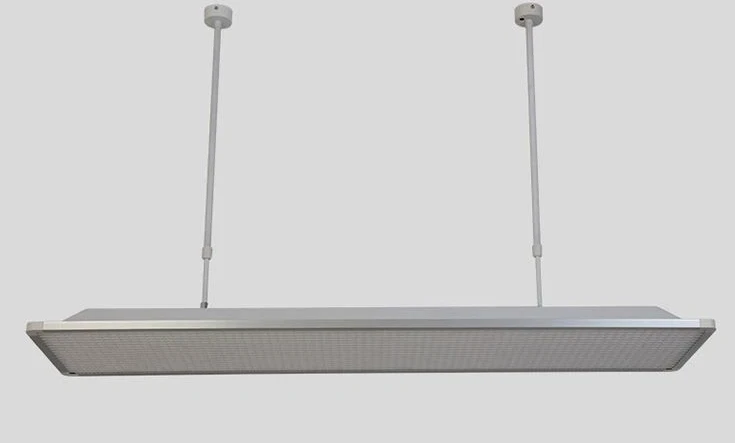
- Classroom luminaires (general lighting) – These illuminate the entire classroom space to ensure desktop illuminance meets the required levels. They are usually integrated anti‑glare LED grille lights, commonly sized around 1200×300mm. The luminaires should have glare‑control features, such as louvers or optical anti‑glare films, to prevent direct light from shining into students' eyes.
- Blackboard luminaires (writing‑board lighting) – These are specifically designed to illuminate the blackboard area. They should feature asymmetric‑beam lenses or adjustable angles to ensure uniform illumination and minimise shadows on the board. Their placement must avoid obstructing students' view or interfering with multimedia equipment.
Typical quantity per standard classroom (approximately 50‑70 m²): about 9 classroom luminaires and 3 blackboard luminaires.
5. Easily Overlooked Details
- CCC certification is the absolute baseline
Classroom luminaires must comply with national "CCC" product certification requirements. Always verify that the product holds a valid CCC certificate at the time of purchase.
- Power density has a strict limit
The new standard reduces lighting power density from 11 W/m² in the 2010 version to no more than 8 W/m², and explicitly excludes blackboard lighting from this calculation.
- Installation height matters
Classrooms should not use bare light sources. The minimum mounting height of the luminaire's light‑emitting surface above the desktop should be no less than 1.7 metres.
- Multimedia classrooms require independent dimming
In classrooms equipped with multimedia teaching systems, each blackboard luminaire should be equipped with independent dimming or brightness‑reduction controls.
- Luminous flux maintenance relates to service life
The rated lifetime of luminaires should be no less than 30,000 hours. After 3,000 hours of normal operation, the luminous flux maintenance factor should be ≥96%; after 6,000 hours, it should be ≥93%. High‑quality LED classroom modules can have a rated lifetime of up to 100,000 hours.

6. Industry Trends: From "Just Having Light" to "Healthy Eye Protection"
The classroom lighting industry is undergoing a profound shift in mindset:
- From fluorescent to LED – The new standard removes the restrictive requirement for tri‑phosphor fluorescent lamps, clearing the way for LED technology to fully enter the classroom environment.
- From single‑indicator to multi‑dimensional control – In the past, the main focus was on achieving the required illuminance. Now, we must simultaneously satisfy illuminance, uniformity, glare, CCT, CRI, blue‑light hazard class, flicker metrics, power density, and more. These indicators often interact with each other – for example, achieving R9>0 requires adding red phosphors, which may reduce luminous efficacy and affect power density.
- From "phosphor‑based" to full‑spectrum solutions – The industry is exploring more advanced technical routes. The China Association for Engineering Construction Standardisation has already approved and issued the "Technical Specification for LED Phosphor‑Free Lighting in Classrooms of Primary and Secondary Schools and Kindergartens" (T/CECS 2397‑2026) , which will come into effect on January 1, 2027.
- From manual control to intelligent lighting – Smart lighting systems support multiple scene modes: study mode (all classroom lights on, blackboard lights off), multimedia mode (dimming partial lights to avoid projector interference), and more. These systems can be centrally controlled via IoT and enable remote maintenance.
Final Thoughts
Every LED light on a classroom ceiling is far more than just a simple lighting tool. Behind it lies a comprehensive set of scientific standards designed around students' visual health – covering illuminance, colour temperature, colour rendering, blue‑light hazard, flicker control, power density, and beyond.
The next time you walk into a classroom, look up at those neatly arranged LED lights – they aren't just illuminators for textbooks; they are the silent guardians protecting children's eyesight. 💡