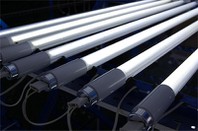
There are a few details to pay attention to when choosing LED classroom eye protection lights
As the myopia of young people in our country is getting more and more serious, our country pays more and more attention to the renovation of classroom lighting. Then, how to choose a comfortable eye-protecting classroom eye-protection lamp for school classroom lighting reform? Let's take a look now!
1. See illuminance and uniformity of illuminance
Requirements in the "Hygienic Requirements for the Lighting Design and Installation of General Classrooms in Primary and Secondary Schools": classroom maintenance illuminance ≥ 300LX, classroom illuminance uniformity ≥ 0.7. Many classrooms that use fluorescent lights are very dim, not to mention glare, and the illuminance and uniformity are not up to standard.
The LED classroom eye protection lamp produced by Benwei Lighting has a light supplement design on the back panel, omni-directional light output, good light transmission, high illuminance, uniform illuminance, in line with standards, and bright light.
2. See if there is anti-glare treatment
Glare is simply understood to mean that there will be excessive brightness in a certain part of the field of view or excessive brightness changes before and after. Fluorescent lamps and other traditional lamps will have a greater glare effect, which is one of the important causes of visual fatigue.
led classroom eye protection lamp produced by Benwei Lighting, the lamp panel part adopts the grille anti-glare design, there is no direct light to human eyes, reducing the impact of glare.
3. See if it contains harmful substances
Some lamps and lanterns use inferior materials and contain some harmful heavy metals, which not only pollute the environment, but also have an impact on human health. The led classroom eye protection lamp produced by Benwei Lighting does not contain harmful substances such as mercury, is green and healthy, and can be used more safely.
4. See if there is any stroboscopic and blue light hazards
Fluorescent lamps are generally equipped with inductive ballasts, which have serious stroboscopic effects. In order to adapt to changes in frequency, the student's visual system will be adjusted excessively frequently; and the high color temperature (6500K) fluorescent tube, because the light color is too white, the blue component is too much , It is easy to cause students to be excited, fatigued, and even cause insomnia.