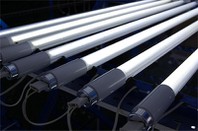
To distinguish the quality of led fluorescent lamp by the same thing, only 2 things are needed, and the price is not expensive
1. Power meter: test the power of led fluorescent lamp accurately
2. Luminance meter: test the brightness of led fluorescent lamps with the same power, whoever has high brightness, is of good quality. Or, the greater the brightness/power, the better, so that poor quality led fluorescent lamps have nowhere to escape.
1. Profile and structure
At present, there are basically two types of profiles in the LED fluorescent lamp market: all-plastic and half-plastic and half-aluminum tubes.
1. All-plastic LED fluorescent tube: The early LED fluorescent lamp used all-plastic tube, because it mainly uses non-isolated power supply, in order to avoid the problem of electric shock, it is more desirable to use all-plastic tube. The φ5 straw hat tube LED is used inside. The biggest problem of this kind of fluorescent lamp is the heat dissipation problem. Because all the heat is sealed in the tube, it cannot be dissipated at all, and the light decay is very serious. In addition, the straw hat tube has a very short lifespan, and it will be broken in less than 2000 hours.
2. Semi-plastic and semi-aluminum LED fluorescent tubes: The LED fluorescent tubes currently sold on the market are basically half of PC and half of aluminum alloy. Plastic is used for the half that needs light transmission. Aluminum alloy is used in half. The power supply is of course placed in the aluminum tube, so that the heat generated by the LED plus the heat generated by the power supply is quite large, because the power of this kind of lamp is usually about 20W.
The power is bigger, half of the aluminum tube can not solve its heat dissipation problem. Therefore, another aluminum tube structure for heat dissipation is proposed: a fan-shaped aluminum tube. The fan-shaped aluminum tube adopts a fan-shaped heat dissipation structure, which greatly increases the area of the radiator.
The LED fluorescent lamp power supply is placed outside the tube, so that half of the aluminum shell can be completely made into a heat sink. Compared with the semicircular aluminum tube, its heat dissipation area has increased by at least three times. In addition, the power supply is not placed in the tube, and the heat can be reduced, which greatly extends the life of the LED.