Understanding LED Downlight Power (W) vs. Brightness (Lumens)
Introduction
When selecting LED downlights, consumers often face confusion between wattage (W) and lumen output (lm). Unlike traditional incandescent bulbs, LED efficiency varies significantly, making wattage alone an unreliable brightness indicator. This guide explains how to convert watts to lumens and recommends optimal coverage for 5W, 7W, and 12W downlights.
1. Wattage vs. Lumens: Key Concepts
What Wattage (W) Measures
Wattage indicates power consumption, not brightness. For example:
A 60W incandescent bulb consumes 60W of power but emits only 800 lumens.
A 12W LED downlight can produce the same brightness (800 lm) while using 80% less energy.
What Lumens (lm) Measure
Lumens quantify visible light output. The higher the lumens, the brighter the light.
General Conversion Rule for LED Downlights
| Incandescent Equivalent | LED Wattage (W) | Lumen Output (lm) |
|---|---|---|
| 40W | 5W | 400–500 lm |
| 60W | 7W | 600–800 lm |
| 75W | 9W | 900–1,100 lm |
| 100W | 12W | 1,200–1,500 lm |
*Note: Efficiency varies by brand. High-quality LEDs (e.g., Philips, Cree) may produce 10–20% more lumens per watt.*
2. How Much Light Do You Need? (Lumens per Square Meter)
The required brightness depends on room function and ceiling height. Here's a standard reference:
| Room Type | Recommended Lumens/m² |
|---|---|
| Bedroom / Hallway | 100–200 lm/m² |
| Living Room / Office | 200–300 lm/m² |
| Kitchen / Workshop | 300–500 lm/m² |
| Retail / Gallery | 500–1,000 lm/m² |
Calculating Coverage for 5W, 7W, and 12W Downlights
Assuming a standard 2.4m (8 ft) ceiling height:
| Downlight Wattage | Lumen Output (lm) | Coverage Area (m²) | Ideal Room Use |
|---|---|---|---|
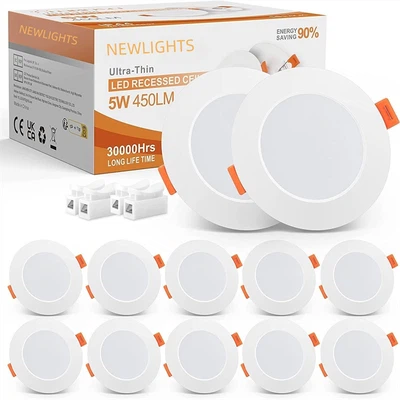
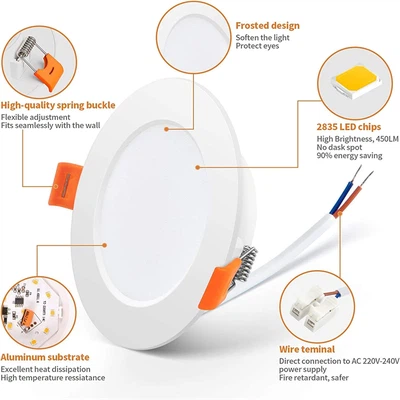
| 5W | 450 lm | 2–4 m² (20–40 sq ft) | Closets, small bathrooms |
| 7W | 700 lm | 3–6 m² (30–65 sq ft) | Bedrooms, hallways |
| 12W | 1,300 lm | 6–12 m² (65–130 sq ft) | Kitchens, living rooms |
Example: A 10m² (108 sq ft) living room needs ~2,000–3,000 lm. Using 12W downlights (1,300 lm each), you'd install 2–3 fixtures.
3. Factors Affecting Brightness & Efficiency
A. Beam Angle
Narrow beam (30°–60°) – Focused light (e.g., accent lighting).
Wide beam (90°–120°) – Broad coverage (e.g., general room lighting).
A 7W downlight with a 90° beam angle covers more area than a narrow 30° spotlight.
B. Color Temperature (CCT)
While not directly related to brightness, warmer light (2700K–3000K) can appear dimmer than cool white (4000K–6000K) at the same lumen level.
C. Fixture Quality
Cheap LEDs may degrade faster, losing 20–30% brightness within a year.
Premium brands (e.g., Cree, Osram) maintain stable lumen output for 50,000+ hours.
4. Practical Examples
Case 1: Kitchen Lighting
Room Size: 12 m² (130 sq ft)
Required Brightness: 400 lm/m² → 4,800 lm total
Solution: Install four 12W downlights (1,300 lm × 4 = 5,200 lm).
Case 2: Bedroom Ambient Lighting
Room Size: 15 m² (160 sq ft)
Required Brightness: 150 lm/m² → 2,250 lm total
Solution: Use three 7W downlights (700 lm × 3 = 2,100 lm).
5. Common Mistakes to Avoid
Assuming Higher Wattage = Brighter Light
A 15W low-quality LED may be dimmer than a 12W high-efficiency model. Always check lumens.
Overlighting Small Spaces
A 5W downlight (450 lm) is sufficient for a 2m² bathroom. A 12W fixture would cause glare.
Ignoring Dimmer Compatibility
Non-dimmable LEDs used with dimmers may flicker or fail prematurely.
Conclusion
Choosing the right LED downlight involves:
Prioritizing lumens over watts (e.g., 7W ≈ 700 lm).
Matching brightness to room size (5W for closets, 12W for living rooms).
Considering beam angle and color temperature for optimal light distribution.
For best results, opt for high-CRI (≥80) and dimmable downlights from reputable brands.