Understanding PIR Sensor Range and False Trigger Mitigation
Passive Infrared (PIR) sensors are the unsung heroes of modern security and automation. These ubiquitous devices, found in everything from security lights to smart home systems, silently monitor their environment for movement. Their operation seems simple-they detect motion and trigger an action. However, the engineering behind them is sophisticated, precisely tailored to identify human presence while intelligently ignoring common environmental distractions. This article delves into the specifics of a PIR sensor's detection range and angle and explores the multi-layered technological strategies it employs to achieve remarkable reliability.
Defining the Detection Zone: Range and Angle
The "view" of a PIR sensor is not a single, sweeping beam but a collection of multiple, individual detection zones created by a specialized lens. The exact specifications can vary by model and manufacturer, but general standards exist.
Detection Angle (Field of View): The most common PIR sensors feature a horizontal detection angle of approximately 110 to 120 degrees, which qualifies as a wide-angle view. This provides broad coverage for a typical room or outdoor area. Vertically, the angle is much narrower, often around 70-80 degrees, focusing the sensor's sensitivity on the area where a person would be walking, not crawling on the floor or flying near the ceiling.
360° Coverage: For applications requiring complete panoramic coverage, such as in a large open office or a retail store, a 360° PIR sensor is used. This is typically achieved not by a single omni-directional element, but by mounting multiple sensor units (e.g., four 90° sensors) inside a single dome housing. Each unit monitors its quadrant, and the system's logic combines their inputs to create a full-circle detection field.
Detection Range: The standard detection range for most residential PIR sensors is up to 10-12 meters (approximately 30-40 feet). High-performance models designed for commercial or outdoor security can extend this range to 20 meters (65 feet) or more. It is crucial to understand that range is not absolute; it is influenced by the size and temperature of the moving object. A person walking directly toward the sensor will be detected at a greater range than a small pet moving laterally at the edge of the detection zone.
The Core Challenge: Mitigating False Triggers
The fundamental principle of a PIR sensor is that it detects changes in infrared radiation (heat), not motion itself. Every object emits IR energy, and the sensor is calibrated to look for a specific signature. This makes it susceptible to false triggers from non-human heat sources. Manufacturers use a combination of hardware and software solutions to overcome this.
1. The Fresnel Lens: Creating a Mosaic of Zones
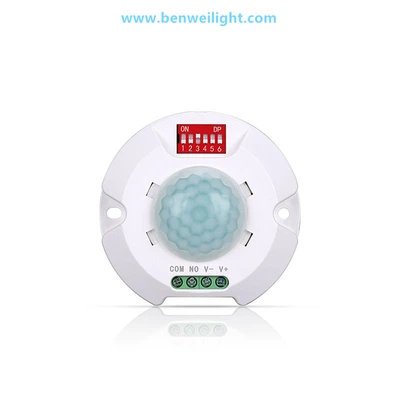
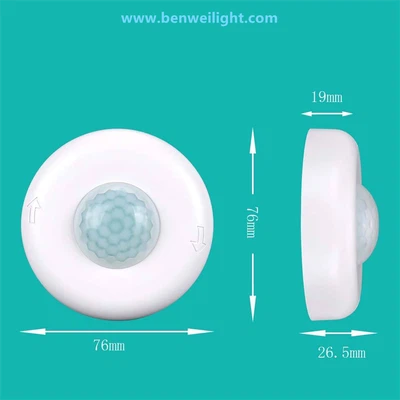
The first line of defense is the plastic dome covering the sensor-a Fresnel lens. This lens is not smooth; it is molded into an array of small, precise facets. Each facet focuses infrared radiation from a specific direction onto the pyroelectric sensor element underneath, effectively creating a mosaic of individual detection zones. For the sensor to register an event, a heat source must move from one zone to another, causing a rapid change in the IR signal. A uniform change in heat across all zones simultaneously-like sunlight slowly spreading across a floor or an HVAC vent blowing air-does not create this sequential zone-triggering pattern and is therefore ignored.
2. Dual or Quad Sensor Elements: The Differential Signal
At the heart of the sensor are two or four pyroelectric elements wired in opposite polarity (a differential pair). When a human moves through the detection field, they first heat one element, then the other, creating a positive-negative voltage pulse that the circuitry recognizes as a valid event. An ambient, uniform heat change (like a sunbeam warming the entire room) would affect both elements equally and simultaneously, resulting in no net differential signal and thus, no trigger. This is the primary reason PIR sensors are highly resistant to false alarms from sunlight and temperature drift.
3. Digital Signal Processing (DSP) and Analytics
Modern PIR sensors incorporate microcontrollers that analyze the analog signal from the sensor elements. This DSP can:
* Filter by Pulse Count and Timing: Human movement creates a specific pattern of pulses. The DSP can be programmed to ignore single, abrupt spikes (like a flash of light) or slow, meandering changes. It requires a sequence of pulses that match the rhythm of a walking person.
* Amplitude Discrimination: The IR signature of a human body is significantly stronger than that of a small pet. The DSP can set a threshold for the signal strength required to cause a trigger, effectively filtering out animals under a certain weight (e.g., 20-40 lbs, depending on the "pet-immune" rating of the sensor).
4. Environmental Sealing and Mechanical Design
To combat false triggers from moving curtains or debris blown by HVAC airflow, sensors are designed with physical barriers. The Fresnel lens itself acts as a filter for airborne particles. Furthermore, the sensor is typically sealed to prevent internal air currents from affecting the sensitive pyroelectric elements.
Conclusion: A Balance of Sensitivity and Reliability
The effectiveness of a PIR sensor is a testament to elegant engineering solving a complex problem. By employing a 120° wide-angle or multi-element 360° lens for coverage, and a multi-faceted approach combining optical focusing (Fresnel lens), electrical differentiation (dual elements), and intelligent digital analysis (DSP), these devices achieve a remarkable feat. They maintain high sensitivity to the unique infrared signature of human movement while remaining steadfastly indifferent to the myriad of environmental factors-sunlight, HVAC drafts, and small pets-that would otherwise render them useless. This careful balance is what makes the PIR sensor a enduring and reliable cornerstone of automated and security systems worldwide.