Understanding Shunted and Non-Shunted Sockets: A Comprehensive Guide
A fundamental aspect of electrical installations for lighting systems involves selecting the appropriate socket type. The distinction between shunted and non-shunted sockets represents a crucial decision point that directly impacts system functionality, safety, and compatibility. This guide provides detailed clarification about these socket types, their operational characteristics, and appropriate application scenarios.
Fundamental Definitions
Shunted sockets feature internally connected electrical contacts that create a unified pathway for electrical current. This configuration allows power to flow along a single track from the power source, through the socket, and subsequently to both pins of the lamp simultaneously. Essentially, shunted sockets receive electricity through one set of wires and distribute it across two contact points internally. For simplified understanding, conceptualize shunted sockets as "connected" internally.
Non-shunted sockets maintain completely separated electrical contacts with individual entry points for wiring connections. This architecture provides two independent pathways for electrical current to travel to the lamp pins. Unlike their shunted counterparts, non-shunted sockets deliver voltage to each contact through separate wiring tracks without internal interconnection. For mnemonic purposes, consider non-shunted sockets as "not connected" internally.
Technical Differentiation and Application Scenarios
The operational distinction between these socket types dictates their specific applications:
Shunted sockets primarily serve systems where power distribution to both lamp contacts occurs uniformly. These are typically implemented in instant-start ballast configurations where the internal connection facilitates simultaneous power delivery to both ends of the linear lamps. The integrated contact design simplifies wiring requirements by reducing connection points.
Non-shunted sockets find their essential application in scenarios requiring independent power routing to separate contacts. These are mandatory for rapid-start and programmed-start ballast systems where distinct wiring paths enable the sequential preheating of lamp filaments before ignition. This independent circuit maintenance proves crucial for applications prioritizing extended lamp longevity and reduced stress on components.
Contemporary LED Retrofit Considerations
The transition to LED technology has introduced additional considerations for socket selection:
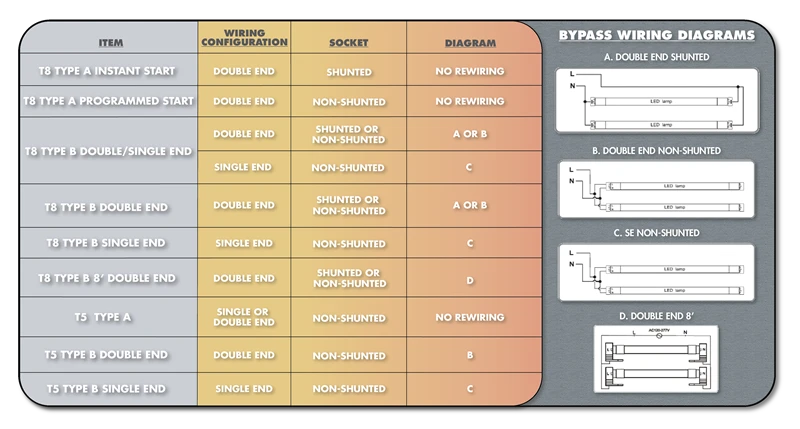
When replacing traditional fluorescent tubes with direct-wire LED bypass lamps, non-shunted sockets become imperative. These installations require maintaining separate electrical pathways to accommodate the LED lamp's internal driver configuration. The independent contacts in non-shunted sockets enable proper operation of LED tubes designed to function without external ballasts.
For LED replacements that maintain existing ballast systems, shunted sockets may remain appropriate depending on the specific ballast-LED tube compatibility. However, industry trends increasingly favor ballast-bypass LED installations for their enhanced energy efficiency and reduced maintenance requirements, making non-shunted sockets the prevailing choice for modernization projects.
Selection Guidelines and Safety Considerations
Proper identification between socket types involves visual inspection of contact configuration. Shunted sockets display metallic bridges connecting the contact points, while non-shunted sockets exhibit completely separated contacts with distinct terminal connections.
Critical safety note: Implementing shunted sockets in applications requiring non-shunted configurations can create short circuits and potential fire hazards. Conversely, utilizing non-shunted sockets where shunted types are specified may result in system malfunction or complete failure to operate. Always verify manufacturer specifications for both lamps and sockets before installation.
Benwei's product documentation clearly indicates socket compatibility requirements for all lighting systems, ensuring informed selection and safe implementation. When undertaking lighting upgrades or new installations, consulting with electrical professionals guarantees appropriate socket selection aligned with specific system requirements and safety standards.