Fighting germs with UV-C light disinfection
Since the start of the epidemic, we have discovered a lot of lessons. There are vaccine programs in place all around the world, and precautions are being made to shield individuals from the virus's effects. But we've also come to understand that certain approaches to stopping the spread of illness are more successful than others.
There is increasing agreement that airborne transmission is the main method of COVID-19 infection. As a result, increasing ventilation and indoor air quality are two of the best strategies to lower the possibility of coming into touch with dangerous microorganisms. Whether or whether the interior air is suitably filtered with clean air depends on how many air changes per hour (ACH) there are.
Air quality improvement
Up to 6 ACH are needed for basic air ventillation in order to deliver fresh air, regulate humidity, and lower levels of CO2 and odor. However, each air change will only result in a 63% reduction in pathogen levels. Opening a window, which at 1-2 ACH will not remove germs but will undoubtedly influence personal comfort, is not exactly the simplest solution. A recognized method for air disinfection is to significantly increase ventilation to 15-20 ACH in order to lower germs to a level that reduces danger. Introducing UV-C air ventillation and indoor climate solutions, such as Philips UV-C luminaires, that provide the necessary levels for air and surface disinfection is one of the finest methods to do this. After fact, according to the results of our upper-air UV-C airborne disinfection test, 99.99% of the SARS-CoV-2 virus was rendered inactive in only 10 minutes1, or 50 ACH.
How does disinfection with UV light work?
The chemical connections that hold electrons and atoms together may be broken by ultraviolet light thanks to its high energy. Because of this, it may cause sunburn and damage to the skin and eyes, but it can also be useful for cleaning surfaces and purifying the air.
In order to prevent the growth of microorganisms like bacteria, spores, and viruses, UV-C disinfection employs light to break down the chemical components in such organisms. Numerous coronaviruses have also been investigated over the years, and all of them react to UV-C disinfection3. Signify's UV-C light sources lowered the SARS-CoV-2 virus's infectivity on a surface to undetectable levels in laboratory testing in as little as 9 seconds1. A compelling argument for why UV-C light should be an important component of your COVID-19 protection plan.
Sustainable methods of disinfection
There is no need to handle, transport, or store dangerous, harmful, or corrosive chemicals during UV-C disinfection since it is a physical process rather than a chemical one. Additionally, there is no chemical residue. It is a straightforward, environmentally friendly, and safety-conscious approach that is highly advised as a component of a thorough disinfection plan that also involves using liquid disinfectants to sanitize hands, surfaces, and objects.

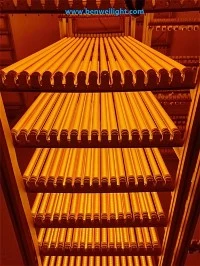
Benwei UV 120cm led tube black light Product Specification:
|
Item |
UV led light tube bulb T8 |
|
Input Volt |
AC85-265V |
|
Power |
10W,18W,24W |
|
Length |
60cm/2ft, 120cm/4ft, 150cm/5ft |
|
Bean Angle |
120°, 180° |
|
Lifespan |
50000 hrs |
|
Wavelength |
365nm 395nm 254nm 280nm |
|
Warranty |
3-5 years |