What Are the Core Technical Specifications of LED Panel Lights? Five Key Parameters Every Professional Buyer Must Know
When walking into a lighting showroom or browsing an online product catalog, are you often confused by long lists of technical parameters – lm/W, CRI, UGR, L70… What do these terms actually mean? Which indicators truly determine the quality of the lighting experience? As a professional lighting buyer or project manager, understanding the meaning behind these parameters will not only help you choose the right product but also avoid the long‑term troubles that come with choosing the wrong luminaire.
1. Luminous Efficacy – The Core Measure of Energy Efficiency
Luminous efficacy is the primary indicator for evaluating the energy efficiency of LED luminaires, expressed in lumens per watt (lm/W). The higher the value, the more light you get for the same amount of electricity. Traditional fluorescent tubes achieve around 60‑80 lm/W, while high‑quality modern LED panel lights have made a significant leap.
According to the Chinese national standard GB38450‑2019 (effective from 2025), LED panel lights are classified into three energy efficiency levels: Level 1 requires luminous efficacy ≥120 lm/W, a color rendering index (CRI) ≥85Ra, and a lumen maintenance rate ≥90% after 3,000 hours of testing. Ordinary LED panel lights on the market typically have luminous efficacy between 110‑120 lm/W, while high‑performance products can reach over 130 lm/W.
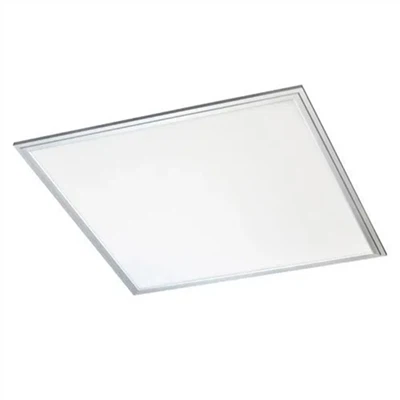
Take Benwei Lighting's wall/ceiling decorative LED panel light as an example: it achieves 110‑120 lm/W, far exceeding traditional fluorescent tubes (approx. 60 lm/W), resulting in significant energy savings. This means that for the same brightness, this LED panel light can reduce electricity costs by about 40‑50% compared to traditional luminaires.
2. Color Rendering Index (CRI) – The Key to True Color Reproduction
The Color Rendering Index (CRI) measures how accurately a light source reproduces the true colors of objects, expressed as an Ra value with a maximum of 100 (natural light). The higher the CRI, the more vivid and realistic objects appear under the light.
General industry classification:
- CRI 80‑90 – Good color rendering, suitable for general commercial and office environments
- CRI 90‑100 – Excellent color rendering, suitable for applications requiring high color accuracy, such as photo studios, retail displays, and medical facilities
Benwei Lighting's LED panel light has a CRI >80Ra, placing it in the good rendering category, sufficient for most applications like offices, hotels, and homes. If you require higher color fidelity, some LED panel lights are available with CRI ≥95 (ultra‑high version).
3. Unified Glare Rating (UGR) – An Important Defense for Eye‑Friendly Lighting
Glare is a major cause of visual fatigue and eye discomfort, especially in long‑duration lighting environments. The Unified Glare Rating (UGR) is an internationally accepted glare evaluation index. The lower the UGR value, the less glare the luminaire produces and the more comfortable the visual experience.
According to European standard EN12464‑1 and relevant Chinese lighting codes:
- UGR ≤ 19 – Meets the glare limit for general office spaces
- UGR ≤ 16 – Suitable for classrooms, fine task work, and other environments demanding high visual comfort
Low glare design is especially critical for panel lights. UGR <19 is the entry pass for panel lights into office lighting applications, while UGR ≤16 represents a higher level of visual comfort. The International Commission on Illumination (CIE) suggests that a difference of 3 units in UGR is noticeably perceived by the human eye.
| Glare Level | UGR Range | Typical Applications |
|---|---|---|
| Extremely low glare | ≤16 | Classrooms, precision work, medical facilities, high‑end offices |
| Low glare | 17‑19 | General offices, meeting rooms, libraries |
| Medium glare | 20‑22 | Ordinary commercial spaces, corridors, storage areas |
| High glare | ≥23 | Not recommended for long‑term visual tasks |
4. Correlated Color Temperature (CCT) – Adjusting Light Tone to Create Ambience
Color temperature, expressed in Kelvin (K), determines whether light appears "warm" or "cool":
- 3000K (warm white) – Yellowish light, creates a cozy and relaxing atmosphere, suitable for home bedrooms, dining rooms, hotel guest rooms
- 4000K (neutral white) – Natural, refreshing light – the most common choice for offices, classrooms, hospitals
- 5000K‑6500K (cool white) – Bluish light, improves concentration, suitable for workshops, parking lots, exhibition halls
Benwei Lighting's LED panel light is available in three standard CCT options: 3000K, 4000K, and 5000K, meeting diverse needs from warm home settings to efficient office lighting. More advanced versions support triac dimming or 0‑10V dimming for three‑step CCT switching, allowing the same luminaire to change color temperature at different times of day.
5. Service Life (L70) – Say Goodbye to Frequent Replacements
The lifespan of an LED luminaire is fundamentally different from that of traditional bulbs – it does not suddenly "burn out." Instead, brightness gradually declines over time. The industry uses the L70 metric to define the "rated life" of LEDs – the number of operating hours until the LED output decays to 70% of its initial brightness.
Benwei Lighting's LED panel light has a lifespan of 50,000 hours and comes with a 5‑year warranty. What does 50,000 hours mean? Assuming 10 hours of use per day, it can last nearly 14 years without replacement. In comparison, traditional fluorescent tubes have an average lifespan of only about 8,000‑10,000 hours and become dimmer over time.
According to industry statistics, L70 values for quality LED panel lights typically range from 25,000 to 50,000 hours – Benwei's product sits at the top end of that range.
Application Scenarios – Full Coverage from Home to Commercial Use
With their slim design, uniform light distribution, and high energy efficiency, LED panel lights are used in a wide range of applications:
- Commercial spaces – Offices, meeting rooms, retail stores, hotel lobbies
- Public facilities – Hospital waiting areas, school classrooms, libraries, subway stations
- Home spaces – Living rooms, kitchens, studies, corridors, balconies
- Special environments – Clean rooms, laboratories, exhibition spaces
Benwei Lighting's panel light can be installed on either walls or ceilings, and its IP44 rating makes it suitable for damp areas such as bathrooms and kitchens – an adaptability advantage that ordinary panel lights rarely achieve.

Conclusion
When selecting an LED panel light, price alone should not be your guide. The five core parameters – luminous efficacy, color rendering index, glare control, color temperature, and service life – together determine the real‑world user experience and long‑term economic benefits. Remember: a high‑quality LED panel light will save far more in electricity and maintenance costs over its 5‑10 year service life than its initial purchase price difference. I hope this article helps you become a more informed "lighting expert" the next time you source LED panel lights.
Should you have any demands for bulk purchase or customized lighting solutions, feel free to contact us for a detailed quote.