What are the differences between LED grow lights and fluorescent grow lights?
After application tests, LED grow lights are very suitable for plant growth, flowering, and fruiting. Generally, indoor plants and flowers will grow worse and worse over time due to lack of natural light. By using LED grow lights with the required spectrum (light quality combination) of plants, not only can they promote their growth, but also prolong their flowering period and improve The quality of the flowers. The application of this high-efficiency light source system to agricultural production such as greenhouses, greenhouses and other facilities on the one hand can solve the shortcomings of the lack of sunlight leading to the decrease in the taste of tomatoes, cucumbers and other greenhouse vegetables, and on the other hand, it can also advance the winter solanum vegetables in the greenhouse. It will be listed around the Spring Festival, so as to achieve the purpose of off-season cultivation.
(1) As artificial supplementary lighting, the lighting can be enhanced at any time and the effective lighting time can be extended.
(2) Regardless of whether it is sunny, cloudy or rainy, the light required by plants can be reasonably and effectively extended and scientifically controlled, as long as you have mastered this light supplement product and product application technology.
(3) In a greenhouse or plant laboratory, it can completely replace natural light, ensure healthy plant growth, and promote better plant growth. As a supplementary light, it provides supplementary light for plants when the external light is insufficient, so as to keep plant growth with sufficient light.
Extend the light time. For mid-day and long-day plants, natural light cannot provide enough light time. Plant lights can extend the light time to achieve the best photoperiod of plants. Use a greenhouse or plant laboratory. Replace natural light and promote plant growth.
The luminous efficiency and luminous flux of the fluorescent lamp type plant lamp are slightly higher than that of the LED type plant lamp, but because only the downward emitted light can effectively illuminate the plant, the real luminous effect and luminous flux of the fluorescent lamp type plant lamp are only its own About 50% of it.
Through experiments to compare the luminous efficiency and luminous flux of the fluorescent lamp type plant lamp and the LED type plant lamp, the results are shown in Table 1. It is obvious that the effect of the LED type plant lamp is better.
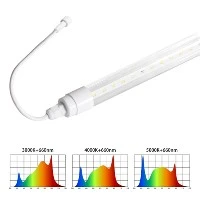
The wavelength of the fluorescent lamp type plant lamp is very dispersed, so although there are various kinds of light, the proportion is not concentrated, while the wavelength of the LED type plant lamp is very concentrated, and the light emitted is mostly red and blue light, which photosynthesizes the plant The effect is better. At the same time, LED grow lights can also be equipped with different proportions of color to light occupancy ratios according to different types of plants. Therefore, the effect of LED grow lights is better.
The real effect of LED plant light on photosynthesis of plants is far better than that of fluorescent light plant light. In addition, the electric power and lifespan of the two plant lights have obvious advantages and disadvantages.
The sum of the red and blue light occupancy rates of LED grow lights is as high as 99.5%, while fluorescent grow lights account for only 53.9%. fluorescent grow lights also contain 46.1% of the green light that is not needed for plant growth. The effect of plant growth is better. At the same time, LED grow lights have the characteristics of long life, small size and light weight. In summary, LED grow lights have better effects, are more conducive to plant growth, and are suitable for actual production.