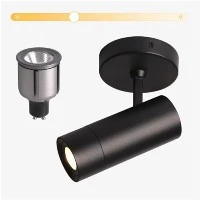
Anyone who has worked on lighting projects has likely encountered this scenario: the exact same surface-mounted COB spotlight looks stunning in a showroom but produces harsh light spots and awkward brightness distribution when installed in a corridor. The problem usually lies not with the fixture itself, but with the choice of beam angle. COB light sources feature a concentrated, high-intensity emitting surface; an incorrect beam angle choice can lead to issues like glare, dark corners, and fuzzy spot edges. Below, we discuss how to select the right beam angle for surface-mounted COB spotlights based on common application scenarios.
First, understand what "beam angle" actually means
Beam angle refers to the angle between the two edges where the light intensity drops to 50% of the peak value at the center. Note that these "edges" do not mark the point where the light disappears completely; there is often a ring of weaker stray light surrounding the main spot, so the actual illuminated area is usually slightly larger than the nominal value.
COB spotlights typically use reflectors or lenses to control the beam angle. Reflector-based designs are cost-effective and produce softer light, while lens-based designs offer cleaner light spots and higher light utilization efficiency. Even with the same rated 24° angle, the edge transition characteristics differ significantly between the two optical systems. When sourcing, it is best to request a light distribution curve from the supplier rather than relying solely on a single number in the specifications table.
15°–24° Narrow Beam: The top choice for accent lighting
Narrow beams are concentrated and offer high contrast, making them ideal for scenarios where you want to highlight specific objects:
Exhibits and artworks: Paintings, sculptures, and jewelry displays that need to firmly draw the viewer's gaze.
Merchandise displays: Featured items in clothing stores or window mannequins.
Wall textures: Lighting stone surfaces or textured paint from a close range to create depth through light and shadow.
The trade-off with narrow beams is a low margin for error. If the fixture position is slightly off, the light spot misses the target. Additionally, using a narrow beam in a space with a low ceiling results in a spot that is too small, creating isolated "dots" of light that look visually uncomfortable.
36° Medium Beam: An "All-Rounder" Balancing Atmosphere and Function
If a project lacks a specific focal point, a 36° beam is often the safest choice. It produces a moderately sized light spot that creates a sense of depth through light and shadow without causing excessive brightness in localized areas.
Common applications include:
Tabletops and walkways in restaurants and cafés
Residential living rooms and entryways
Hotel guest room corridors
When clients are unsure, we recommend starting with a 36° beam for general lighting and switching to narrower angles for specific focal points; this controls costs while ensuring a reliable visual outcome.
45°–60° Wide Beam: Large-Area General Lighting
Wide-beam lights produce a soft spread, allowing light pools to blend seamlessly without creating harsh patches of light and shadow. Suitable for:
Supplementary lighting in office areas and conference rooms
Aisles in supermarkets and warehouse-style retail stores
Spaces with low ceilings (under 2.5 meters)
Note that wide beams disperse light more broadly, resulting in lower central illuminance. If the space requires higher brightness levels, you must increase the number of fixtures or the wattage of individual lights, rather than simply adjusting the beam angle.
Two Often-Overlooked Details Beyond Beam Angle
Anti-glare depth. COB light sources are intensely bright; if the light fixture lacks sufficient recess depth, the light-emitting surface becomes visible when viewed from an angle, causing glare. This is particularly important when selecting narrow-beam lights; consider using honeycomb louvers or fixtures with deeper housings.
Adjustability requirements. A key advantage of surface-mounted spotlights is their adjustable heads. If displays are frequently rearranged, opt for models with a wide range of rotation. Also, consider fixtures that support interchangeable lenses to allow for flexible beam angle adjustments in the future.
Summary
To highlight specific features or create visual depth: Choose 15°–24°.
For a balanced look without a specific focal point: Choose 36°.
For general ambient lighting or low ceilings: Choose 45°–60°.
Before finalizing the angle, calculate the light spot size using the height formula, then determine the spacing and quantity of lights.
Don't focus solely on the beam angle figure; light distribution curves and anti-glare design also significantly impact the final result.
There is no single "best" beam angle-only the one that is most suitable. Making your choice based on the space's function, ceiling height, and lighting objectives will generally ensure a successful outcome.
Not sure which beam angle is right for your project? Feel free to send us the dimensions, ceiling height, and intended use of the space. Our engineers will recommend a suitable COB surface-mounted spotlight solution for free, including light distribution curves and sample testing.
We offer customization for various beam angles, color temperatures, and power ratings, as well as bulk pricing based on order volume. Click the "Inquiry" button on the page or email us directly; we will respond within 24 hours.
https://www.benweilight.com/industrial-lighting/adjustable-led-cob-surface-mount-spotlight.html