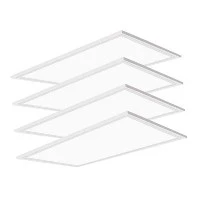
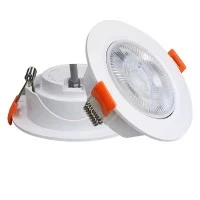
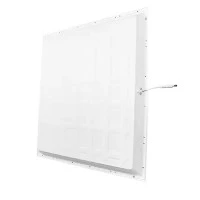
When shopping for LED panel lights, you have likely encountered two terms: "Backlit" (direct-lit) and "Edge-Lit." While both appear to be flat, white square panels, there can be a significant price difference between them, along with variations in brightness, thickness, and installation methods. Many buyers placing their first order focus solely on wattage and color temperature, only to discover upon delivery that the ceiling clearance is insufficient or the light distribution is uneven. This article clarifies the differences between the two types of panel lights-covering structure, luminous efficacy, cost, and installation-to help you select the right product for your project's needs.
Differences in Luminous Structure
This is the fundamental distinction between the two; most other differences stem from this structural variation.
Backlit: LED chips are arranged directly on the back panel, and light projects forward through a diffuser. You can visualize this as "LEDs positioned directly behind, with light traveling straight forward."
Edge-Lit: LED strips are mounted within the frame surrounding the panel. Light first enters a light guide plate (LGP) and is then redirected toward the front surface via dot patterns on the bottom of the LGP. Since the LEDs are not located directly behind the face, the light source itself is not visible from the front.
Thickness and Appearance
With edge-lit models, the LEDs are positioned at the edges, eliminating the need for internal space to accommodate the chips and optical components. Consequently, they can be made very thin-typically 8–15mm-offering a more refined and modern aesthetic.
Backlit models require a specific distance between the LEDs and the diffuser to ensure proper light mixing; otherwise, distinct "hotspots" (visible LED dots) would appear. As a result, they are usually thicker, ranging from 25mm to 40mm or more.
If a project prioritizes a slim profile-such as in high-end offices, hotel corridors, or showrooms-edge-lit models offer a distinct advantage.
Luminous Efficacy and Brightness
Backlit models project light directly outward with minimal internal loss, generally resulting in higher overall luminous efficacy (lm/W) and greater brightness for the same wattage. In edge-lit designs, light travels through a light guide plate and undergoes refraction via optical patterns; this longer path results in relatively higher light loss. However, significant advancements in light guide plate and reflective film technologies in recent years have narrowed the efficiency gap for high-quality edge-lit products. Nevertheless, for the same cost, back-lit designs still make it easier to achieve high luminous efficacy.
It is important not to rely solely on nominal efficacy ratings; it is best to request third-party optical test reports from suppliers and base decisions on actual measured data.
Light Uniformity and Glare
Edge-lit: Light is diffused across the entire emitting surface by the light guide plate, resulting in very uniform brightness without visible LED dots, creating a soft visual effect. However, if the light guide plate's pattern design or quality is poor, the edges may appear brighter while the center appears darker.
Back-lit: With a high density of LEDs and a quality diffuser plate, uniform lighting can also be achieved. However, if LED spacing or the diffuser's light transmission rate is not properly controlled, shadows or bright spots may occur. Additionally, because back-lit designs emit light more directly, glare can be more noticeable in environments with low ceilings, making the UGR (Unified Glare Rating) value a key consideration.
Cost and Price
The cost structures differ:
Back-lit: Uses a large number of LEDs but eliminates the need for a light guide plate. The structure is relatively simple, and the overall cost is usually lower, making it suitable for large-scale, budget-sensitive projects.
Edge-lit: Uses fewer LEDs but incurs higher material costs for components like light guide plates, reflective paper, and diffuser films. It also demands more complex manufacturing processes, resulting in higher price quotes for equivalent specifications.
For wholesale project clients, this factor directly impacts profit margins and pricing strategies.
Heat Dissipation and Lifespan
Back-lit: LEDs are distributed across the entire base plate, spreading out the heat and balancing the thermal load. This results in lower operating temperatures for the LEDs, which extends their lifespan.
Edge-lit: LEDs are concentrated along the perimeter frame, leading to heat concentration and placing higher demands on the aluminum frame's thermal design. Poor heat dissipation can cause the LEDs to experience premature lumen depreciation. Therefore, when selecting edge-lit products, pay attention to the frame material and thickness; all-aluminum frames are the preferred choice.
Installation and Application Scenarios
Both types of lights support various installation methods (recessed, suspended, and surface-mounted); the choice depends primarily on spatial constraints:
Back-lit models are better suited for: scenarios with ample ceiling plenum space, high brightness requirements, and limited budgets-such as schools, factory office areas, supermarkets, warehouse offices, and general hospital areas.
Edge-lit models are better suited for: scenarios with shallow ceiling spaces where a sleek, aesthetic look is desired-such as high-end office buildings, hotels, shopping malls, conference rooms, and showrooms.
Additionally, edge-lit models are more easily designed with frameless, ultra-thin, or suspended profiles, making them a popular choice among designers.
Summary
In short: choose back-lit models for cost-effectiveness and high brightness; choose edge-lit models for a slim profile, aesthetic appeal, and soft lighting. There is no absolute "best" option; the right choice depends on the project's budget and spatial conditions.
We offer two main series of LED panel lights-back-lit and edge-lit-covering common sizes such as 300×300, 600×600, 300×1200, and 600×1200. We support customization of color temperature, wattage, and driver solutions, as well as OEM/ODM services.
If you are currently selecting products or wish to compare samples, please contact us. Simply provide details regarding your project type, ceiling height, and budget range, and we will provide a recommended solution and quotation within 24 hours. Send an inquiry now to receive free samples and a price quote.