What Is a Full‑Spectrum LED Grow Light?
With the rapid development of LED plant lighting, the term "full spectrum" appears frequently on the packaging and promotional materials of various grow lights. Many people intuitively assume that since it is called "full spectrum", it must be better for plants. But is that really the case? This article will thoroughly explain what a "full‑spectrum LED grow light" really is from four perspectives: technical definition, spectral composition, comparison with red‑blue grow lights, and market realities.
1. Concept: What Is a Full‑Spectrum LED Grow Light?
The term "full‑spectrum LED grow light" contains two elements: "full spectrum" and "grow light".
A grow light is an artificial light source using LEDs as emitters to provide the light conditions required for plant photosynthesis. More precisely, a full‑spectrum LED grow light is a luminaire that emits light across the complete photosynthetically relevant wavelength range (typically 380‑780 nm) and is deliberately spectrally engineered to target the key absorption peaks of chlorophyll and other plant photoreceptors.
In simple terms, the goal of a full‑spectrum LED grow light is to simulate the spectral profile of sunlight. Through precise phosphor formulations, the light emitted by the LEDs extends from the violet‑blue region around 380 nm all the way to the red region up to 780 nm, making the spectral curve as close as possible to natural daylight. Sunlight has a continuous spectrum, and full‑spectrum grow lights strive to provide continuous radiation across all bands, rather than concentrating energy only on a few narrow peaks like traditional red‑blue LEDs.
Today, full‑spectrum LED grow lights are widely used in commercial greenhouses, plant factories, vertical farming, and home horticulture.
2. Which Wavelengths Does a Full‑Spectrum Grow Light Cover? - Far More Than Red and Blue
The value of natural sunlight to plants goes far beyond photosynthesis itself. Besides the red and blue wavelengths that drive photosynthesis, other spectral bands play irreplaceable roles in plant photomorphogenesis (i.e., the development of plant shape). A full‑spectrum grow light is called "full spectrum" precisely because it is deliberately engineered across multiple key bands in the 380‑780 nm range to mimic the completeness of sunlight.
The table below summarises the main functions of each waveband in a full‑spectrum grow light:
| Waveband | Range | Primary Functions |
|---|---|---|
| UV‑A | 315–400 nm | Induces secondary metabolite synthesis, promotes accumulation of anthocyanins and other antioxidants, enhances crop flavour and colour |
| Violet | 380–420 nm | Activates cryptochromes, regulates plant architecture, promotes anthocyanin production |
| Blue | 420–490 nm | Core photosynthetic band; regulates stomatal opening, inhibits hypocotyl elongation (prevents legginess), promotes root development and compact stems/leaves |
| Green | 490–560 nm | Penetrates the plant canopy to reach lower leaves; assists photosynthesis; also critical for human visual comfort |
| Yellow/Orange | 560–620 nm | Moderate photosynthetic activity |
| Red | 620–700 nm | Highest photosynthetic quantum yield band; directly drives photosynthesis, promotes flowering, fruiting and dry matter accumulation |
| Far‑red | 700–780 nm | Regulates phytochrome signalling, induces internode elongation, promotes early flowering; together with red produces the "Emerson enhancement effect", making photosynthetic efficiency far exceed that of either band alone |
3. Full‑Spectrum vs. Red‑Blue Grow Lights: Core Differences
Currently, there are two main technical routes for grow lights: the "full‑spectrum" white‑light type and the "red‑blue" purple‑light type. Understanding their essential differences is the first step toward making a correct purchasing decision.
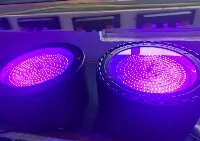
Red‑blue (single‑band) grow lights mainly deploy narrow‑band blue light centred around 450‑460 nm and narrow‑band red light around 660 nm, concentrating energy on the two chlorophyll absorption peaks. This approach has extremely high efficacy because almost every joule of electrical energy is directly converted into photons that plants need most. However, the spectral coverage is very narrow, with little or no green, yellow or far‑red light. This purple‑red light is mainly suitable as supplemental lighting in greenhouses for crops that already receive natural full‑spectrum sunlight, focusing electrical energy on the most deficient bands to achieve the highest energy efficiency.
However, most purple‑red grow lights sold for indoor cultivation (with no natural sunlight) have incomplete spectral coverage, leading to abnormal plant morphogenesis. These lights fail to fully activate photoreceptors such as cryptochromes and phytochromes. While green leafy plants may stay green, they often become spindly, have excessive internode elongation, and fail to fully expand their leaves.
Full‑spectrum (white‑light) grow lights emit a continuous spectrum covering 380‑780 nm, including blue, green, yellow, red and far‑red bands. Through specialised phosphor blends, they convert blue LED chips into broad‑spectrum white light, mimicking the full‑band characteristics of sunlight. These lights are suitable for crop cultivation in fully artificial light environments, allowing plants to maintain natural morphogenesis and full physiological functions under an "artificial sun".
4. How Is True "Full Spectrum" Achieved? - Phosphor Formulation Is the Key
The fundamental difference between ordinary white LEDs and full‑spectrum LEDs lies in the phosphor blend formulation.
Ordinary white LEDs typically use a blue chip plus a single yellow phosphor. Their spectrum has a high blue component, too much yellow light, and a clear deficiency in red light. Looking at the spectral graph, the red peak of such light sources is usually around 610 nm, while the red peak that plant chlorophyll truly absorbs efficiently is 660 nm – a deviation of about 50 nm.
True full‑spectrum grow lights use multi‑component phosphor blends. During chip packaging, the energy from the blue chip is precisely converted to cover a much wider range of visible light:
- Retain a sufficient blue peak (450‑470 nm) for chlorophyll absorption
- Fill the green/yellow region with continuous spectrum to improve human visual comfort and canopy penetration
- Strengthen the red peak (660 nm) for chlorophyll absorption
This multi‑component phosphor formulation is several times more expensive than that of ordinary white LEDs, directly raising the cost of full‑spectrum grow lights.
5. Full Spectrum Does Not Equal "Efficient Spectrum" - A Common Misconception
This is the most easily misunderstood point about full‑spectrum LED grow lights. Industry experts clearly state: "Full spectrum" describes the shape of the spectrum, not an evaluation of photosynthetic efficiency.
A full‑spectrum grow light may allocate a large amount of energy to the yellow‑green region – which looks very bright and white to the human eye – but this energy contributes relatively little to chlorophyll. The effective range for plants is photosynthetically active radiation (PAR) between 400‑700 nm, and within this range, red and blue light are the main drivers of photosynthesis. If a "full‑spectrum" grow light puts too much energy into green and yellow light, although the light feels comfortable to people, the plant may actually receive fewer useful photosynthetic photons.
The correct metrics: To evaluate the value of an LED grow light for plants, you should look at PPE (Photosynthetic Photon Efficiency, in μmol/J) and the proportion of red and blue light within the total PAR, rather than CRI or colour temperature. If the product specification sheet only shows lumens and colour temperature, without PPF (total Photosynthetic Photon Flux, μmol/s) and PPE data, the product was not designed with plant growth as its primary goal.
There is currently no unified, authoritative industry standard defining "full spectrum". Different manufacturers define the wavelength range of "full spectrum" differently – some emphasise 380‑780 nm, others cover only the 400‑700 nm PAR range, and some simply relabel ordinary white LEDs as "full spectrum". This ambiguity is exactly what buyers need to watch out for when sourcing.
6. Typical Application Scenarios for Full‑Spectrum Grow Lights
Scenario 1: Fully artificial light plant factories / vertical farms
In fully enclosed plant factories where plants receive no natural sunlight at all, full‑spectrum LEDs are needed to simulate the full‑band characteristics of sunlight. The seamless collaboration of enclosed environments, LED spectral lighting, vertical multi‑layer cultivation, AI‑driven management, and automated irrigation can produce yields far higher than those of traditional greenhouses. For example, a plant factory growing just 8,460 strawberry seedlings can achieve a production equivalent to 200 mu (≈13.3 hectares) of traditional greenhouse cultivation.
Scenario 2: Supplemental lighting in commercial greenhouses
During short‑day winter periods or extended cloudy weather, full‑spectrum grow lights supplement natural light, extending effective light duration and maintaining continuous photosynthesis and stable plant architecture. The winter months are precisely the window when full‑spectrum LED grow lights can deliver the greatest value.
Scenario 3: Home horticulture and indoor greenery
For plants placed in living rooms, studies, or other indoor spaces, full‑spectrum white light blends naturally with home décor, while purple‑red light can appear out of place. Although the light requirements of plants in home environments are less demanding than in commercial cultivation, choosing products with genuine red peaks at 660 nm and blue peaks at 450 nm is still the basic prerequisite for ensuring healthy plant growth.
7. summary
A full‑spectrum LED grow light is a plant lighting device that emits light across a broad wavelength range of 380‑780 nm. It aims to simulate the spectral profile of sunlight while deliberately strengthening key absorption peaks such as chlorophyll. It balances the light quality needs for plant photosynthesis, the light signals required for plant morphogenesis, and the visual comfort of human eyes. However, it is important to recognise that "full spectrum" describes the breadth of the spectral shape, not directly the level of photosynthetic efficiency. True plant lighting efficiency is determined jointly by PPE, PPFD, and how well the spectrum matches the target crop. There is no absolute "good" or "bad" spectrum for grow lights – only the spectrum that is "most suitable" for a specific plant and its particular growth stage.