From the Basics of AC and DC to Proper LED Fixture Selection
In the lighting industry, especially on LED product datasheets, we often see markings like "AC 220V" or "DC 24V". For non‑electrical professionals, what exactly do AC and DC mean? Why do LED luminaires come in both power supply types? What happens if you choose the wrong one?
This article first explains the concepts of AC and DC in simple terms, then dives into their application scenarios and key selection criteria for LED lighting.
What are AC and DC?
1. AC – Alternating Current
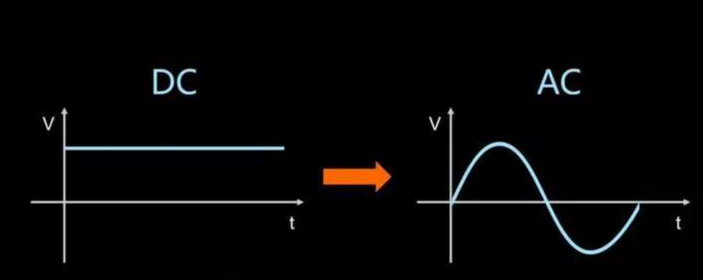
AC stands for Alternating Current. Its characteristic is that both the magnitude and direction of the current change periodically over time.
- Waveform: Most commonly a sine wave (like a smooth up‑down curve).
- Voltage: The "220V mains" we refer to is the RMS value of AC. In China, the frequency is 50Hz, meaning the current direction changes 100 times per second (50 complete cycles back and forth).
- Advantage: AC can be easily stepped up or down using transformers, making it very efficient for long‑distance transmission. That is why electrical grids use AC.
- Everyday example: Wall sockets, lights, refrigerators, air conditioners – all draw AC directly from the grid.
2. DC – Direct Current
DC stands for Direct Current. Its characteristic is that the direction of the current never changes (though the magnitude may vary).
- Waveform: Ideally a straight line (steady), or a smooth line with some ripple.
- Voltage: Common DC voltages are 1.5V (dry cell), 12V (car battery), 24V (industrial control), 300V (after rectification), etc.
- Advantage: DC is stable and clean. Electronic circuits require DC to operate. LED chips, microcontrollers, etc. cannot work directly on AC.
- Everyday example: Batteries, the output of a phone charger, USB power from a computer, electricity from a solar panel.
A simple analogy
- AC is like a two‑way road where vehicles (charges) move back and forth. Even though each vehicle only oscillates locally, large amounts of energy can be transferred.
- DC is like a one‑way street where vehicles keep moving in the same direction – the flow is steady and continuous.
Why can LED luminaires use either AC or DC?
An LED chip itself is a low‑voltage DC device. A single chip typically operates at 2‑4V; multiple chips can be connected in series/parallel to reach higher voltages. An LED only lights up with DC – if the polarity is reversed, it will not light (and may even be damaged).
Therefore:
- If the power source is AC (e.g., a 220V wall outlet), the luminaire must contain (or be paired with) a driver that converts AC to DC. Such products are called AC‑type LED luminaires.
- If the power source is DC (e.g., a battery, a DC power supply, or a solar panel), the luminaire only needs a simple current‑regulating circuit (or even just a resistor) to work. These are called DC‑type LED luminaires.
In essence, all LED lights work on DC. The distinction between AC and DC types is actually about the source of electricity and whether an internal AC‑DC converter is needed.
What "AC" and "DC" mean on an LED luminaire
AC‑type LED luminaire
- Label example: AC 100‑240V, 50/60Hz
- Internal construction: Contains a full AC‑DC switching power supply (driver) that converts AC to a constant DC current for the LEDs.
- Connection: Plugs directly into an AC wall socket or connects to an AC distribution panel.
- Typical products: Home ceiling lights, LED panels, T8 tubes (direct AC tubes), high‑bay lights, street lights, etc.
DC‑type LED luminaire
- Label example: DC 12V, DC 24V, DC 48V
- Internal construction: Usually only the LED board + current‑limiting resistors or a simple linear IC. No AC‑DC conversion stage.
- Connection: Requires an external DC power source (e.g., a switching power supply, a battery, a solar charge controller).
- Typical products: Low‑voltage LED strips (12V/24V), RV lights, solar street light heads, under‑cabinet lights, machine work lights.
Application scenarios – When to use AC and when to use DC?
With the above understanding, the application scenarios become very clear.
1. Typical scenarios for AC‑type LED luminaires
Residential and office lighting
Homes, offices, shops, schools, hospitals – these places already have AC wiring. Using AC luminaires is the most convenient and cost‑effective.
Large‑scale outdoor lighting
Street lighting, sports stadium floodlights, industrial high‑bay lighting – these have high power (tens to hundreds of watts) and long distances. AC supply reduces line losses and voltage drop.
Commercial basic lighting
Hotel corridors, subway stations, airports – use AC‑driven panels and downlights, which can be connected to building lighting circuits and centrally controlled.
High‑voltage LED strips and linear lights
When long continuous runs are required (e.g., architectural outline lighting), AC‑powered high‑voltage strips (usually 220V) can be connected in series for tens or even over one hundred meters without needing multiple power supplies.
2. Typical scenarios for DC‑type LED luminaires
Mobile / vehicle lighting (RVs, trucks, yachts, ships)
These applications use battery power (12V/24V DC). Using DC luminaires allows direct battery connection, avoiding inverter losses (saving 10‑15% of energy). Low voltage is also safer in confined spaces.
Solar and off‑grid lighting
Solar street lights, portable camping lights, off‑grid home lighting – solar panels charge a battery that outputs DC 12V/24V/48V. The luminaire must be DC‑type; otherwise an inverter would be needed, wasting energy.
Low‑voltage decorative and display lighting
Under‑cabinet lights, showcase lights, low‑voltage LED strips, magnetic lights – using DC 12V/24V provides safe‑to‑touch extra‑low voltage (SELV). Non‑professionals can install them safely, and the low heat output makes them suitable near combustible materials (e.g., wooden furniture).
Industrial and special‑purpose lighting
Machine tool interiors, crane cabins, wind turbine nacelles, hazardous areas – using DC 24V or 36V work lights reduces electric shock risk and avoids electromagnetic interference from AC that could affect sensitive equipment.
Emergency and backup lighting
Exit signs, emergency light heads – under normal power, the internal battery charges; when mains fails, the battery supplies DC low voltage to the LEDs. These luminaires are inherently DC‑type.
DC microgrids and zero‑carbon buildings
Some advanced projects (e.g., DC buildings, smart campuses) use a DC 380V bus. LED luminaires are designed as DC‑input, eliminating the traditional AC‑DC conversion stage. Overall system efficiency improves by 5‑8%, and integration with PV and storage becomes much simpler.

Common misconceptions and important notes
Misconception 1: AC lights are brighter than DC lights
Brightness is determined by power and efficacy, not by whether the supply is AC or DC. At the same power, they can be equally bright.
Misconception 2: DC lights are always more energy‑efficient
Not necessarily. If the source is AC mains, a DC luminaire requires an external switching power supply, which itself has conversion efficiency (typically 88‑94%). Adding line voltage drop, the overall efficiency may not be better than a good AC‑built‑in driver. The efficiency advantage of DC lamps appears only in battery/solar scenarios.
Misconception 3: An AC luminaire can be directly connected to a DC source
Never! The driver inside an AC luminaire is designed for AC input. Applying DC (e.g., feeding a 220V AC lamp with 220V DC) will likely destroy the driver and could cause fire. Conversely, a DC lamp must never be plugged into an AC socket – it will burn out.
Key points to remember
- Read the label – The luminaire label clearly states "AC" or "DC" and the rated voltage range.
- Wide voltage input is better
AC wide range: 90‑305V (handles grid fluctuations, generator supply)
DC wide range: 10‑30V (compatible with both 12V and 24V systems, handles battery charge/discharge variation)
- For low‑voltage DC, watch cable length – For a 12V system, if the supply cable exceeds 5‑8 metres, brightness will drop noticeably. Consider using 24V or 48V, or place the power supply close to the load.
- Safety certifications – Whether AC or DC, always choose products with recognised marks (CCC, CE, UL, etc.) to ensure electrical safety and lifetime.
One‑sentence summary
AC is the "standard fuel" supplied by the grid, suitable for most fixed‑location general lighting; DC is the "native language" of batteries, solar, and vehicle electrical systems, ideal for mobile, off‑grid, and low‑voltage safe applications.
Once you understand the nature of AC and DC, you can see through the specifications when choosing LED luminaires, select the correct power supply method, and achieve both safety and cost savings while improving system efficiency.
✨Contact✨
🙋♀️Harriet
📫Email: bwzm88@benweilighting.com
📞Whatsapp: +8613007285242