A Comprehensive Guide to Selecting the Best LED Bulb for Your Home: E27 vs. E14
Introduction: The Significance of Lamp Holder Type for LED Bulbs
The designations "E27" and "E14" are frequently used when replacing outdated incandescents, halogen lamps, or compact fluorescent lights (CFLs) with energy-efficient LED bulbs for your home. The type of lamp holder (or socket) that your bulb must fit into is indicated by these alphanumeric codes, which are not random; selecting the incorrect one will result in a frustrating mismatch between your new bulb and your existing fixture. Due to their dominance in household lighting in Europe, Asia, and many other places, E27 and E14 are the only socket types that most homeowners will ever need to take into account. However, how can you distinguish between them and choose which one is appropriate for your area? Everything you need to know is covered in this book, including easy, no-tool measurement tips and technical differences.
Let's start by emphasizing why switching to LED lights is worthwhile and why socket compatibility is a must. In almost every aspect, LEDs perform better than conventional lighting. They consume up to 80% less energy than incandescents, which lowers your electricity costs and lessens your carbon footprint. Compared to incandescents, which have a lifespan of only 1,000 hours, and halogens, which have a lifespan of 2,000 hours, they have an equally astounding longevity of 15,000 to 30,000 hours. This implies that an LED lightbulb purchased today might last for ten years or longer before needing to be replaced. However, if the bulb does not screw into your fixture, then none of these advantages are relevant. The first step in choosing a bulb is determining the type of lamp holder, which is simpler to do than you may think. All you need is a little knowledge and no fancy equipment.
Technical Comparison of E14 and E27 Socket Sizes and Applications
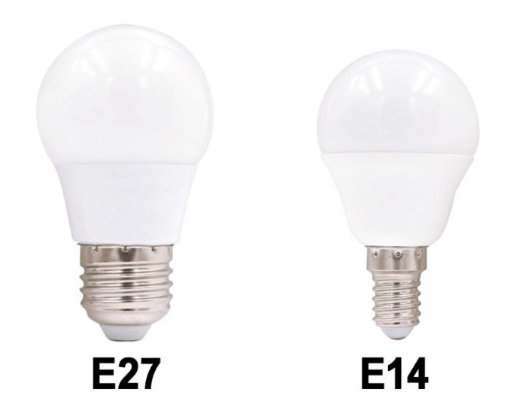
Thomas Edison's famous screw-in bulb design, which is now the industry standard, is referenced by the "E" in both codes, which stands for "Edison." The key is the following figure, which is the threaded base diameter of the socket in millimeters (mm). The primary distinction between the two categories is this straightforward measurement.
With a threaded base diameter of 14 mm, an E14 socket is the smaller of the two and is frequently referred to as a "small Edison screw" (SES) in some places. Because of its modest size, it is perfect for fixtures in spaces with limited space. Examples include wall sconces, under-cabinet lighting in kitchens, chandeliers with several tiny arms, and table lamps with delicate bases. It's also typical in ornamental fixtures where a larger socket would detract from the design, such as string lights or vintage pendant lamps.
In contrast, the E27 socket, also referred to as the "standard Edison screw" (SES) or "medium Edison screw" (MES), has a diameter of 27 mm. It is the most common form of home socket and may be found in almost all "everyday" fixtures, including porch lights, large table lamps, floor lamps, ceiling lights, and recessed lighting cans. Its greater size makes it more robust for frequent use in high-traffic areas like corridors and living rooms, and it can hold higher-wattage LEDs (though wattage is less important for LEDs than lumen output).
To put these proportions into perspective, an E27 socket is more like the width of a AAA battery piled on top of another, and an E14 socket is about the width of an AA battery. However, there are even easier methods to measure if you don't have a ruler on hand.
Not a Ruler? Three Easy Ways to Determine Your Socket Type
1. The Most Convenient Finger Test
You already have a measuring device in your fingers. An adult male's index finger is typically 15 mm wide, which is marginally bigger than an E14 socket's 14 mm width. When positioned side by side, the width of an adult's index and middle fingers is about 30 mm, which is extremely similar to that of an E27's 27 mm. To test, disconnect the fixture's electricity and place your index finger over the socket, which is where the lightbulb screws in. It's an E14 if your finger fits through the whole opening with some space left over. It's an E27 if you have to cover the socket with both your index and middle fingers side by side. A child's index finger might be closer to 14 mm, but two small fingers will still cover an E27, so make a small adjustment for women or smaller hands.
2. The Most Accurate Coin Test
Coins are ideal for rapid comparisons because of their uniform size. Hold a couple common coins up to the socket after grabbing them:
The diameter of a U.S. dollar coin is 26.5 mm, which is about the same as that of an E27. The coin is €27 if it fits precisely over the socket aperture.
The diameter of the U.S. penny (1 cent) is 19.05 mm. The E27 socket will be nearly the same size as the dollar coin, but the E14 socket will be substantially smaller than a penny. Despite being slightly larger than the E14's 14 mm, it's still a helpful reference.
The size of a 2-euro coin is 25.75 mm, which is near to E27, and a 1-euro coin is 23.25 mm, which is still larger than E14 and helps you tell the two apart.
3. The Most Reliable Old Bulb Test
The simplest way to replace an existing bulb is to examine it directly. The socket type is printed immediately on the base of the majority of LED, halogen, or incandescent bulbs (for example, "E14" or "E27" will be stamped close to the threads). Use a ruler to measure the width of the bulb's threaded base if there isn't a label: 14 mm = E14, 27 mm = E27. This approach removes any uncertainty, particularly in cases where you are uncertain about the coin or finger tests.
You may be tempted to use an E14-to-E27 or E27-to-E14 converter, which is a tiny threaded adaptor that allows you to fit a bulb into a mismatched socket, if you inadvertently purchase the incorrect bulb. Although technically functional, these converters are rarely advised. They give the fixture more heft, which can detract from the style of the lamp (particularly for old or delicate chandeliers). Additionally, they produce an additional connection point that may become loose with time, raising the possibility of inadequate electrical contact or even overheating. Purchasing the appropriate bulb for your socket is always preferable to using adapters for both safety and cosmetic reasons.
Last Checklist: Always Select the Correct Bulb
Take these easy steps to make sure your new LED bulb fits precisely and to prevent frustration:
1. Examine the Old Bulb: Check the base for the stamps "E14" or "E27." Purchase the matching bulb if you can.
2. Measure the Socket: If there isn't an old bulb, measure the threaded hole of the socket with a ruler (14 mm = E14, 27 mm = E27).
3. Apply a Fast Test: Not a ruler? Try the coin test (dollar coin = E27, penny = less than E14) or the finger test (one finger = E14, two = E27).
4. Examine the Fixture: E14 represents little, ornamental fixtures; E27 represents huge, daily fixtures.
5. Skip Converters: For safety and style, use the appropriate lightbulb rather than converters.
You won't ever confuse E14 with E27 again if you follow these tips. Making the switch to LED bulbs is simple and easy, and you can enjoy brighter, more efficient light without having to worry about mismatched parts. The first step to a well-lit, energy-efficient house is selecting the appropriate socket type, whether you're changing the kitchen ceiling light or updating your living room chandelier.
Shenzhen Benwei Lighting Technology Co., Ltd.
Telephone: +86 0755 27186329
Mobile (+86) 18673599565
WhatsApp: 19113306783
Email: bwzm15@benweilighting.com
Skype: benweilight88
Web: www.benweilight.com