Why Do Some Plants Thrive Under One Grow Light but Struggle Under Another?
Imagine two indoor growers starting with the same herb seedlings. Both provide water, nutrients and a suitable temperature. One grower places the plants under an ordinary household lamp; the other uses a dedicated LED grow light.
After several weeks, the growers may notice differences in leaf development, plant shape and overall growth. The reason is not simply that one lamp looks brighter. Plants respond to the wavelengths, intensity and duration of the light they receive.
This is where full-spectrum LED grow lighting becomes important.
Unlike lighting designed primarily to illuminate a room for human vision, horticultural lighting is selected to support plant processes such as photosynthesis and growth regulation. Red and blue wavelengths are especially relevant, but their proportions and the crop's requirements matter too.
For indoor gardeners, greenhouse operators and vertical farming projects, understanding the spectrum is a practical way to choose lighting more intelligently.
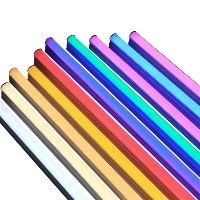
Benwei's T5 LED Grow Light Tube Full Spectrum Red Blue is one example of a tube-style grow light designed around red and blue wavelength bands. Rather than focusing on a long list of product specifications, let's explore the science behind these wavelengths and how growers can evaluate a lighting setup.

1. What Does "Full Spectrum" Mean in Plant Lighting?
When people hear "full spectrum," they often imagine a lamp that reproduces natural sunlight. In horticultural lighting, however, the term can be used differently by different manufacturers.
A broad-spectrum grow light may combine multiple wavelength bands to provide a wider distribution of light. A red-blue grow light concentrates its output in selected parts of the spectrum that are useful for plant growth.
The important point is to examine the actual spectral distribution rather than relying on the product label alone.
Photosynthetically active radiation, commonly called PAR, is conventionally defined as light in the wavelength range of 400–700 nanometers (nm). This range is widely used when discussing the light available for photosynthesis.
| Light characteristic | Wavelength or measurement | Why it matters |
|---|---|---|
| Blue light | Approximately 400–500 nm | Influences photosynthesis, leaf development and plant form |
| Green light | Approximately 500–600 nm | Can contribute to photosynthesis, including light penetration into plant canopies |
| Red light | Approximately 600–700 nm | Contributes strongly to photosynthesis and can influence flowering responses |
| PAR range | 400–700 nm | Standard wavelength range used in many plant-light measurements |
| Far-red light | Approximately 700–750 nm | Can influence shade responses, plant architecture and flowering in some species |
These are general horticultural wavelength ranges, not a measured spectral report for the Benwei product.
Oklahoma State University Extension explains that different LED wavelengths can be selected to support particular plant responses, while the Agriculture and Horticulture Development Board (AHDB) emphasizes that there is no single ideal spectrum for every crop. The right choice depends on the intended growth response and production system.

2. Why Are Red and Blue Light So Important?
Blue light: Supporting leaves and plant structure
Blue light is often associated with vegetative growth. It contributes to photosynthesis and influences how plants develop their leaves, stems and overall shape.
Depending on the species, intensity and growing conditions, blue light can help produce more compact growth and influence leaf characteristics. However, more blue light is not automatically better. The appropriate amount depends on the crop and the objective.
For example, a grower producing compact herb seedlings may prioritize different plant characteristics from a grower cultivating a flowering ornamental plant.
Red light: Supporting photosynthesis and flowering responses
Red light is absorbed efficiently by photosynthetic pigments and can make a substantial contribution to photosynthesis. Certain red wavelengths, including those around 660 nm, are commonly used in horticultural LED systems.
Red light can also influence flowering and development, but its effect depends on the plant species, photoperiod and the rest of the spectrum. Red light alone should not be treated as a universal solution for every crop.
Why the balance matters
A grow light is not defined by one wavelength in isolation. Plants respond to the combined spectrum, the quantity of light reaching the leaves and the duration of exposure.
Research comparing different LED spectra has found that plant responses can differ depending on the crop and the spectral treatment. For a scientific example, see the open-access study, "Spectral effects of light-emitting diodes on plant growth, visual color quality, and photosynthetic photon efficacy: White versus blue plus red radiation".
The practical takeaway is simple: select a spectrum based on the plants you want to grow, rather than assuming that a red-blue combination or a product labeled "full spectrum" will produce the same results for every species.
3. How Can You Measure Whether a Grow Light Provides Enough Light?
A grow light can have an appropriate spectrum but still provide too little or too much light at the plant canopy. This is why horticultural lighting uses measurements beyond ordinary brightness ratings.
Three useful terms are PPF, PPFD and DLI.
| Metric | Full name | What it tells you |
|---|---|---|
| PPF | Photosynthetic Photon Flux | The total amount of photosynthetically active photons emitted by a light source per second; unit: µmol/s |
| PPFD | Photosynthetic Photon Flux Density | The number of photosynthetic photons reaching a surface each second; unit: µmol/m²/s |
| DLI | Daily Light Integral | The total photosynthetic light received per square metre over a day; unit: mol/m²/day |
PPF describes the light output of the fixture, while PPFD describes the light arriving at a particular point on the growing surface. DLI adds the time dimension by accounting for how long that light is delivered.
This distinction is important because the same fixture can deliver different PPFD values at different distances, across different shelf positions or beneath different parts of a plant canopy.
A numerical example: How does daily lighting time change DLI?
DLI can be calculated from PPFD and the number of hours the light is on:
DLI = PPFD × lighting hours × 3,600 ÷ 1,000,000
The table below uses three illustrative PPFD values and three daily lighting periods to show how DLI changes. These are calculation examples, not measurements of the Benwei tube.
| PPFD at canopy | 12 hours/day | 14 hours/day | 16 hours/day |
|---|---|---|---|
| 100 µmol/m²/s | 4.32 mol/m²/day | 5.04 mol/m²/day | 5.76 mol/m²/day |
| 200 µmol/m²/s | 8.64 mol/m²/day | 10.08 mol/m²/day | 11.52 mol/m²/day |
| 300 µmol/m²/s | 12.96 mol/m²/day | 15.12 mol/m²/day | 17.28 mol/m²/day |
Source of numbers: calculations using the formula above. PPFD values are illustrative, not product specifications or recommendations for every crop.
The table demonstrates that increasing daily lighting time increases DLI when PPFD remains constant. But longer lighting is not always the right answer: plants differ in their light requirements and their responses to day length, and many need a dark period.
Before choosing the number of tubes or setting a timer, determine the target DLI for the crop and measure the PPFD at canopy level where possible.
For more information about horticultural light measurements, see Oklahoma State University Extension.
4. Does a Red-Blue Grow Light Work for Every Growth Stage?
A seedling, a leafy herb and a flowering plant do not necessarily need the same lighting conditions throughout their life cycles.
A red-blue grow light can be useful in controlled indoor growing, but the appropriate spectrum and light intensity depend on the crop and its stage of development.
| Growing objective | Lighting considerations | What to monitor |
|---|---|---|
| Seedling establishment | Avoid excessive intensity; provide a suitable spectrum for the species | Seedling shape, leaf condition and PPFD |
| Leafy growth | Balance light quantity with the crop's vegetative requirements | Leaf development, canopy coverage and DLI |
| Flowering | Consider species-specific flowering responses and photoperiod | Flower initiation, day length and plant health |
| Multi-shelf growing | Maintain suitable and reasonably consistent light across each shelf | PPFD at multiple positions and shading |
This table is a practical planning guide rather than a universal crop prescription. Different plant species can respond differently to the same lighting conditions.
For example, leafy greens grown for rapid leaf production may require a different DLI from shade-tolerant houseplants. Flowering plants may also respond to day length in ways that cannot be addressed simply by increasing red-light intensity.
A useful lighting plan therefore combines spectrum, intensity and timing rather than relying on a single feature.
5. Why Is Light Distribution Important in Indoor Growing?
Imagine a growing shelf with several trays of seedlings. Plants directly beneath a tube receive one level of light, while those near the edges may receive less. As the plants grow taller, the distance between the light source and different parts of the canopy may change.
This can create uneven growth even when every plant receives the same number of hours of lighting.
To improve consistency:
Position the fixtures according to the manufacturer's installation guidance.
Measure PPFD at several points across the growing area rather than at one central point.
Consider the distance between the lamp and the canopy.
Recheck the arrangement as the plants grow.
Avoid assuming that connecting more fixtures automatically guarantees uniform light.
Tube-style grow lights can be practical for narrow shelves, plant racks, seedlings and other linear growing areas. Their usefulness still depends on the light output, spacing, mounting height and coverage needed by the crop.
The Benwei T5 model is described on its product page as a linkable red-blue grow light tube intended for applications including seedlings, succulents, herbs and vegetables. Its product-specific output should be confirmed from the latest technical documentation before designing a larger growing installation.

6. How Can You Estimate the Electricity Used by Grow Lights?
Spectrum helps determine how light is distributed across wavelengths, but growers also need to plan operating costs.
Electrical energy consumption can be estimated from the fixture's rated input power and daily operating time:
Energy consumption (kWh) = power (W) × operating hours ÷ 1,000
For a clear example, consider a hypothetical 20W LED grow light. This is an illustrative rating, not a claim about the wattage of the specific Benwei T5 product.
| Daily operating time | Energy per day for one 20W light | Energy over 30 days |
|---|---|---|
| 8 hours | 0.16 kWh | 4.8 kWh |
| 12 hours | 0.24 kWh | 7.2 kWh |
| 14 hours | 0.28 kWh | 8.4 kWh |
| 16 hours | 0.32 kWh | 9.6 kWh |
Assumption: one 20W fixture operating at its rated input power every day for 30 days. Actual consumption depends on the actual product and operating conditions.
For multiple fixtures, multiply the energy use per fixture by the number of units. To estimate the electricity cost, multiply total kWh by the electricity rate charged by the utility.
This calculation helps growers compare possible operating schedules, but lighting time should still be selected according to crop requirements. Reducing the hours solely to lower energy costs may compromise plant performance if the daily light target is no longer met.
7. What Should You Check Before Choosing a Full-Spectrum LED Grow Tube?
Before purchasing a grow light for a home garden, nursery, greenhouse or commercial growing rack, consider the following points.
Spectrum: Request a spectral power distribution (SPD) chart where available. It helps clarify which wavelengths the fixture emits and how their relative output is distributed.
Light output: Look for PPF and efficacy data where available. PPFD measurements at the intended mounting height are especially useful when planning coverage.
Crop requirements: Identify the plant species, growth stage, target DLI and photoperiod before deciding on fixture quantity and spacing.
Installation: Check the tube's dimensions, mounting method, electrical input and compatibility with the intended installation.
Heat management: Consider the operating environment and allow suitable heat dissipation. High ambient temperatures can shorten LED life and reduce performance.
Expandable layout: If you intend to connect several fixtures, follow the manufacturer's stated connection limit and electrical instructions. Do not assume that every linkable fixture supports the same number of connected units.
The Benwei T5 LED Grow Light Tube Full Spectrum Red Blue is presented as a slim, linkable tube-style option for indoor growing. The product page identifies blue and red wavelength ranges and describes applications for seedlings, herbs, vegetables and flowering plants. For a commercial project, request the exact model's wattage, PPF, efficacy, spectral chart and photometric information rather than estimating these values from the product name.
Summary: Is a Red-Blue Full-Spectrum LED Grow Light Right for Your Plants?
Choosing a grow light starts with understanding what the plant needs-not simply how bright the lamp appears or whether its marketing uses the term "full spectrum."
Red and blue wavelengths can make important contributions to photosynthesis and plant development. However, the best lighting setup also depends on spectral balance, PPFD at canopy level, daily light integral, photoperiod and the specific crop being cultivated.
A data-based approach makes it easier to plan fixture spacing, lighting schedules and electricity use. It also helps distinguish measured product performance from general horticultural principles.
Planning an indoor growing or horticultural lighting project? Contact Benwei with your plant type, growing area, daily lighting schedule and installation requirements. Our team can help you identify suitable LED grow light options and prepare a quotation for your project.
Contact Benwei about LED grow lights