What Spectral Requirements Balance Preservation and Presentation in Museum Lighting?
Table of Contents
The Curator's Dilemma: Preservation vs. Presentation
Understanding Spectral Power Distribution in Museum Environments
The Preservation Challenge: Controlling Light-Induced Damage
The Presentation Goal: Achieving High Color Rendering and Authenticity
Balancing the Two: Engineering Spectral Requirements
Regulatory Standards and Best Practices for Museum Lighting
Conclusion: Future-Proofing Your Gallery Lighting
The Curator's Dilemma: Preservation vs. Presentation
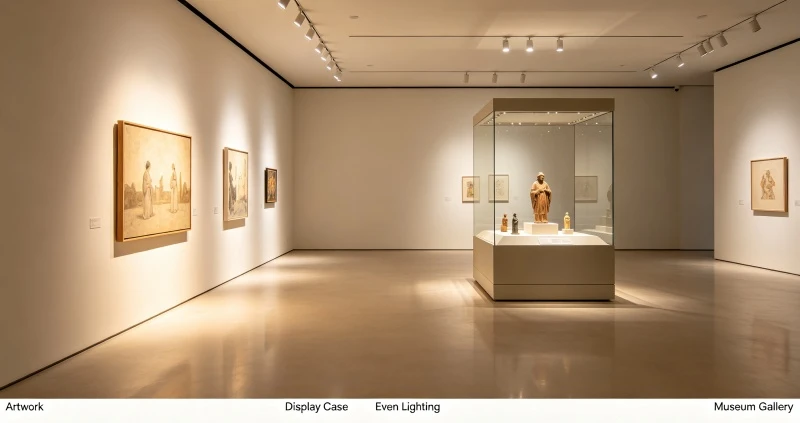
Museum lighting has to achieve two objectives that can appear to conflict: it must protect sensitive collections while presenting objects with accurate, engaging color.
A textile, watercolor, manuscript, photograph, or painted surface may fade gradually under excessive light exposure. At the same time, insufficient or poorly balanced illumination can make the same object appear dull, distorted, or visually disconnected from its original character.
This is why spectral requirements for museum lighting cannot be reduced to color temperature or brightness alone. A successful lighting plan considers:
The object's material sensitivity
The total amount of light exposure
The spectral power distribution of the source
Color rendering and visual authenticity
Heat management
Viewing distance, beam angle, and glare
The gallery's operating schedule and exhibition objectives
In practice, lighting designers must often reconcile the priorities of curators, conservators, architects, educators, and visitors. The best solution is rarely the brightest fixture or the highest CRI rating. It is a controlled system that delivers the right spectrum and intensity for each collection area.
For project-specific guidance, consider working with Benwei that can assess the collection, gallery architecture, and exhibition requirements together.
Key principle: Museum lighting should be designed around the sensitivity and visual needs of the objects-not around a fixture specification in isolation.
Understanding Spectral Power Distribution in Museum Environments
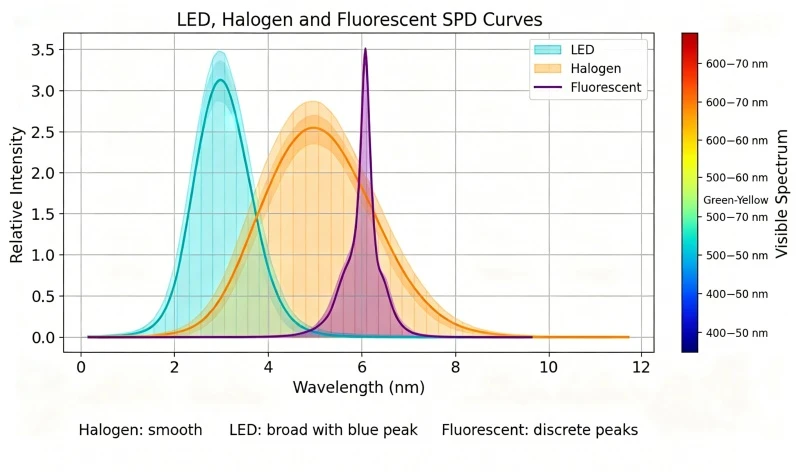
Spectral Power Distribution (SPD) describes how much radiant power a light source emits at different wavelengths. Rather than treating light as a single value, an SPD curve shows the composition of the light across ultraviolet, visible, and infrared ranges.
This matters because two light sources with the same color temperature and illuminance can interact with museum objects differently. Their energy may be distributed differently across the spectrum, affecting both material aging and perceived color.
The main spectral regions
| Wavelength range | Primary preservation consideration |
Presentation consideration |
|---|---|---|
| Ultraviolet, below approximately 400 nm | UV radiation can contribute to photochemical degradation and is generally minimized in exhibition lighting. | Usually provides little useful visible color information. |
| Visible light, approximately 400–700 nm | Visible energy still contributes to cumulative exposure and fading, depending on the material. | Provides the visual information needed to perceive hue, saturation, detail, and contrast. |
| Infrared, above approximately 700 nm | Near-infrared energy can contribute to thermal load, particularly when heat reaches the object or enclosure. | Usually has limited direct value for normal color perception. |
The boundaries in this table are practical engineering references rather than absolute divisions. The effect of light depends on the object's composition, exposure time, intensity, environment, and existing condition.
Why SPD is more useful than color temperature alone
Correlated color temperature, or CCT, describes whether light appears visually warm or cool. It does not explain the complete spectral output of a fixture.
For example, two sources may both be described as 3000 K but have different spectral peaks and gaps. One may render reds, blues, or skin tones more naturally than the other. Another may produce stronger energy in wavelengths that a conservator would prefer to limit.
When reviewing a fixture, museum teams should request:
SPD data
CCT
Illuminance range
Color rendering metrics
UV emissions or filtering information
Thermal characteristics
Dimming performance
Beam distribution and optical accessories
The cie.co.at provides internationally recognized terminology and recommendations related to color, light, and photometry. Its resources can help project teams distinguish between visual appearance, measured light, and spectral behavior.
The Preservation Challenge: Controlling Light-Induced Damage
Light damage is cumulative. Once certain forms of fading or material deterioration occur, they may not be reversible. This makes exposure management a central part of museum lighting standards and conservation planning.
The risk is not determined by brightness alone. A useful starting point is to consider the interaction of:
Spectral sensitivity
Illuminance at the object
Duration of exposure
Frequency of display
Material condition
Environmental factors such as temperature and humidity
Photochemical damage and cumulative exposure
Light-sensitive objects can experience photochemical change when exposed to sufficient radiant energy over time. Organic dyes, pigments, paper fibers, and certain textiles may be especially vulnerable.
Many institutions therefore manage exposure using a combination of illuminance and time, often expressed as lux-hours. A lower illuminance level over a longer exhibition period can create a similar cumulative exposure to a higher level over a shorter period.
This means that a conservation plan should consider both:
The light level during each viewing period
The total annual or exhibition-cycle exposure
A lighting system with precise dimming and scheduling can help museums manage this exposure more effectively than a system that simply operates at one fixed output.
The role of UV and infrared
UV emissions are commonly minimized because ultraviolet radiation can contribute to photochemical damage without offering meaningful benefits for ordinary visual presentation.
Infrared and other longer wavelengths require a different approach. The main concern is often heat, especially when fixtures are positioned close to cases or objects. Excess heat can affect the object, case microclimate, adhesives, coatings, or surrounding materials.
Well-designed museum LED lighting preservation strategies typically include:
Minimal or controlled UV output
Adequate thermal management
Remote or carefully positioned fixtures
Accurate dimming and zoning
Timed operation
Appropriate beam control
Regular measurement at the object plane
Practical conservation questions
Before selecting a luminaire, the project team should ask:
How light-sensitive is the object?
Is the object already faded or structurally fragile?
What illuminance level is appropriate for the material?
How long will the object be displayed?
Can the lighting be reduced when the gallery is closed?
Does the fixture introduce unnecessary UV or heat?
Can the system be reprogrammed for future exhibitions?
The getty.edu provides valuable conservation research and resources concerning the effects of light and environmental conditions on cultural heritage materials.
For projects requiring controlled output, explore Benwei designed for precision, dimming, and collection-sensitive applications.
The Presentation Goal: Achieving High Color Rendering and Authenticity
Preservation is only half of the design problem. Visitors also need to see objects clearly and experience colors that are faithful to the artist's, maker's, or culture's original intent.
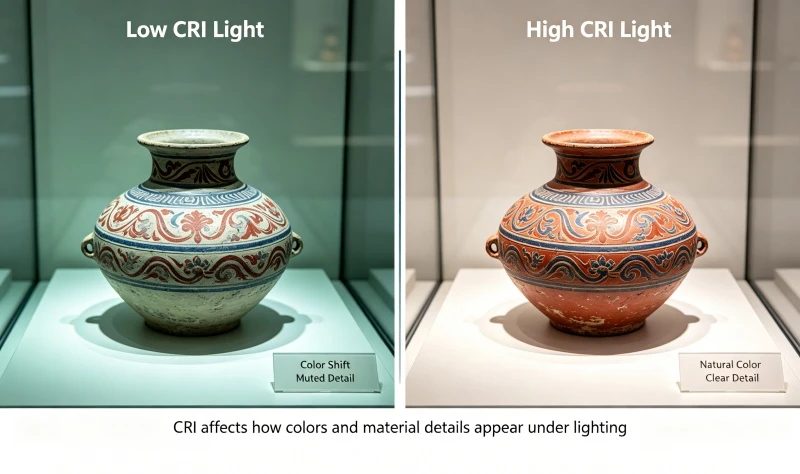
This is where color rendering becomes important. However, a single CRI value should not be treated as a complete measure of visual quality.
CRI and its limitations
The color rendering index, or CRI, is widely used to describe how a light source reproduces selected reference colors compared with a reference illuminant.
A high CRI value generally can be useful, but it may not reveal how a source handles every color family. Two fixtures with similar Ra values may produce noticeably different results with:
Deep reds
Saturated blues
Green textiles
Skin tones
Metallic surfaces
Low-saturation historical pigments
CRI also does not fully describe color saturation, hue shifts, or the consistency of color appearance across a collection.
CRI vs. TM-30 for museums
TM-30 provides a more detailed framework for evaluating color rendition. Common TM-30 metrics include:
Rf: Fidelity index, describing how closely colors are reproduced relative to a reference.
Rg: Gamut index, indicating the average increase or decrease in colorfulness.
Color Vector Graphic: A visual representation of hue-specific shifts.
Color evaluation samples: A broader sample set than the traditional CRI approach.
The relationship between CRI and TM-30 for museums is not a matter of replacing one number with another. Rather, TM-30 can provide additional information when the appearance of specific colors matters.
| Metric | What it describes |
Relevance to museum lighting |
|---|---|---|
| CRI Ra | General color rendering based on a traditional reference set | Useful as an initial specification, but insufficient on its own for complex collections |
| R9 | Rendering of a saturated red sample | Helpful when evaluating artworks, textiles, skin tones, and warm-colored objects |
| TM-30 Rf | Color fidelity across a broader sample set | Helps identify how accurately a source reproduces colors overall |
| TM-30 Rg | Average color gamut or perceived colorfulness | Helps reveal whether colors may appear muted or excessively saturated |
| Color Vector Graphic | Hue-specific color shifts | Useful for identifying problems affecting particular color families |
How to choose museum lighting for visual authenticity
When deciding how to choose museum lighting, do not start with CRI alone. Instead, review the intended collection and request sample evaluations.
A practical assessment may include:
Viewing representative objects under the proposed light source.
Comparing the source with an approved reference condition.
Reviewing Rf, Rg, and relevant color vector data.
Checking saturated red performance and other collection-critical hues.
Confirming that the visual improvement does not require excessive illuminance.
Testing glare, reflections, shadows, and viewing comfort.
High color quality is most valuable when it supports the object's interpretation without encouraging unnecessary brightness.
Balancing the Two: Engineering Spectral Requirements
The most effective spectral requirements for museum lighting are developed through a coordinated process rather than selected from a generic product catalog.
A lighting designer may tune the source, optics, intensity, and control system to remove unnecessary spectral output while preserving the colors visitors need to see.
A practical design workflow
1. Classify the collection
Begin by identifying the materials and their relative sensitivity. A gallery containing oil paintings may require a different approach from one displaying historic textiles, watercolors, manuscripts, or mixed-media installations.
The collection assessment should also record:
Existing damage
Display duration
Object orientation
Surface reflectance
Glazing or case materials
Required viewing distance
Interpretation and accessibility needs
2. Define the visual priorities
Not every gallery needs the same visual target. The design brief should clarify whether the priority is:
Accurate color reproduction
Texture and surface detail
Dramatic contrast
Uniform illumination
Low-glare viewing
Flexible lighting for rotating exhibitions
This prevents the project from using a single specification for every object.
3. Review the full SPD
Ask the manufacturer or lighting supplier for measured spectral data-not only marketing claims. Examine whether the fixture has excessive energy in UV or unwanted heat-producing regions, and whether its visible output supports the collection's color requirements.
4. Set illuminance and exposure controls
Spectral selection should be paired with appropriate illuminance limits, dimming, occupancy controls, and exhibition schedules. A carefully selected spectrum cannot compensate for excessive exposure time or poor control.
5. Test at the object plane
Measurements should be taken where the light reaches the object, not only at the fixture. This confirms actual illuminance, uniformity, glare, and color behavior in the installed environment.
6. Validate with conservators and stakeholders
A final review should include the conservator, curator, lighting designer, facilities team, and-where appropriate-accessibility representatives. Technical results and human visual experience both matter.
Example project scenario
Consider a gallery displaying a mixed collection of paintings and dyed textiles. The museum wants stronger color differentiation but cannot increase exposure substantially.
A balanced approach could include:
A low-UV LED source with documented SPD
Tunable or carefully selected spectral output
High-quality red and blue rendering
Adjustable beam angles to reduce spill
Dimming by display zone
Scheduled operation during visitor hours
Lux monitoring at sensitive objects
A review after installation using representative artworks
The result should not be described simply as "brighter." A successful outcome is better visual discrimination at a controlled exposure level.
Important: Any parameter recommendations should be validated against the collection's conservation assessment and the requirements of the responsible museum professionals.
Regulatory Standards and Best Practices for Museum Lighting
Museum lighting standards are not usually represented by one universal number for every object and exhibition. Requirements vary according to material sensitivity, institutional policy, regional guidance, and the conservation assessment.
However, several categories of guidance should inform the design process.
Relevant standards and professional resources
CIE recommendations: Useful for terminology, photometry, colorimetry, and lighting principles.
IES resources: Relevant to professional lighting practice, visual environments, measurement, and design methods.
Conservation institutions: Organizations such as the Getty Conservation Institute publish research and educational resources concerning light damage and cultural heritage.
Institutional conservation policies: Museums often maintain their own object-specific illuminance and exposure limits.
Local building and electrical requirements: These may affect emergency lighting, controls, wiring, accessibility, and installation.
The ies.org is a useful professional reference for lighting practice and technical guidance. Project teams should verify the applicable edition of any standard and confirm whether it is legally required, advisory, or used as an industry benchmark.
Best-practice checklist
Before approving a museum lighting system, confirm that it can:
Provide measured SPD data
Manage heat near sensitive objects
Deliver appropriate color quality
Support accurate dimming
Maintain stable performance over time
Provide zoning and scheduling
Be measured and commissioned after installation
Adapt to future exhibitions
Integrate with the museum's conservation policy
Commissioning and documentation
Documentation is part of trustworthiness. The final project file should ideally include:
Fixture specifications
SPD and color data
Illuminance measurements
Control settings
Dimming scenes
Maintenance instructions
Warranty information
Commissioning records
Recommended review intervals
A documented system allows future staff to understand why the lighting was configured in a particular way and how changes may affect preservation.
Conclusion: Future-Proofing Your Gallery Lighting
The right museum lighting solution balances visual authenticity with responsible collection care. That balance depends on more than CRI, CCT, or fixture wattage. It requires attention to spectral power distribution, material sensitivity, illuminance, exposure time, thermal behavior, color quality, and control flexibility.
A reliable process should:
Assess the collection and identify sensitive materials.
Review the complete SPD and color performance data.
Set exposure levels with conservators and curators.
Test the system at the object plane.
Document the design for future exhibitions.
Choose equipment and partners that can support long-term adjustment.
The most effective lighting system is one that protects the collection while making the visitor experience more accurate, comfortable, and meaningful.
If you are planning a new gallery, updating an exhibition, or reviewing an existing system,pls contact benweilight and discuss a lighting approach tailored to your collection, architecture, and operational goals.
Our High CRI Product