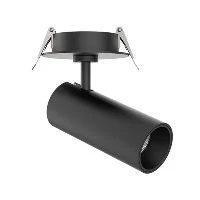
Those working in commercial or residential lighting have likely encountered this scenario: two track lights, both rated at 20W, are aimed at the same wall. One produces a clean, crisp, and luminous beam, while the other has a blurred, "fuzzy" edge and a noticeable "grainy" texture in the center. Many clients often ask, "Are COB lights brighter?"
Strictly speaking, "brightness" and "beam quality" (smoothness) are two different things, though both are determined by the structure of the light source. This article avoids abstract theory; instead, it breaks down the practical differences between COB and SMD track lights, providing you with a solid basis for product selection or for explaining these concepts to your clients.
Structural Differences: COB vs. SMD
Understanding the basics makes it easier to grasp the subsequent differences.
SMD (Surface-Mounted Device): Individual LED chips are packaged as separate, small light-emitting units and then soldered onto an aluminum-based circuit board. In a track light, these units are typically arranged in an array, where each unit acts as an independent point source.
COB (Chip-on-Board): Multiple LED chips are mounted directly onto a substrate and covered with a layer of phosphor-infused resin, creating a single, continuous, circular light-emitting surface.
In short, SMD consists of "many small point sources," while COB functions as "a single, unified surface source." All other differences stem from this fundamental distinction.
Why COB Produces a Cleaner, Smoother Beam
Track lights almost always utilize reflectors or lenses to control the light beam; the physical form of the light source directly influences the final beam pattern.
Multi-point sources often cause "ghosting": Because SMD chips are distributed across a surface, each chip interacts with the reflector or lens to create its own individual light-and-shadow pattern. When these overlap, it can result in multiple shadows, blurred edges, or even a visible, grainy texture of the individual chips within the beam.
COB acts more like a single, unified light source: With a continuous and concentrated light-emitting surface, the reflector or lens only needs to manage one source. This results in sharper beam edges and a more natural, seamless transition. This is even more apparent on walls and exhibits: when light from a COB source hits a white wall, a garment, or a display case, there is no visible "graininess" in the light spot-a quality often described as "smooth light."
The Real Reason It "Looks Brighter"
To be frank, given the same power and similar luminous efficacy, the total luminous flux of a COB source and an SMD source may not differ significantly. The human eye perceives COB as brighter primarily due to the following two factors:
Higher central luminous intensity: Because the light-emitting surface of a COB source is small and concentrated, optical systems can more effectively focus the light onto a target area. With the same number of lumens concentrated into a narrower angle, the brightness (measured in candelas, or cd) at the illuminated spot is naturally higher.
Higher optical efficiency: With SMD sources-which consist of multiple, spatially distributed points-some light is difficult for a reflector to capture effectively, leading to stray light in unwanted areas. COB light, by contrast, can be projected with greater precision.
Therefore, it is more accurate to say that COB provides higher *effective* illumination brightness, rather than simply having a higher lumen count on a spec sheet. When selecting products, we advise clients to consider lumens, beam angle, and central luminous intensity-rather than focusing solely on wattage.
The Impact of Heat Dissipation on Brightness Stability
Track light heads are compact, offering limited space for heat dissipation. If the LED junction temperature rises, brightness will decline, and the color may shift.
In a COB design, the chip is mounted directly onto a substrate, resulting in a shorter thermal conduction path. This eliminates several thermal resistance points found in the typical SMD structure (where heat must travel through the chip, the package frame, the solder joints, and finally the substrate).
In a compact light head, this structure facilitates the rapid transfer of heat to the aluminum heat sink.
As a result, brightness and color temperature remain more stable during prolonged operation, avoiding the common issue where a light starts off bright but dims after half an hour.
Of course, overall thermal performance still depends on the design of the fixture's heat sink and the quality of the LED driver; COB simply offers an inherent advantage at the light-source level.
Color Rendering Index (CRI) and Color Consistency
This is a critical consideration for clients in sectors such as jewelry, apparel, food and beverage, and museum or gallery exhibitions. COB (Chip-on-Board) solutions make it easier to achieve a CRI (Color Rendering Index) of 90 or higher. They also offer more stable performance in the red spectrum (R9), ensuring that the colors of illuminated objects appear more authentic.
Because the phosphor coating is applied across the entire surface, COB modules exhibit excellent color temperature consistency-both within a single unit and across different lighting fixtures.
In contrast, SMD (Surface-Mounted Device) LEDs are binned individually before being assembled. If the binning process is not sufficiently rigorous, subtle color temperature variations can occur-either within a single fixture or between different units-which may become noticeable when the lights are arranged across a large wall surface.
Glare and Visual Comfort
With multiple discrete SMD LEDs, the human eye perceives individual, intense points of light when viewed from the side, resulting in significant glare.
COB technology provides a uniform, continuous light-emitting surface with a more even distribution of brightness. When combined with a "deep-recessed" design-where the light source is set back within the fixture housing-the output becomes visually softer, preventing eye strain even during prolonged exposure.
This is a highly practical advantage for retail stores, hotels, and office spaces-environments where people tend to spend extended periods of time.
Where Are SMD Track Lights Best Used?
This is not to say that SMD technology is inferior; it certainly has its own appropriate applications.
Cost-sensitive projects: SMD solutions are mature and supported by an extensive supply chain, offering excellent value for low-wattage applications with limited budgets.
General flood lighting with less stringent requirements for beam precision: For basic ambient lighting or wide-angle wall washing, the "cleanliness" of the light beam is less critical.
Scenarios requiring flexible configuration: SMD arrays allow for easier implementation of specific color temperatures or multi-color combinations.
However, for projects focused on accent lighting or display illumination, the advantages of COB technology-specifically regarding beam quality and visual experience-become much more apparent.
Summary
The reason COB track lights appear "brighter and smoother" can be attributed to four key factors:
A surface-light-source structure ensures clean-edged light spots, free from "ghosting" or a granular appearance.
A concentrated light-emitting surface enhances the efficiency of the optical system, resulting in greater brightness at the illuminated point.
A shorter thermal conduction path ensures superior stability in both brightness and color temperature.
Improved color rendering and color consistency, combined with reduced glare, create a more comfortable overall visual experience.
While SMD technology remains a viable option, COB is generally the preferred choice for accent lighting, displays, and high-end interior spaces.
Interested in learning more or customizing a track lighting solution?
We offer a wide range of COB track lights with various power ratings, beam angles, color temperatures, and color rendering indices (CRI). We support OEM/ODM customization and can recommend the ideal models based on your specific project requirements. If you are currently selecting lighting products-or would like to request samples to compare the actual light output of COB versus SMD-please reach out to our team. Simply let us know your application scenario and the required quantity, and we will provide a prompt response and a formal quote.
https://www.benweilight.com/industrial-lighting/adjustable-led-cob-surface-mount-spotlight.html