If you have ever planned an outdoor Halloween event or run a bar with a terrace, you may have noticed something counterintuitive: the brighter you make the venue, the harder it becomes to create atmosphere. White floodlights illuminate every face clearly, but they also chase away "the night" itself. What really makes fluorescent paint, glow decorations, body paint, and stage costumes "pop" is not higher brightness, but a wavelength that is almost invisible to the naked eye yet causes specific materials to glow intensely - 365nm or 395nm UVA ultraviolet light.
This explains why outdoor UV floodlights have been growing faster than ordinary floodlights in event planning and hospitality settings in recent years. They solve not a "lighting" problem, but a problem of the underlying physical conditions for atmosphere.
1. Why Ordinary Floodlights Completely Fail in "Blacklight Scenes"
Start with a frequently overlooked data point: the global LED floodlight market was valued at about USD 9.4 billion in 2025 and is expected to reach USD 20.1 billion by 2034, with a CAGR of 8.52% from 2026 to 2034. One of the main growth drivers is that LEDs do not emit ultraviolet or infrared radiation, which is an advantage for everyday lighting. But conversely, when your scene specifically needs ultraviolet light to excite fluorescent materials, a standard white or warm-white LED floodlight is completely useless.
The growth rate of the UV LED market makes the point even clearer: the global UV LED market was about USD 1.95 billion in 2025 and is expected to reach USD 9.31 billion by 2034, with a CAGR of 18.97% from 2026 to 2034. The more narrowly defined industrial blacklight fixtures segment is also expanding steadily, from about USD 305 million in 2025 to an estimated USD 397 million by 2031, at a CAGR of 4.5%. These numbers all point to the same thing: UV light is spilling over from industrial inspection and curing applications into events, entertainment, and outdoor atmospheric lighting.
| Market segment | 2025 size | Longer-term forecast | CAGR | Implication for UV floodlight procurement |
|---|---|---|---|---|
| Global LED floodlights overall | About USD 9.4 billion | About USD 20.1 billion by 2034 | 8.52% (2026–2034) | The floodlight category itself is expanding, and the LED replacement logic remains solid |
| Global UV LED | About USD 1.95 billion | About USD 9.31 billion by 2034 | 18.97% (2026–2034) | UV LED is one of the fastest-growing sub-segments within floodlights |
| Industrial blacklight fixtures | About USD 305 million | About USD 397 million by 2031 | 4.5% (2025–2031) | The "tool" nature of blacklights is mature; event scenes are an incremental outlet |
Data sources: IMARC Group (LED floodlights), Straits Research (UV LED), LP Information (blacklight fixtures).
2. 365nm vs. 395nm: Choose the Wrong Wavelength and Fluorescent Effects Are Cut in Half
This is the most common pitfall in outdoor UV floodlight procurement. Both 365nm and 395nm can make fluorescent materials glow, but they work in completely different ways.
365nm has very little visible violet content, and the beam is almost "invisible." Its energy is concentrated in the ultraviolet band, and fluorescent excitation efficiency is higher. It is suitable for scenes that need "only fluorescent objects glowing while the environment stays dark": blacklight art exhibitions, body painting, fluorescent graffiti walls, and events that need to preserve dark-area atmosphere in photography and video. 395nm carries a portion of visible deep-purple light; the beam itself is visible and can create that classic "purple light column through smoke" stage effect. It is suitable for Halloween yard sets, nightclub dance floor edges, and occasions where the audience needs to "see where the light comes from."
| Wavelength option | Visible violet proportion | Fluorescent excitation characteristics | Best-suited scenes | Less-suited scenes |
|---|---|---|---|---|
| 365nm | Very low; beam is nearly invisible | Higher fluorescent efficiency; cleaner dark field | Blacklight art exhibitions, body-paint photography, fluorescent graffiti | Stages that need a purple beam for visual impact |
| 395nm | Higher; deep-purple beam is visible | Slightly weaker fluorescent effect, but the light path itself becomes an atmospheric element | Halloween yards, dance floor edges, stages with beams through smoke | Fluorescent photography that demands a very clean dark field |
Regarding safety, both 365nm and 395nm belong to the UVA band (315–400nm). Under normal use conditions, UVA blacklights are generally harmless to the eyes and skin, provided you do not look directly into the lamp. This is fundamentally different from UVB and UVC - the latter two are the bands that require strict protection.
3. The Real Weight of IP66: Not "Waterproofing," but "the Event Not Being Canceled by Weather"
The most expensive cost of an outdoor event is often not the equipment, but the entire event being canceled or relocated because of rain. In event lighting, the meaning of IP66 goes far beyond a number on a spec sheet.
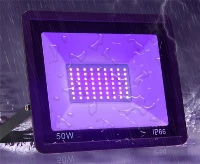
According to IEC 60529, the first digit "6" in IP66 means dust-tight: no dust enters under the specified test conditions. The second digit "6" means protection against powerful water jets - not splash resistance, not rain resistance, but the ability to withstand powerful water streams sprayed from any direction. The test conditions usually involve 100 liters of water per minute, from a distance of 3 meters, for at least 3 minutes. In other words, a floodlight rated IP66 is designed not just for "can it be used in light rain," but for direct garden-hose spray, driving rain, and the routine practice of hosing down the housing after an event.
| IP rating | Dust protection | Water protection | Practical coverage for outdoor event scenes |
|---|---|---|---|
| IP44 | Solid objects over 1mm | Splashing water from all directions | Covered semi-outdoor areas, light breeze and light rain |
| IP65 | Dust-tight | Water jets from all directions | Regular outdoor use, moderate to heavy rain |
| IP66 | Dust-tight | Powerful water jets (higher pressure/flow) | Heavy rain, washing down, direct garden-hose spray, rainy climates |
| IP67 | Dust-tight | Short-term immersion | Ground installations where water may accumulate, but not for underwater use |
Data sources: Unilamp / IEC 60529 interpretation; water-jet test conditions referenced from industry patent documents.
For decorative equipment that needs to be reused throughout the year, IP66 also implies a cost logic: a floodlight that takes in water after the first heavy rain is not just a replacement cost - the "blackout" on the event night is the truly unrecoverable loss.
4. LED Replacing Halogen: The "Power Equation" for Outdoor Floodlights Has Long Since Turned the Page
In the UV floodlight niche, directly comparing "wattage" with traditional fixtures can be misleading, because the luminous efficiency of UV-A LEDs is not on the same track as white LEDs. But within the broader replacement logic of outdoor floodlights, the difference is still strikingly clear: compared with traditional halogen lamps, LED floodlights can typically save 60%–90% of electricity, and in commercial and event settings, the payback period is generally 6–18 months.
The comparison table below puts typical replacement relationships and operational implications together:
| Traditional floodlight type | Actual power consumption (including ballast/transformer) | Typical LED replacement wattage | Power-saving range | Implication for event operators |
|---|---|---|---|---|
| 150W halogen | 150W | 20W LED (about 2,500 lm) | ~85% | Single-lamp power drops to about 1/7 of the original |
| 300W halogen | 300W | 30W LED (about 4,200 lm) | ~90% | In multi-lamp setups, circuit load drops significantly |
| 500W halogen | 500W | 50W LED (about 7,000 lm) | ~90% | In plug-and-play setups, an ordinary outlet can handle the load |
| 150W metal halide | About 170W | 50W LED | ~70% | No warm-up needed; instant full brightness; compatible with sensor/switch control |
Data source: Future House Store, halogen/metal halide to LED replacement guide published in October 2026.
The lifespan gap is equally important: typical lifespan for metal halide and SON lamps is 10,000–20,000 hours, while quality LED floodlights are rated for 50,000 hours or more. For UV floodlights used at dozens of events a year, lit for several hours each time, this means that for several years you hardly need to think about "the lamp breaking", and both labor replacement and event-interruption risks decline accordingly.
5. Plug-and-Play Is an Underestimated "Operational Parameter" in the Event Industry
Event planning and venue operation share one characteristic: temporary lighting is the norm; electricians are not. The on-site difference between a pre-wired, switched, ready-to-plug floodlight and a fixture that requires hardwiring or an additional controller is not "a little more convenient" - it is setup time, labor cost, and flexibility for last-minute adjustments.
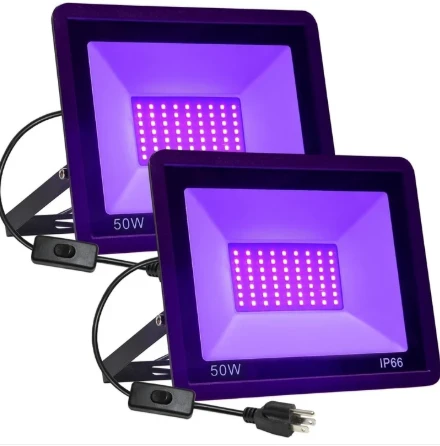
Benwei's UV floodlight series (the 365/395nm IP66 waterproof outdoor UV floodlights on the page) is organized around exactly this logic: 20W / 30W / 50W / 100W power options, 365nm and 395nm wavelength choices, 120° beam angle, pre-wired with switch, aluminum housing with PC cover, and AC100–240V wide voltage input. It does not try to fill up a spec sheet; instead, it puts wavelength-selection accuracy, the weather tolerance brought by IP66, and the lower on-site threshold created by plug-and-play into the same product framework. The product page clearly lists a 2-pack 50W configuration for large-area coverage needs such as parties, dance floors, and Halloween, and customization is supported.
If you are looking for a UV floodlight for outdoor event venues, yard sets, Halloween installations, or nightclub terraces - one that can withstand rain, can actually make fluorescent materials glow, and can be lit without an electrician on site - you can visit Benwei's IP66 waterproof outdoor UV floodlight product page to view the specific 365nm / 395nm configurations and power options. You can also send your scene type, coverage area, and target market directly to get targeted wavelength recommendations and bulk quotations. The success or failure of outdoor atmosphere often does not depend on how bright the light is, but on whether the light is set to that "invisible wavelength."