Why Do Photochemical Reactions Require Precisely Wavelength-Matched UV LEDs?
Walk into any photocatalysis lab and you'll probably see a familiar scene: a xenon or mercury lamp humming away, its fan running at full speed, a filter sitting beside it, and a researcher staring at the reaction flask, quietly wondering whether this batch of data will be reproducible.
Photochemical reactions are moving from the lab to pilot scale and industrial production. From photocatalytic water splitting for hydrogen production and advanced oxidation in wastewater treatment to the targeted synthesis of pharmaceutical intermediates, all of them rely on one idea: using light to drive molecules. And the light source is often the most underestimated variable in the entire system.
1. Photochemistry Is Essentially a "Wavelength Matching" Game
Molecules do not react just because light shines on them. Electrons are efficiently excited, and the reaction follows its intended pathway, only when the photon energy matches the absorption band of the molecule (or catalyst).
This has two direct consequences:
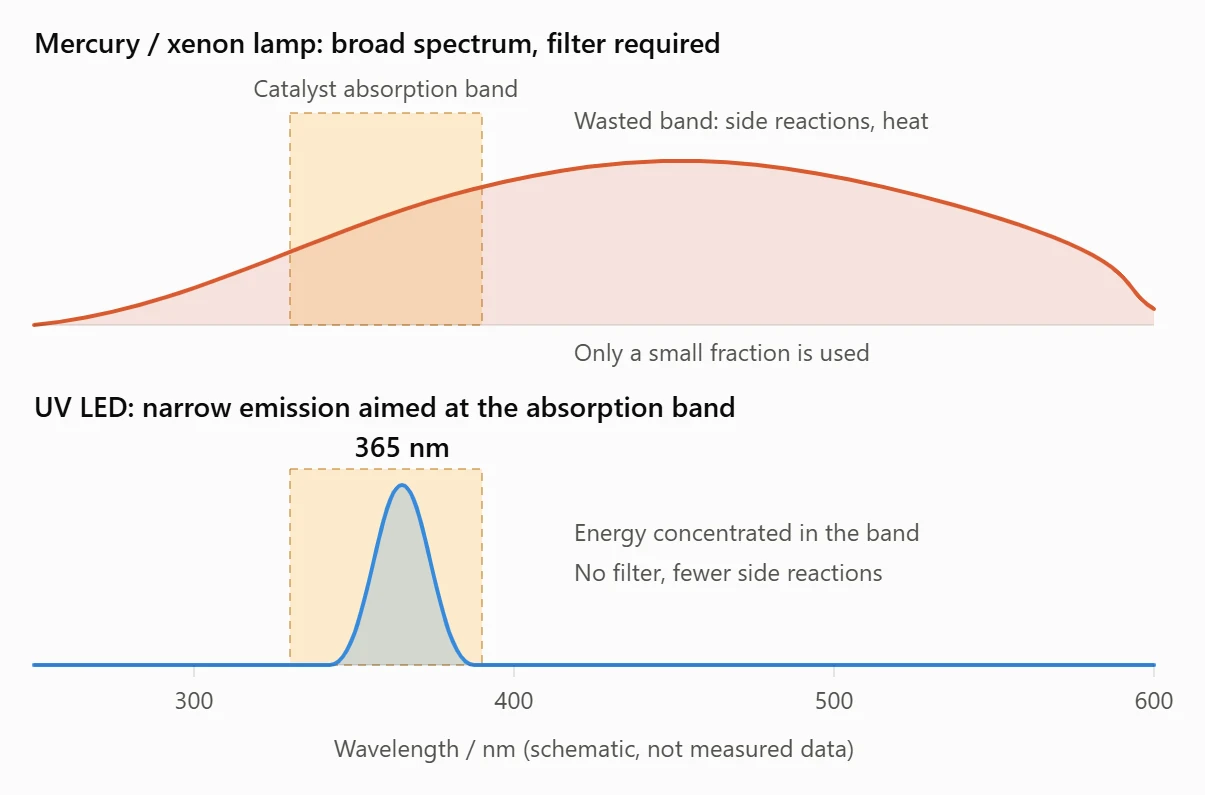
1.1 If the wavelength is off, energy is wasted. Photons that fall outside the absorption peak are either not absorbed at all or are converted into heat, contributing nothing to the reaction.
1.2 If the spectrum is too broad, side reactions appear. Mercury and xenon lamps are broad-spectrum sources, and their output includes large amounts of unwanted UV and infrared components. Excess high-energy photons can degrade the target product, generate by-products, or deactivate the catalyst. This is a hidden reason why many experiments are "hard to reproduce."
So in photochemistry, "having light" is far from enough. "Having the right light" is what matters.
2. The Familiar Problems of Traditional Light Sources
Xenon and mercury lamps have served for decades and deserve credit, but in today's applications their shortcomings are increasingly obvious:
- Broad spectrum requiring extra filtering. Filtering sharply reduces effective light intensity and lowers overall system efficiency.
- High heat output. Large amounts of infrared radiation heat the reaction system, require additional cooling equipment, and interfere with temperature-sensitive reactions.
- Warm-up and stability issues. Mercury lamps need to warm up, and frequent switching shortens their lifespan. Light intensity decays over time, making batch-to-batch consistency difficult.
- Short lifespan and high maintenance cost. Lamps need frequent replacement, so operating costs are not low.
- Mercury-related environmental and safety concerns. Mercury lamps contain mercury, and their disposal is subject to increasingly strict regulation.
3. UV LEDs: Why Are More and More People Switching?
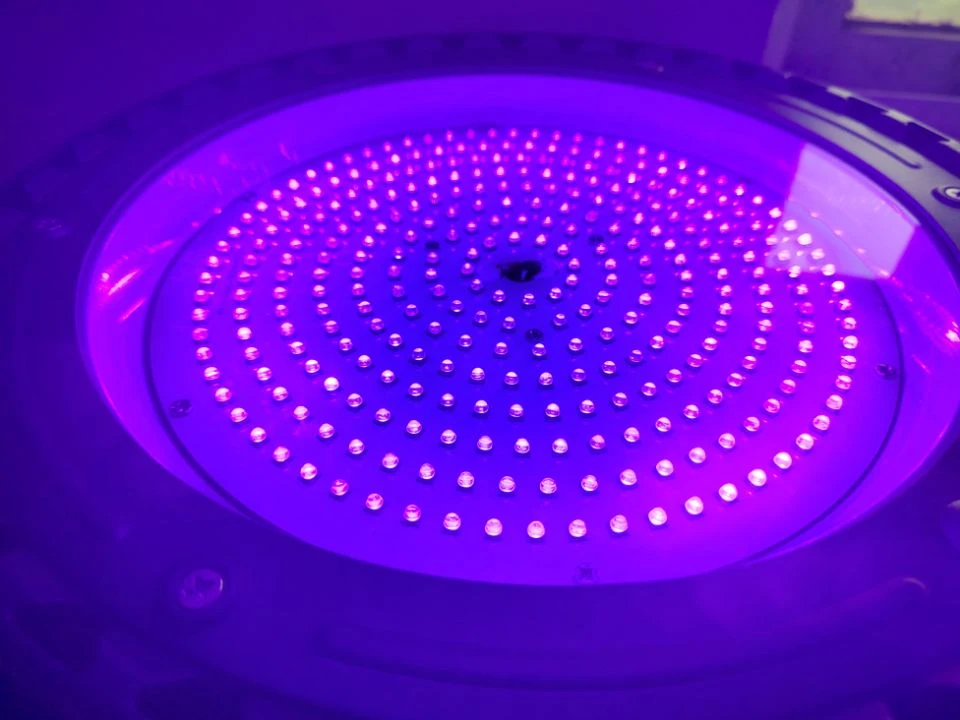
Narrow-band emission, selectable wavelengths. UV LEDs typically have an emission bandwidth of only about ten to twenty-odd nanometers. You can choose 365 nm, 385 nm, 395 nm, 405 nm, or other wavelengths according to the absorption characteristics of your reaction system, delivering energy exactly where it is needed while significantly reducing side reactions.
Instant on, precisely controllable. No warm-up is required, switching takes place within milliseconds, and intensity can be adjusted continuously. This also makes pulsed illumination and programmed control easy, which suits kinetic studies and automated workflows.
Cold light source, low thermal load. LEDs emit almost no infrared radiation, so the temperature of the reaction system is easier to control.
Long lifespan, good stability. Lifespans can reach thousands or even tens of thousands of hours, with slow output decay, which supports long-term experimental consistency and reproducibility.
Mercury-free, safer, and easier to scale up. Modular design allows LED arrays to be combined flexibly, scaling smoothly from small laboratory setups to pilot-scale and even industrial reactors.
Putting the two types of light sources side by side makes the gap clearer:
Table 1 Performance Comparison of Traditional Light Sources and UV LEDs for Photochemistry
| Item | Mercury Lamp | Xenon Lamp | UV LED |
|---|---|---|---|
| Spectral characteristics | Line spectrum + broad spectrum, filtering required | Continuous broad spectrum (UV to IR) | Narrow-band emission, FWHM approx. 10–20 nm |
| Wavelength selection | Relies on filters | Relies on filters or monochromator | Directly select the peak wavelength |
| Effective light utilization | Low (large filtering loss) | Low (large filtering loss) | High (energy concentrated in the target band) |
| Infrared thermal load | High | High | Extremely low |
| Start-up | Several minutes of warm-up | Warm-up and triggering required | Instant on, millisecond response |
| Intensity adjustment | Difficult to adjust continuously | Limited | Current-controlled, continuously adjustable |
| Typical lifespan* | About 1,000–3,000 hours | About 500–2,000 hours | Typically 10,000 hours or more |
| Mercury content | Contains mercury | Mercury-free | Mercury-free |
| System complexity | Requires cooling, filtering, ballast | Requires cooling, filtering, power supply | Compact, modular combination possible |
*Lifespan figures are typical industry ranges. Actual values vary with product model, power, and operating conditions.
As the table shows, the advantage of UV LEDs is not leadership in a single metric. It is simultaneous improvement across spectrum, heat, lifespan, and controllability, and that is why they can replace traditional light sources.
4. How Should You Evaluate UV LEDs When Selecting One?
Only by choosing the right LED can the advantages above be truly realized. We recommend focusing on the following dimensions:
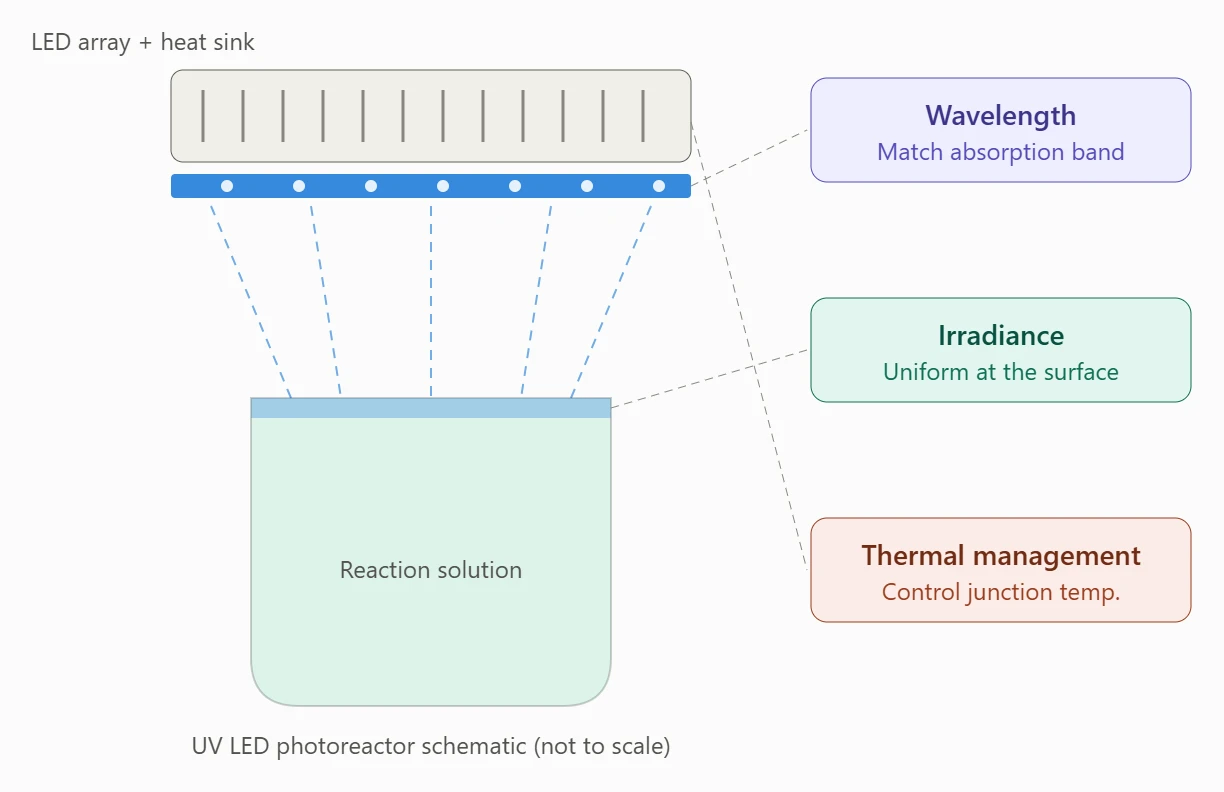
4.1 Wavelength: Look at the reaction first, then choose the lamp
- Base your choice on the absorption spectrum of the target molecule or catalyst, rather than "close enough" experience.
- Pay attention to the tolerance of the peak wavelength and batch-to-batch consistency. In systems with steep absorption bands, a shift of just a few nanometers can mean a noticeable difference in efficiency.
- If you need to study reaction response at different wavelengths, consider a multi-wavelength, switchable light source solution.
The typical application directions for different wavelengths can serve as a preliminary selection reference:
Table 2 Common LED Wavelengths and Typical Photochemical Applications
| Wavelength Range | Typical Applications | Selection Notes |
|---|---|---|
| 255–280 nm (deep UV) | Water disinfection, advanced oxidation such as UV/H₂O₂, organic pollutant degradation | Lower optical power per chip; pay close attention to efficiency and heat dissipation |
| 365 nm | Photocatalysis with wide-bandgap semiconductors such as TiO₂, photoinitiated polymerization, photo-click reactions | One of the most commonly used wavelengths in photochemical research; confirm the catalyst's absorption edge |
| 385–395 nm | Photoinitiator activation, some organic photocatalysis and synthesis | Balances efficiency and cost; commonly used for pilot scale-up |
| 405 nm | Photosensitizers such as porphyrins, some photocatalytic organic synthesis | Near-visible region with better penetration; suitable for deeper reaction solutions |
| 450–460 nm (blue light) | Ir/Ru complexes, organic dye photoredox catalysis | Non-UV band; the same platform can be extended, making it easy to compare different wavelengths |
*The table above is a general reference for common applications. The specific wavelength should be based on the absorption spectrum of your reaction system and literature conditions.
4.2 Power and Irradiance: Look at effective light intensity, not just rated power
- Rated electrical power is not the same as effective optical output. Focus on optical power (mW) and irradiance (mW/cm²).
- Evaluate the actual irradiance from the light source to the surface of the reaction liquid, as well as illumination uniformity, which directly determine reaction rate and reproducibility.
- During scale-up, consider optical path design and penetration depth to avoid a situation where "the surface reacts vigorously while the interior receives almost no light."
4.3 Thermal Management: Determines how long the LED lasts and how stable it is
- High-power UV LEDs have limited electrical-to-optical conversion efficiency, and most of the energy is generated as heat. Junction temperature directly affects wavelength drift, light output, and lifespan.
- Prefer light source modules with good heat dissipation structures (such as high-thermal-conductivity substrates, air cooling, or water cooling).
- Also pay attention to the temperature control design on the reactor side, so that LED heat does not affect the temperature of the reaction system.
4.4 Other Practical Details
- Whether the beam shape matches the reactor (collimated light, point source, ring array, etc.);
- Whether precise dimming, timing, and external signal control are supported;
- Whether spectral test reports and intensity calibration data are complete;
- Whether the supplier can provide a customized solution based on your reaction setup.
5. In Closing
In a sense, competition in photochemistry is competition in "light quality." When the wavelength is more precise, the intensity more controllable, the thermal load lower, and the results more reproducible, R&D cycles become shorter and scale-up risk is reduced. Moving from xenon and mercury lamps to UV LEDs is not just a change of light source. It is an important step toward standardizing and scaling photochemical processes.
Looking for the best-matched UV LED solution for your photochemical reaction?
Not sure which wavelength to choose? Unsure how much irradiance is enough? Wondering how to convert your existing reactor to LED illumination?
Feel free to contact our technical team at any time.
Leave a message or call us today, and let precise light power your experimental success.