Introduction: The Paradox of LED Lifespan and Practical Application Failure
The Industry Misunderstanding of LED Lifespan
Most consumers and even some engineering practitioners simply equate the nominal 50,000-hour lifespan of LED lights with actual service life, ignoring that official laboratory rating data is obtained under ideal constant temperature, constant voltage, dust-free, and dry environment conditions. In actual indoor engineering applications, complex operating conditions including ceiling heat accumulation, voltage fluctuation, dust accumulation, and ambient humidity changes will continuously impact LED operational stability. Industry after-sales data shows that nearly 48% of low and medium-grade commercial LED lights fail within 2–3 years, manifested as dimmed light output, obvious color shift, frequent flicker, and complete light-off damage, forming a serious deviation between theoretical parameters and practical performance.
Three Core Root Causes of Premature LED Failure
Different from traditional light bulbs that suffer from simple filament burnout, LED light failure is a systematic failure caused by the coupling of multiple factors. Through sorting and analyzing thousands of LED fixture failure cases in commercial and residential projects, the core inducements are summarized into three categories. First, insufficient core lighting performance and defective optical design lead to unstable light output and accelerated chip aging. Second, unreasonable thermal structure design causes excessive heat loss and continuous temperature rise, which is the primary killer of LED premature aging. Third, insufficient protection grade leads to dust and moisture erosion, damaging internal circuits and light sources. This paper will conduct in-depth professional analysis of the above three factors one by one, and combine high-quality fixture design standards to propose targeted optimization solutions.

Lighting Performance Defects: The Hidden Cause of Gradual Early Failure
Light Source Quality and Optical Design Deficiencies
The core of LED lighting performance lies in the chip light source and optical system design, which directly determines the long-term operational stability of the fixture. Inferior LED products on the market usually adopt low-cost fragmented chip light sources with uneven current conduction and poor luminous consistency. In the long-term working state, local over-current of the chip occurs frequently, resulting in gradual luminous attenuation, color temperature drift, and reduced color rendering performance. Moreover, most low-end fixtures adopt single and crude optical design, lacking professional reflector and lens matching structure. The light cannot be uniformly output, forming local light concentration, which intensifies the thermal load of the local chip and accelerates component aging.
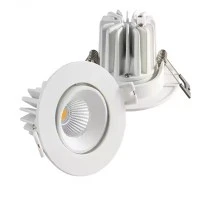
In contrast, the premium gimbal-adjustable COB LED recessed spotlight adopts high-performance integrated COB light source, which realizes uniform current conduction and ultra-stable luminous output, completely avoiding local over-current damage. The high CRI light source configuration can truly restore the color of objects, while ensuring no flicker throughout the service life, protecting eye health and avoiding performance degradation caused by light source jitter. In terms of optical design, the product supports dual optical solutions of reflector and lens, with multiple optional beam angles including 15°, 20°, 24°, 38°, 40°, and 60°. It is equipped with three professional optical accessories: clear reflector, frosted reflector, and lens, which can flexibly switch between precise spot accent lighting and soft wide-area lighting according to application scenarios. The scientific optical structure disperses light reasonably, eliminates local light concentration, and fundamentally reduces the performance loss caused by optical system defects.
Structural Design Limitations Affecting Long-Term Performance Stability
Most ordinary recessed LED downlights adopt fixed integrated structural design with no adjustable angle function. In practical applications, long-term fixed directional light irradiation will cause cumulative aging of local light sources and heat accumulation, resulting in uneven performance attenuation of the fixture. In addition, inferior products use thin and low-strength shell materials, which are prone to deformation after long-term ceiling embedding and extrusion, squeezing internal light sources and circuits and causing hidden performance failures.
The high-end adjustable LED spotlight adopts a professional gimbal tilting adjustment structure, with the lamp head freely swinging to adjust the light projection direction. This flexible design avoids long-term fixed heat accumulation in a single position, uniformizes the aging degree of the light source, and effectively delays performance attenuation. At the same time, the product is equipped with high-strength spring fixing clips, which can be firmly embedded in the ceiling without loosening or deformation after long-term use. The two optional finishes of pure white and matte black front trim not only match modern interior decoration styles but also adopt anti-oxidation and anti-corrosion surface treatment technology, avoiding shell aging and discoloration caused by long-term indoor air oxidation, and maintaining long-term stable appearance and structural performance.
Heat Loss and Thermal Management Failure: The Primary Cause of LED Premature Aging
The Core Law of LED Thermal Aging
Different from traditional lighting equipment that converts most energy into light, LED lights convert nearly 70% of electric energy into heat energy during operation, and only 30% is converted into light energy. This thermal operation characteristic determines that thermal management is the core factor restricting LED service life. The industry's authoritative 10℃ temperature rule clearly points out that for every 10℃ increase in the working junction temperature of LED chips, the service life of electronic components will be halved, and the lumen depreciation rate will increase exponentially. Engineering data shows that more than 50% of early LED failures are directly caused by poor heat dissipation and uncontrolled thermal loss, making overheating the number one invisible killer of LED fixtures.
Inferior LED products usually adopt simple plastic shells or thin iron sheet heat dissipation structures with small heat dissipation area and low thermal conductivity. After the fixture is embedded in the ceiling, the closed ceiling space forms a heat accumulation zone, and the heat generated by the chip cannot be dissipated in time, resulting in a continuous rise in junction temperature. Long-term high-temperature operation will accelerate the aging of LED chips, degrade phosphor performance, and cause serious lumen depreciation. At the same time, high temperature will damage the electrolytic capacitors and driving chips inside the power supply, resulting in reduced driving stability, frequent flicker, and even direct burnout of the power supply.
Professional Thermal Structure Design to Control Heat Loss
High-performance COB recessed spotlights completely solve the thermal loss problem through industrial-grade thermal design. The whole machine adopts high-quality die-cast aluminum integral radiator with a fin-shaped three-dimensional heat dissipation structure. Compared with ordinary flat heat dissipation structures, the fin-shaped design greatly expands the heat dissipation surface area, forms an efficient air convection channel, and can quickly export the heat generated by the LED chip to the outside of the fixture, avoiding internal heat accumulation. The high thermal conductivity of die-cast aluminum material realizes rapid heat conduction and uniform heat distribution, effectively controls the LED junction temperature within the safe working range, and completely breaks the aging law of temperature rise and lifespan decay.
This excellent thermal management system brings two core advantages. First, it effectively inhibits lumen depreciation, realizing ultra-slow light attenuation. After 50,000 hours of continuous operation, the lumen maintenance rate is still higher than 70% (L70 industry standard), avoiding the problem of obvious dimming and brightness decline in the middle and later stages of use. Second, it protects the internal driving components, avoids high-temperature aging of capacitors and chips, ensures long-term stable output of the drive power supply, and eliminates flicker, stroboscopic and sudden failure problems caused by power supply damage. While reducing thermal loss, it extends the overall service life of the fixture and greatly reduces the maintenance and replacement cost of engineering projects.
Insufficient Protection Level: Environmental Erosion Induced Long-Term Failure
The Practical Impact of IP Protection Grade on LED Service Life
Ingress Protection (IP rating) is a key technical index to measure the environmental adaptability of lighting fixtures, which defines the protection ability of equipment against solid particles and liquid intrusion. Indoor ceiling LED fixtures are in a semi-closed working environment for a long time, and are easily affected by indoor dust, floating particles, and ambient humidity. Inferior LED products often cut corners on structural sealing, resulting in low protection grades. A large number of tiny dust particles enter the fixture interior, adhere to the chip surface and heat dissipation structure, block heat dissipation channels, aggravate heat accumulation, and reduce luminous efficiency. In humid indoor environments, moisture intrusion will cause circuit oxidation, short circuit, and electric leakage, leading to intermittent failure or permanent damage of the fixture.
Many project buyers ignore the importance of IP protection grade in the procurement process, mistakenly believing that indoor lights do not need high-level protection. In fact, long-term dust accumulation and slight moisture erosion are important hidden dangers of early failure of indoor LED lights, which will continuously consume the performance of the fixture and shorten the actual service life by more than 40%.
Standardized IP Protection Design to Resist Environmental Risks
This high-grade recessed LED spotlight is designed with standard IP20 professional protection grade, which is perfectly adapted to various dry indoor application scenarios such as residences, hotels, shopping malls, showrooms, and offices. The IP20 protection standard can effectively block solid foreign objects larger than 12.5mm, preventing large-particle dust, debris, and foreign matter from entering the fixture interior. The precise assembly process and tight structural fitting avoid internal dust accumulation, keep the heat dissipation channel unobstructed at all times, and ensure that the thermal management system always maintains efficient operation.
In addition to standard dust protection, the product also optimizes the internal sealing and circuit protection structure, with excellent anti-oxidation and anti-moisture performance. It can adapt to the ambient temperature changes of indoor ceilings, avoid circuit aging and component damage caused by mild humidity and air oxidation, and maintain stable operation in long-term complex indoor environments. For special humid indoor scenarios, the product also supports customized upgraded protection schemes to meet higher environmental application requirements and eliminate environmental-induced failure risks in an all-round way.
Comprehensive Advantages of High-Quality LED Fixtures: Avoid Early Failure and Improve Long-Term Cost Performance
Systematic Optimization of Full-Link Performance
Different from ordinary LED products with single performance and defective structure, this gimbal-adjustable COB LED recessed spotlight realizes full-link optimization from light source performance, optical design, thermal management to environmental protection. The high-stability COB light source eliminates light source performance attenuation, the multi-angle optical design avoids local thermal overload, the die-cast aluminum thermal system controls thermal loss to the greatest extent, and the standard IP protection grade resists environmental erosion. The systematic design completely solves the three core problems leading to early LED failure, realizing ultra-long stable operation of the fixture.
Engineering-Level Durability and Low Maintenance Cost
In commercial engineering and long-term home decoration scenarios, the comprehensive cost of lighting fixtures includes not only the initial procurement cost but also the later maintenance, replacement, and loss cost. Although low-cost inferior LED lights have low initial investment, they are prone to early failure, requiring frequent replacement and maintenance, resulting in high long-term comprehensive costs. This high-performance LED fixture has a rated service life of up to 50,000 hours, with extremely low lumen depreciation rate and failure rate. It can maintain stable lighting effect for more than 10 years of daily use, almost no later maintenance is required, which greatly saves project operation and maintenance costs and brings ultra-high long-term return on investment.
Scenario Adaptability and Customized Value
The product supports diversified beam angle customization, multi-type optical accessory matching, and two-color shell selection, which can perfectly adapt to high-end home accent lighting, commercial display lighting, hotel scene lighting, and office basic lighting. The flexible gimbal adjustment structure meets the personalized lighting needs of different scenarios, while maintaining performance stability in different working environments. It is a high-reliability and multi-scene adaptive lighting solution that balances professional performance, aesthetic effect, and long-term durability.
Conclusion: Professional Design Is the Fundamental Guarantee for Long-Term LED Stability
The premature failure of most LED lights is not caused by the natural aging of LED chip technology, but by the performance defects, uncontrolled thermal loss, and insufficient environmental protection of low-end product design and manufacturing. Lighting buyers and designers should abandon the single price-oriented procurement concept and take core performance, thermal management capability, and protection grade as the key evaluation standards for LED fixture selection. High-quality engineered LED products represented by gimbal-adjustable COB recessed spotlights eliminate various hidden dangers of early failure through professional optical design, efficient thermal dissipation system, and standardized protection configuration. They not only deliver excellent lighting experience and stable performance but also create lower comprehensive cost and higher long-term value for users. In the long-term lighting engineering application, only products with systematic professional design can truly realize the ultra-long service life advantage of LED technology and achieve the perfect balance of lighting effect, stability, and cost performance.

How To Cooperate With Us?
We are happy to have total control over the manufacturing process and the calibre of our products since we have our own facilities. Since we are producers rather than just brokers, we are dedicated to providing our customers with the best pricing. Since we are certain that the price and quality of our products are clear, we invite customers to see our samples first. Our commitment to quality and customer satisfaction drives us to continuously provide top-notch goods.
Our address
3rd Floor, 5th Building, Hebei Industrial Park, Hualian Community, Longhua District, Shenzhen, China