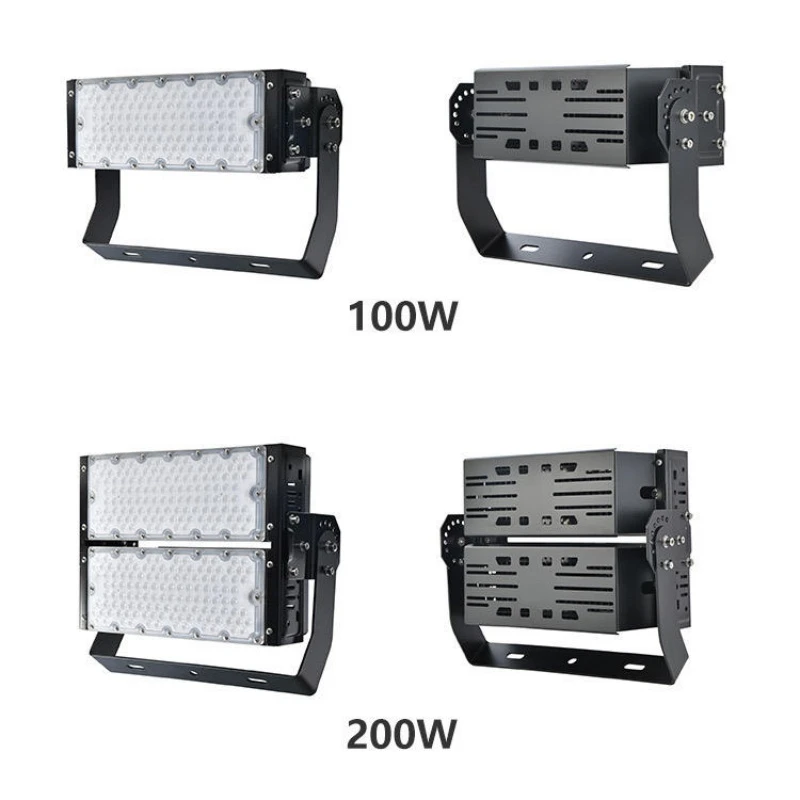
Many venue owners and contractors have encountered this scenario: the lights are installed, and the specifications-such as power and luminous efficacy-look impressive on paper. Yet, when switched on at night, the playing surface ends up with uneven patches of light and shadow. This makes it difficult for players to judge the ball accurately when it moves between bright and dark zones, and it can even cause flickering or inconsistent brightness in broadcast footage. The issue is rarely that the lights themselves lack brightness; rather, it is that the light is not being directed where it is actually needed. Let's break down how these "bright spots" and uneven lighting patterns occur, from the perspectives of both product selection and design.
Mismatch Between Light Distribution Curves and the Playing Surface
Every sports light has a specific "light distribution curve"-a representation of how light intensity is distributed across various angles. If a light has a "narrow and concentrated" beam pattern, the area directly beneath it will be intensely bright, while more distant areas will appear significantly darker. Conversely, if a luminaire designed with an asymmetric distribution (intended for a rectangular field) is used like a standard, general-purpose floodlight, the sidelines and corners will likely suffer from insufficient illumination.
When selecting lighting, one should not rely solely on total lumen output. Instead, it is essential to examine the light distribution data (IES files) in the context of the specific venue shape-as the requirements for a soccer field, a basketball court, and a tennis court differ vastly.
Overly Uniform Beam Angle Selection
In many projects, a single beam angle is used across the entire venue for the sake of convenience. In reality, lights positioned closer to the target area require a wider beam angle to provide broad coverage, while lights positioned further away require a narrower beam angle to "throw" light over a greater distance. A "one-size-fits-all" approach often results in overexposure nearby, insufficient light at a distance, and potential gaps in the middle where the light patterns fail to overlap effectively.
A more sound approach is to combine luminaires with different beam angles, tailored to the distance between each light and its target area.
Inappropriate Pole Layout and Mounting Height
Mounting height too low: This results in an excessively large angle of incidence, creating sharp peaks of illumination near the light source, while light levels drop off rapidly further away.
Spacing too wide: The light patterns from adjacent fixtures fail to overlap effectively, leading to dark zones between them.
Lighting installed on only one side: Light from the opposite side must travel across the entire field, making it extremely difficult to ensure uniform illumination.
Because the placement and height of light poles are nearly impossible to change once installed, this stage of the process requires the utmost care and deliberation.
Failure to Calibrate the Aiming Angle for Each Individual Luminaire
On any given field, every luminaire should have a specific, calculated aiming point-defined by both its tilt (pitch) and rotation (yaw) angles. If, during installation, the lights are merely "pointed roughly toward the field," even a deviation of just a few degrees can result in the light beam landing significantly off-target at a distance of several dozen meters. This leads to areas where light beams overlap excessively-becoming too bright-while other areas are left in relative darkness.
Best practice involves creating a formal aiming diagram, then marking and locking the precise angle for each individual luminaire on-site.
Poor Quality of Secondary Optics (Lenses/Reflectors)
An LED is inherently a point source; the actual light distribution pattern is determined by the secondary optics-the lens or reflector placed over it. Common issues include:
Inadequate lens material quality or mold precision, causing deviations in the direction of the emitted light.
The appearance of "ghosting" or irregular light patterns when beams from multiple LEDs overlap.
Deformation of the lens due to prolonged exposure to heat, causing the light distribution pattern to shift.
Such issues may not be apparent during the sampling phase; they often only emerge after the luminaires have been in use for a year or two.
Lack of Consistency Between Luminaires
Even with a perfect design, discrepancies between individual luminaires can result in uneven lighting across the field:
Loose "binning" (sorting) of LED chips, leading to variations in luminous flux or color temperature among units from the same batch.
Inconsistent output current from LED drivers, causing luminaires with the same nominal wattage to produce different actual brightness levels.
Mismatches in color or brightness when replacement units from different production batches are introduced.
In sports lighting, a brightness difference of even 10–15% between two luminaires is often visible to the naked eye, creating a "patchy" effect of light and dark areas on the field.
Unintended Side Effects of Anti-Glare Structures
Glare control is a critical priority in sports venues, often addressed through the use of visors, louvers, or deep-recessed designs. If these structures are not engineered precisely, they may inadvertently block light intended for the playing surface, resulting in dark zones or harsh, distinct edges in the light distribution. A careful balance must be struck between glare control and illuminance uniformity; one should not be prioritized at the complete expense of the other.
Proceeding with Construction Without Lighting Simulation
Professional projects typically utilize software such as DIALux or AGi32 to perform illuminance simulations based on precise luminaire photometric data and venue dimensions. This allows for the advance assessment of illuminance levels at specific points, uniformity (U1, U2), and glare indices.
Skipping this step is essentially a "gamble" based on guesswork. Many issues-such as unwanted "hot spots" (bright patches)-can be easily avoided by adjusting luminaire positioning or angles during the simulation phase; rectifying these problems after installation is significantly more costly.
Lumen Depreciation and Dust Accumulation Over Time
After a period of use, luminaires in different locations will experience varying rates of lumen depreciation:
Fixtures near the perimeter of the venue, or those exposed to higher levels of wind, sand, and dust, are more prone to dust accumulation on their lens surfaces.
Luminaires with poor heat dissipation will experience faster lumen depreciation.
Loose mounting brackets can cause the orientation of the fixtures to shift over time.
Therefore, achieving the required uniformity immediately after installation does not guarantee that it will be maintained years later; robust thermal management and structural protection are equally critical.
Conclusion
If you are planning a lighting project for a sports facility, or if your existing lighting system is suffering from issues like "hot spots" (bright patches) or dark zones, please contact us. Simply provide us with the following details:
Venue type and dimensions (e.g., soccer field, basketball court, tennis court, etc.)
Positions and heights of the light poles (we can also assist with this if not yet determined)
Usage level (e.g., amateur training, competitive events, or television broadcasting)
Based on this information, our engineers will provide professional lighting distribution recommendations and an illuminance simulation report, allowing you to visualize the final outcome before construction begins. Reach out to us today to receive a customized solution and a quote tailored to your specific venue.