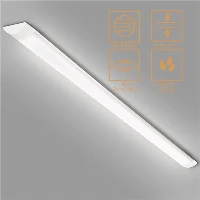
Ask two suppliers to quote an LED batten of the same length and wattage. One quote is for a standard fixture, the other for a cleanroom fixture. The cleanroom quote can come back at two to three times the price, even though the two look nearly identical in photos.
Most buyers assume the gap is branding. It is not. The price follows from what a cleanroom demands of everything inside it. This article walks through the numbers.
1. The Room Sets the Rules, Not the Light
A cleanroom is classified by how many airborne particles it allows. The international standard, ISO 14644-1, sets limits per cubic meter of air. Here are the limits for particles of 0.5 µm and larger, alongside typical airflow designs:
| ISO Class | Max particles ≥0.5 µm per m³ | Typical air changes per hour |
|---|---|---|
| ISO 5 | 3,520 | 240–360 |
| ISO 6 | 35,200 | 90–180 |
| ISO 7 | 352,000 | 30–60 |
| ISO 8 | 3,520,000 | 15–25 |
| ISO 9 | 35,200,000 | not specified |
Particle limits: ISO 14644-1:2015, Table 1. Air change rates are typical design ranges, not mandatory values; actual requirements depend on the project.
Two things stand out:
Each class is ten times cleaner than the next. An ISO 5 room allows 1,000 times fewer 0.5 µm particles than an ISO 8 room.
Air moves constantly. An ISO 5 room may replace its air hundreds of times every hour. Every ceiling fixture sits directly in that airflow.
In that environment, a light is part of the contamination budget. Any gap that traps dust, any rough surface that sheds particles, or any seam that is hard to clean becomes a measurable problem.

2. Where the Extra Cost Actually Goes
| Cost driver | Standard LED batten | Cleanroom LED batten | Why it costs more |
|---|---|---|---|
| Housing and seams | Open ends, visible joints | Smooth, sealed body | Tighter tolerances, extra finishing |
| Surface cleaning | Not designed for wipe-down | Wipeable with alcohol | Materials and coatings must tolerate repeated cleaning |
| Static behavior | Rarely addressed | Anti-static design | Material selection and testing |
| Driver quality | Cost-optimized | Stable, low-flicker | Better components and circuit design |
| Row installation | Gaps at each joint | Seamless end-to-end | Connection design, fewer end parts |
| Batch consistency | Wider tolerance | Tighter QC | More inspection, higher rejection rate |
No single item is dramatic. Together, they explain why a fixture built for a cleanroom cannot be sold at the price of a general-purpose one.
3. The Flicker Question: What the Standard Says
Flicker is the cost item buyers see least and feel most. LED lights have almost no light persistence, so poor drivers can pulse noticeably. Under the recommended practice IEEE 1789-2015, the maximum acceptable flicker depends on frequency:
| Flicker frequency | Low-risk limit (max % flicker) | "No observable effect" limit |
|---|---|---|
| 100 Hz (from 50 Hz mains) | 8% | about 3% |
| 120 Hz (from 60 Hz mains) | about 10% | about 4% |
| 1,200 Hz | 96% | 40% |
| Above 1,250 Hz / 3,000 Hz | no restriction | no restriction (above 3,000 Hz) |
Low-risk limit = frequency × 0.08 for 90–1,250 Hz. No-effect limit = frequency × 0.0333 for 90–3,000 Hz. Values rounded.
The practical meaning is simple. A cheap driver that rectifies mains power with little smoothing produces flicker at 100–120 Hz, exactly where the limits are strictest. A well-designed driver either smooths the output or runs at high frequency. That design work costs money, and it matters in rooms where people inspect, assemble or operate for hours.

4. Do You Actually Need One?
This depends on your classification and process, not on the label.
| Application | Typical fit |
|---|---|
| ISO 5–7 areas, GMP-classified production, operating rooms, labs, semiconductor and electronics cleanrooms | Cleanroom fixture strongly recommended |
| ISO 8 areas, food processing, clean assembly | Usually worth it; confirm with your quality team |
| Offices, warehouses, supermarkets, garages, homes | A standard fixture is normally enough |
Spending cleanroom money on a storage room wastes budget. Installing a general fixture in a certified cleanroom risks audit findings and early replacement. Both mistakes are avoidable.
5. Our Approach, in One Paragraph
Our cleanroom LED batten light uses a sealed aluminum body with a PC lens, supports seamless end-to-end connection and surface, suspended or recessed mounting. It offers up to 160 lm/W, 3000–6000K options and a 5-year warranty. It is rated IP44, so it suits clean indoor areas and not wet or washdown zones. The full specifications are on the product page, and for general-purpose projects our standard LED batten light is the more economical choice.
Planning a Cleanroom Lighting Project?
Tell us your cleanroom class or application, ceiling type, fixture length and order quantity. We will recommend a suitable model, and we also support custom specifications through our ODM lighting solutions.