Why Does Your LED Panel Light Become Dim After Only Two Years? Three Durability Indicators Most Buyers Overlook
Many purchasers focus only on initial brightness and price, only to find that after one or two years the light is noticeably dimmer than when new, or even flickering with dark spots. This is not bad luck – you have overlooked three core indicators that determine long‑term reliability: junction temperature control, driver power supply quality, and lumen maintenance. This article uses real test data and industry standards to help you fully understand the "life code" of LED panel lights.
1. Junction Temperature: The LED Chip's "Body Temperature" Determines How Long It Lives
LED chips generate heat when operating. Junction temperature (Tj) is the temperature of the PN junction inside the chip. For every 10°C increase, the lifespan of the LED roughly halves. This is the well‑known "10°C rule" in the LED industry.
According to solid‑state lighting research from the U.S. Department of Energy (DOE), at a junction temperature of 85°C, the L70 life (time until brightness decays to 70%) of an LED can exceed 50,000 hours. But when the junction temperature rises to 105°C, the L70 life drops sharply to less than 15,000 hours.
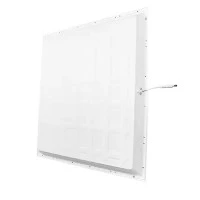
The key factor affecting junction temperature is thermal design – the housing material, heat sink area, and thermal interface quality of a panel light directly determine how quickly heat is conducted away. Taking Benwei's panel light as an example, it uses an aluminium backplate + PMMA light guide plate structure. Aluminium's high thermal conductivity (approx. 200 W/m·K) effectively spreads heat from the chip across the entire backplate, keeping the junction temperature in the 75‑85°C range – the foundation for a 50,000‑hour life.
In contrast, low‑priced panel lights on the market often use iron or plastic backplates (thermal conductivity only 0.2‑0.5 W/m·K). Heat accumulates, causing the junction temperature to easily exceed 100°C. After two years, lumen depreciation may exceed 30%, which feels like losing nearly half the perceived brightness.

2. Driver Power Supply: The "Heart" of an LED Panel Light – Most Prone to Cost Cutting
LED chips themselves are low‑voltage DC devices and need a driver power supply to convert AC mains (220V or 110V) into constant DC current. The quality of the driver directly determines:
- Whether the light flickers (harmful to eyesight)
- Whether there is start‑up delay or flashing
- Whether it can withstand grid voltage fluctuations
Key parameters are power factor (PF) and ripple current. Chinese national standard GB/T 24825‑2009 requires PF > 0.9 for LED module control gear. Benwei's panel light has PF > 0.95, meaning high power utilisation and low harmonic pollution to the grid. Poor‑quality drivers may have PF as low as 0.5‑0.7, wasting electricity and causing current fluctuations that accelerate chip aging.
Another often‑ignored figure is surge protection level. According to IEC 61000‑4‑5, a good LED driver should withstand differential mode 2kV and common mode 4kV surges. Benwei products use wide input voltage (85‑265V AC), adapting to unstable grid environments and reducing the risk of damage from lightning strikes or switching of high‑power equipment.
The table below compares typical differences between a high‑quality driver and a low‑quality driver:
| Parameter | High‑Quality Driver (Benwei level) | Low‑Quality Driver (cheap products) |
|---|---|---|
| Power Factor (PF) | ≥0.95 | 0.5‑0.7 |
| Input voltage range | 85‑265V (wide) | 180‑240V (narrow) |
| Surge protection | DM 2kV / CM 4kV | None or <1kV |
| Ripple current | <5% | >15% |
| Flicker risk | No visible flicker | Obvious flicker |
| Expected life | >50,000 hours | 10,000‑20,000 hours |
3. Lumen Maintenance: Don't Be Misled by "50,000‑Hour Life" Claims
"50,000‑hour life" sounds impressive, but many manufacturers play word games – that figure is the theoretical L70 value of the LED chip under ideal lab conditions (junction temperature 55°C, constant current and temperature). In real use, if heat dissipation is poor or the driver is unstable, the actual life may be only one‑third to one‑half of the claimed value.
The true quality indicator is lumen maintenance – the percentage of light output remaining after a period of operation. ENERGY STAR requires LED luminaires to achieve ≥91.8% lumen maintenance at 6,000 hours and ≥70% at 40,000 hours.
A simple formula to estimate actual life:
Actual L70 life = claimed life × (reference junction temperature / actual junction temperature) acceleration factor, where the acceleration factor is roughly halved for every 10°C increase.
Example:
- A cheap panel light claims 50,000 hours, but its actual junction temperature is 105°C (20°C higher than the ideal 85°C). Then actual life ≈ 50,000 × (1/2)² = 12,500 hours.
- Benwei's product maintains actual junction temperature ≤85°C, so the 50,000‑hour life is achievable.
Benwei's panel light has TUV and CE certifications, including lumen maintenance tests according to IEC 62717. Although the product page does not list a specific lumen maintenance value, the 5‑year warranty is itself the strongest promise – because the warranty period directly corresponds to the manufacturer's expectation of light decay.

4. Selection Guide: A Quick Table for Different Applications
| Application | Minimum Efficacy | Minimum CRI | Maximum UGR | Recommended CCT | Recommended IP Rating |
|---|---|---|---|---|---|
| Office / Meeting room | 110 lm/W | 80 | 19 | 4000K | IP20 |
| Classroom / Library | 120 lm/W | 90 | 16 | 4000K‑5000K | IP20 |
| Hospital ward | 110 lm/W | 90 | 16 | 4000K | IP20 |
| Hotel guest room | 100 lm/W | 80 | 22 | 3000K | IP20 |
| Kitchen / Bathroom | 100 lm/W | 80 | 22 | 4000K | IP44 (required) |
| Parking / Warehouse | 120 lm/W | 80 | 25 | 5000K | IP44 |
Benwei's product supports both IP44 (splash‑proof) and multiple CCTs, making it suitable for both ordinary offices and damp environments like kitchens and bathrooms – one product for multiple uses, reducing inventory pressure.
5. Four Key Documents to Ask Suppliers For Before Ordering
Professional buyers should request the following from suppliers before placing an order:
- LM‑80 test report (lumen maintenance of the LED chip, issued by a third party such as Intertek or UL)
- CE/UL/CCC certificates for the driver (confirming safety and EMC compliance)
- IES or LDT optical files (for lighting design software to simulate illuminance distribution)
- Actual UGR test report (especially for office or classroom projects)
Benwei's products have TUV, CE, and ROHS certifications. TUV certification includes strict EMC and safety testing, which is more credible than a simple CE self‑declaration.
Conclusion
An LED panel light is not a disposable consumer product – it is a 5‑ to 10‑year long‑term investment. The three "invisible indicators" – junction temperature control, driver quality, and lumen maintenance – are more important than initial brightness. Next time you source panel lights, ask the supplier three questions: What is the design junction temperature? What are the driver's power factor and surge protection levels? Can you provide an LM‑80 test report? The answers will quickly tell you who is a true professional and who is just selling an empty shell.
Should you have any demands for bulk purchase or customized lighting solutions, feel free to contact us for a detailed quote.