Introduction: Why the "corn" shape is taking over outdoor retrofits
Walk through any municipal street-lighting upgrade program in 2026 and you will see the same replacement showing up in old cobra-head fixtures, decorative garden poles, factory yards and mining camps: a cylindrical cluster of small LED boards that looks like a cob of corn. It is not a stylistic choice. It is an engineering response to a hard physical constraint - the luminaires already in the field were designed around a glowing, omnidirectional light source, and any LED replacement that emits light in only one direction leaves half the reflector, and half the road, dark.
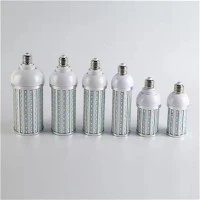
High-power LED corn bulbs are the product category that answers this constraint directly. They pack a multi-watt LED array onto multiple faces of a cylindrical body, screw into an existing E27 or E40 socket, and throw light in every direction like the sodium lamp they replace - but with a fraction of the energy, no warm-up time, no mercury and a maintained lumen output that the old technology cannot match.
What "high power" means in this category
Not every corn bulb is a high-power corn bulb. The distinction matters for procurement.
A low-power corn bulb, typically 5–15 W, is a direct replacement for incandescent or compact fluorescent bulbs in indoor and residential settings. A high-power corn bulb is the class that targets outdoor HPS, mercury-vapor and metal-halide lamps - usually in the 30 W to 120 W range, designed to replace 70 W, 100 W, 150 W, 250 W and even 400 W legacy sources. The defining engineering challenge of this class is thermal management: at 50 W and above, the LED array must be cooled by an aluminum radiator sized for continuous 12-hour outdoor operation, and the driver must survive the heat trapped inside the existing luminaire.
A flat LED panel or a single-sided round LED bulb looks modern on a spec sheet, but inside an old street or garden luminaire it behaves poorly. The reflector behind it was tuned for a point source that radiated in all directions; a flat panel shining only forward sends light straight out through the glass and leaves the reflector empty. The result is uneven pools of light and dark patches along the road. A corn bulb, by contrast, emits light radially: it illuminates the reflector symmetrically from every side, reproduces the original beam pattern, and - crucially - lights the area the fixture was actually designed to cover.
Anatomy of a High-Power LED Corn Bulb
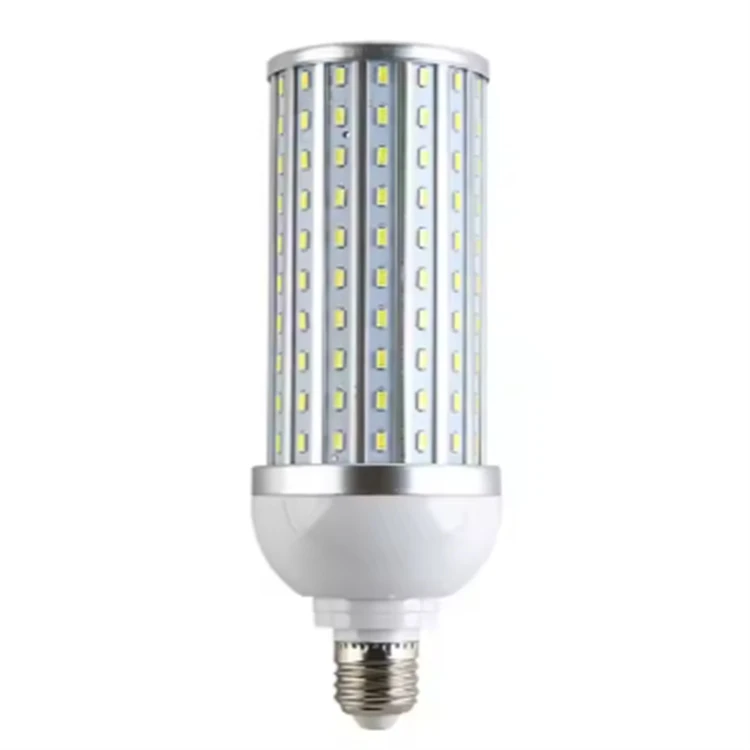
To understand why this bulb class is ideal for outdoor work, it helps to look inside. A quality high-power corn bulb is not a cluster of cheap LEDs on a stick; it is a carefully balanced stack of thermal, optical and electronic subsystems.
Multi-sided LED array on a cylindrical PCB
The LED chips are soldered onto several curved or flat PCB faces that wrap around the aluminum core - typically three, four, six or more faces depending on wattage. This layout is what gives the corn bulb its true omnidirectional output. When installed inside a post-top garden fixture or a cobra-head street luminaire, every face contributes light to the reflector, and there is no dark side behind the socket. For specifiers this is the single biggest functional difference between a corn bulb and a flat LED replacement: it restores the original lighting distribution without requiring fixture replacement.
High-power outdoor work demands high-bin LED dies. The chips are sorted by forward voltage, wavelength and high-temperature lumen maintenance, and interconnected with pure gold bond wire rather than copper-clad or aluminum alternatives. Gold wire is more expensive, but under daily outdoor thermal cycling it resists fatigue and delamination far better - which directly translates into slower light decay and a longer useful life. This is the component choice that separates a 30,000-hour corn lamp from a 12,000-hour one.
Thermal design: the deciding subsystem
At 50–100 W continuous load, heat is the enemy. The body of a high-power corn bulb is a machined or die-cast aluminum radiator with deep, closely pitched fins extending along the full length of the cylinder. The fins provide the convective surface that rejects heat into the surrounding air - there is no fan, and the sealed luminaire provides no forced ventilation. A quality radiator will hold the LED junction at a safe temperature even in a sealed post-top fixture on a 40 °C summer night; a cheap radiator will cook the chips and the driver within one season.
Each PCB face is mounted directly against the aluminum core through a thermally conductive pad, eliminating air gaps that would otherwise insulate the chips. The multi-sided layout also spreads heat evenly across the whole radiator instead of concentrating it on one face. This is why a well-designed 80 W corn bulb can feel only mildly warm to the touch even while running at full power - the heat is distributed and rejected, not trapped.
Isolated driver with protection circuits
The driver sits in the socket base, the hottest part of the lamp. A high-power corn bulb uses an isolated switching driver that separates the AC input from the low-voltage LED output. This is both a safety feature and a reliability feature: it prevents ground-loop currents, reduces output stress, and allows the use of high-temperature-rated electrolytic capacitors whose service life is preserved even when the base is warm. Generic non-isolated drivers with consumer-grade capacitors are the most common failure point in cheap corn bulbs, and they typically fail within the first year of outdoor service.
Outdoor power grids - municipal feeders, factory substations, rural networks - are noisier than indoor building circuits. Voltage spikes, lightning surges and phase imbalance are routine. A professional-grade corn bulb integrates over-current protection, short-circuit protection and surge-absorbing components so that a bad grid night does not become a premature re-lamping visit. For a contractor managing thousands of street lamps across a city, this protection alone can eliminate a large share of warranty call-outs.
Sealed PC shade for outdoor exposure
The polycarbonate shade seals the internal chamber against dust, flying insects and rain splash. Insects are a chronic problem in unsealed outdoor bulbs: moths and beetles enter, die inside, and accumulate on the PCB, where they both absorb light and insulate the chips. A sealed shade with UV-stabilized, anti-yellowing PC prevents this and preserves light transmittance across years of UV exposure - unlike cheap PC that turns brown and cuts output by 20–30% within two years.
Why High-Power Corn Bulbs Are Ideal for Street Lighting
Street lighting is the application where high-power corn bulbs have delivered the clearest, most measurable business case. Municipalities and contractors choose them for four tightly linked reasons.
Direct HPS replacement with zero fixture modification
Most existing street luminaires in the world still run 70 W, 100 W or 150 W HPS bulbs on E40 or E27 sockets. A high-power corn bulb is manufactured to cross-reference each of those wattages: a 50 W corn bulb replaces a 100 W HPS, an 80 W corn bulb replaces a 150 W HPS, and so on. Because the corn bulb emits in 360°, it fills the existing reflector exactly as the sodium lamp did, so the road coverage, pole spacing and lighting level remain compliant with the original design. There is no need to re-engineer the photometric layout of the street - a huge advantage when a city must upgrade tens of thousands of poles on a tight budget.
HPS lamps take several minutes to reach full output and flicker on cold nights. A corn bulb reaches 100% brightness the instant power is applied, and maintains a consistent correlated color temperature (typically 3000 K warm white, 4000 K neutral white or 5000 K daylight). For municipal road safety, a consistent color across the city means drivers experience even illumination and their eyes adapt smoothly along the route.
Municipal economics: energy, maintenance and mercury
Replacing a 150 W HPS lamp with an 80 W corn bulb cuts energy consumption by roughly 47%. Across a street lamp that runs 4,000–4,500 hours per year, that single bulb saves several hundred kilowatt-hours annually. Multiply by 10,000 poles and the municipal electricity bill drops by hundreds of thousands of euros or dollars per year - typically enough to pay back the retrofit program within three to four years.
A HPS lamp is typically re-lamped every 2–3 years. A high-power corn bulb built with a screened chip, isolated driver and proper radiator carries a 30,000+ hour L70 rating - roughly seven years of street-lighting service. The reduction in lift-truck visits, night-shift crews and traffic-control closures is often larger than the electricity savings themselves, and it is the reason most modern street-lighting contracts now specify LED corn bulbs as the default retrofit source.
HPS lamps contain mercury and must be handled as hazardous waste at end of life. Many cities in the EU, North America and beyond are phasing them out under ecodesign and waste regulations. Switching to a corn LED bulb eliminates the mercury disposal cost and puts the municipality ahead of upcoming regulatory deadlines - without the capital expense of replacing the entire luminaire.
Why They Work for Garden and Landscape Lighting
Garden, plaza, pathway and decorative landscape lighting imposes a different set of requirements - and high-power corn bulbs meet them surprisingly well.
Symmetric fill in decorative fixtures
Decorative garden luminaires - post-top lanterns, cast-aluminum wall packs, bollard heads - are often designed around a clear glass enclosure with a glowing cylindrical source visible through the glass. A flat LED panel looks wrong inside these fixtures: it creates a bright front face and a dark back, visible through the glass. A corn bulb, by contrast, looks and glows like the classic flame or sodium source it replaces, preserving the intended aesthetic while delivering LED efficiency. This is why landscape architects and property managers favor corn bulbs for heritage-style or decorative streetscapes.
Screened LED bins ensure that every corn bulb on a pathway or plaza emits the same warm-white color - no visible color patchwork across 50 poles. For hotels, residential compounds, shopping streets and public parks, that consistency is what makes the lighting design look intentional rather than patched together.
Outdoor durability in exposed positions
Garden fixtures are often low to the ground, where dust, pollen, rain splash and insect activity are highest. The sealed PC shade with UV inhibitors keeps the chamber clean and prevents the yellowing that would otherwise make the light look dim and amber after a summer. The aluminum radiator naturally weathers without corrosion because of its surface treatment.
Garden and landscape installations in resorts, parklands and industrial campuses are often fed by long cable runs where voltage can sag at the end of the line. A high-power corn bulb designed for wide input voltage (typically 100–277 V range) will maintain consistent brightness from the first pole to the last - eliminating the dim-end-of-the-line problem that plagues less tolerant LED replacements.
Why They Are Ideal for Industrial and Mining Lighting
Industrial and outdoor worksite lighting is the harshest environment a corn bulb will face. It is also the application where its strengths are most decisive.
Yard, warehouse perimeter and mining camp illumination
Factories, freight depots, steel yards, cement plants and mining camps commonly run 150 W to 400 W HPS or metal-halide lamps on high poles and in ceiling-mount fixtures. A high-power corn bulb in the 80–120 W class directly replaces these sources, delivering the same footprint illumination with 50–65% less power. Because the lamp runs 24/7 in many industrial settings, the energy savings are even larger than in street lighting - often on a two-shift or continuous schedule.
Metal-halide lamps require a 10–15 minute cool-down before they can restart after a power interruption. In a worksite where lighting must be restored immediately after a power glitch, this delay is a safety hazard. A corn LED bulb restarts instantly, every time.
Withstanding dust, vibration and grid noise
Cement plants, coal yards and mineral processing sites generate airborne dust that would quickly insulate and overheat an unsealed lamp. The sealed PC shade and gasketed body of a high-power corn bulb keep dust out of the LED chamber, preserving both light output and cooling performance. The aluminum radiator can be periodically washed down without harming the lamp.
Industrial areas have heavy rotating machinery and frequent large motor starts that cause vibration and voltage dips. The gold-wire bond structure and the protected driver tolerate both: vibration does not loosen the LED package joints the way it would in a cheaper bulb, and the driver rides through voltage dips and surges without latching off. For a mining operator whose lighting must run through blasts, conveyor starts and substation switching, this is not a nice-to-have - it is the baseline requirement.
Total Cost of Ownership Across the Three Applications
The case for high-power corn bulbs is easiest to see when the three use cases are put side by side. The table below summarizes what a typical specifier evaluates when choosing a corn bulb versus the legacy alternative.
|
Dimension |
Street lighting (municipal) |
Garden / landscape |
Industrial / mining yard |
|---|---|---|---|
|
Legacy source being replaced |
70–250 W HPS, E27/E40 |
70–150 W HPS / CFL in post-top lanterns |
150–400 W HPS / metal halide |
|
Corn bulb replacement |
30–100 W high-power corn |
20–50 W corn in warm white |
80–120 W high-power corn |
|
Energy reduction |
~50% |
~50–60% |
~55–65% |
|
Light distribution |
360° fills existing reflector, no dark side |
Symmetric glow through decorative glass |
Full-area yard illumination, instant restart |
|
Maintenance cycle |
~7 years (vs 2–3 for HPS) |
~5–7 years, sealed against insects |
~5+ years in continuous operation |
|
Key environmental demand |
Regulatory mercury phase-out |
UV stability, color consistency |
Dust sealing, surge tolerance, vibration |
|
Business driver |
Energy contract payback in 3–4 years |
Aesthetic preservation + lower upkeep |
Safety uptime + reduced production loss |
Across all three applications the same pattern appears: the corn bulb leverages an existing fixture investment, cuts energy by roughly half, and removes the recurring maintenance visits that historically drove the cost of outdoor lighting. The only variable that changes between street, garden and industrial is which environmental protection feature matters most - but the core engineering answer is the same product.
Specifier's Checklist: What to Demand Before Buying
Not every high-power corn bulb on the market delivers the performance described above. A buyer evaluating suppliers should ask for the following items in writing. These are the screens that separate a professional product from a generic copy.
LM-80 / TM-21 data for the LED chips, not just a headline "50,000 hours" claim. The report must state the case temperature at which the L70 extrapolation was measured.
Junction-to-case thermal resistance and a description of the radiator construction (fin depth, material, surface area).
Driver type: isolated topology, high-temperature capacitor rating, and explicit over-current, short-circuit and surge protection components.
Bond-wire material: gold wire, not copper or aluminum clad.
Shade material: UV-stabilized polycarbonate with anti-yellowing grade, plus the sealing method (gasket, sealant).
Input voltage range and power factor (a power factor above 0.9 is expected for outdoor commercial-grade drivers).
Binned CCT: tight color tolerance (3-step or 5-step SDCM) so a mixed batch across a site does not show color variation.
Warranty terms: 3–5 years is the industry baseline for a product that truly expects to last the L70 curve.
Conclusion: One Form Factor, Three Applications, One Business Case
High-power LED corn bulbs have earned their place in street, garden and industrial lighting for a simple reason: they are the only retrofit form factor that honestly reproduces the 360° light distribution of the sodium and metal-halide sources they replace. A flat panel saves energy but breaks the photometric design of the existing luminaire; a tube-style replacement saves energy but lights only one direction. The corn bulb saves energy, preserves the original beam pattern, looks right inside decorative glass, and survives the dust, surges and heat of a worksite.
For a municipal procurement team, that means a street-lighting program that pays back in three to four years. For a hotel or landscape manager, it means decorative poles that keep their warm glow and their finish for years. For an industrial or mining operator, it means yard lighting that comes back on instantly, survives the grid, and does not require a maintenance crew in the middle of a shift. Across all three, the common denominator is the same engineering: screened gold-wire chips, a thickened aluminum radiator, an isolated protected driver, and a sealed UV-stabilized shade.
Next step. Whether you are planning a municipal HPS-to-LED street conversion, a landscape relamping, or an industrial yard upgrade, ask for our LM-80/TM-21 reports, cross-reference wattage charts, and free sample bulbs for a side-by-side trial in your own fixtures. We support E27 and E40 bases, wide-voltage drivers, OEM/ODM marking and project-volume pricing.
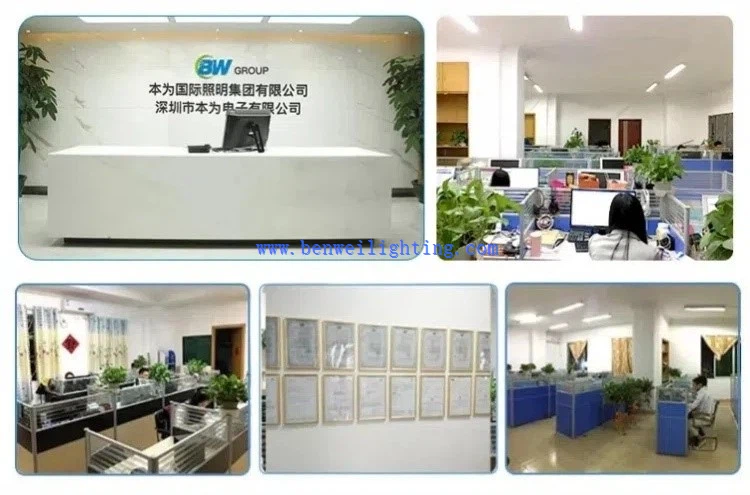
How To Cooperate With Us?
We are happy to have total control over the manufacturing process and the calibre of our products since we have our own facilities. Since we are producers rather than just brokers, we are dedicated to providing our customers with the best pricing. Since we are certain that the price and quality of our products are clear, we invite customers to see our samples first. Our commitment to quality and customer satisfaction drives us to continuously provide top-notch goods.
Our address
3rd Floor, 5th Building, Hebei Industrial Park, Hualian Community, Longhua District, Shenzhen, China