One of the most common complaints about long-term LED lighting is gradual brightness loss. Many users find their brand-new bright LED fixtures turn dimmer after months or years of daily use, even though the lights still power on normally. Unlike traditional bulbs that burn out suddenly, LEDs suffer slow, invisible brightness degradation over time. Most buyers attribute this issue solely to poor LED chip quality, yet three core factors work together to speed up brightness drop: operating temperature, LED driver stability, and overall internal component quality. Chips are rarely the main culprit. This article breaks down how these three key elements affect LED lumen maintenance, with an intuitive failure proportion chart and detailed comparison table to help buyers select long-lasting LED lights with minimal brightness decay.
Basic Knowledge: What Is LED Brightness Loss (Lumen Depreciation)
Gradual LED brightness loss is professionally defined as lumen depreciation. Every LED fixture will lose a certain percentage of initial brightness during continuous operation, as internal electronic components age slowly with working time. Industry standards use the L70 benchmark to measure lighting lifespan: when a lamp drops to 70% of its original brightness, it reaches the end of its effective service life for commercial use.High-quality commercial LEDs can maintain stable brightness for more than 50,000 hours, while cheap budget LEDs lose over 30% brightness within just 20,000 hours. The huge gap does not come from chip differences alone, but mainly from heat accumulation, unstable drivers and inferior supporting components.
Visual Chart: Three Root Causes of LED Brightness Loss
The pie chart below shows the proportion of brightness loss caused by three core factors and other minor reasons, based on real long-term lighting project monitoring data:
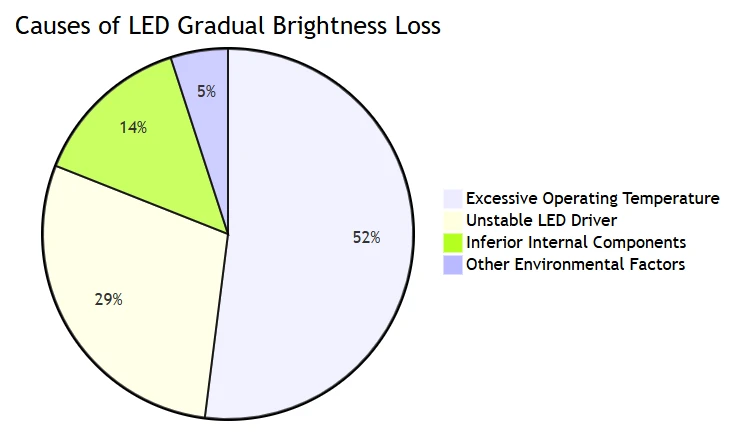
The data clearly shows that high working temperature is the biggest cause of LED brightness fading, accounting for more than half of all light decay issues. Poor drivers rank second, followed by low-grade capacitors and heat dissipation parts. Combined, temperature, drivers and component quality contribute 95% of all LED brightness loss problems.
Three Core Factors Comparison Table: How They Affect LED Brightness
This table compares high-performance and low-performance LED fixtures in temperature control, driver performance and component quality, and illustrates their direct impact on long-term brightness retention:
|
Influencing Factor |
Premium LED Lights (Good Brightness Retention) |
Cheap LED Lights (Fast Brightness Loss) |
Specific Impact on Brightness |
|---|---|---|---|
|
Operating Temperature |
Stable working temperature below 50℃, efficient aluminum heat sink, no heat accumulation |
Working temperature over 70℃, thin heat sink, severe internal heat buildup |
Every 10℃ temperature rise accelerates light decay by 15%; high heat permanently damages LED chips |
|
LED Driver Performance |
Isolated constant-current driver, steady current output, low current ripple |
Non-isolated cheap driver, fluctuating current, unstable power supply |
Unstable current reduces real-time luminous output and speeds up chip aging |
|
Internal Component Quality |
High-temperature resistant capacitors, high-transmittance lenses, reliable wiring |
Low-grade ordinary capacitors, low light-transmission lenses, rough assembly |
Aging capacitors cause brightness drop; poor lenses reduce effective light output |
How Each Factor Causes LED Brightness Loss Step by Step
1. High Operating Temperature (The Primary Killer)
Although LEDs are cool lighting, they still generate internal working heat during operation. If the heat sink is too thin or the internal heat dissipation channel is blocked, heat will gather inside the lamp housing continuously. High temperature destroys the phosphor layer on LED chips and damages semiconductor structures gradually. This damage is irreversible. Once the chip performance declines, the LED can never restore its original brightness, even after cooling down.
2. Unstable LED Drivers
LED chips require fixed constant current to keep stable brightness. Low-cost drivers cannot maintain consistent current output after long-hour operation. Fluctuating current makes chips work under abnormal power all the time. Insufficient current directly lowers real-time brightness, while overcurrent accelerates chip thermal aging. Unlike visible flicker caused by severe driver failure, mild current fluctuation only leads to slow, unnoticeable brightness reduction.
3. Inferior Supporting Components
Electrolytic capacitors inside drivers degrade rapidly under long-term high temperature. Aging capacitors cannot stabilize voltage and current, indirectly weakening lighting performance. Meanwhile, low-quality optical lenses absorb more visible light, reducing effective brightness that reaches working surfaces. Even with qualified LED chips, these cheap auxiliary components will inevitably cause overall brightness attenuation.
How to Slow Down LED Brightness Loss During Procurement and Use
First, prioritize LED lights with thickened aluminum heat sinks to control working temperature within a safe range, cutting the biggest cause of light decay. Second, always choose isolated flicker-free drivers instead of low-cost non-isolated drivers to ensure stable current supply. Third, check internal component configuration, especially high-temperature resistant capacitors for long-time continuous lighting scenarios. Finally, avoid installing LED lights in fully enclosed spaces without ventilation, which will worsen heat accumulation and accelerate dimming.
Conclusion
LED brightness loss is rarely caused by defective LED chips alone. Excessive working temperature, unstable drivers and inferior internal components are the three dominant reasons for gradual dimming. Heat accumulation is the top factor affecting long-term lumen maintenance, followed by poor driver performance. When purchasing LED lights, buyers should not only focus on initial brightness and chip brands, but also pay attention to heat dissipation design, driver quality and matching components. Reasonable temperature control and high-quality core accessories can effectively slow down lumen depreciation, maintaining consistent LED brightness throughout the long rated service life.
Shenzhen Benwei Lighting Technology Co., Ltd.
Tel/WhatsApp: +86 18681294064
Website: www.benweilight.com
Address: 3rd Floor, 5th Building, Hebei Industrial Park, Hualian Community, Longhua District, Shenzhen, China