Why Double-Row LED Linear Lights Come With a Higher Price Tag?
When sourcing LED linear lights, nearly all customers raise the same question: these lights look almost identical in overall size, so why are your double-row LED tubes far more expensive than single-row alternatives available on the market? Most suppliers simply give a vague answer like "better raw materials", yet few elaborate on the professional technical logic behind the price gap. This article breaks down the core differences between single-row and double-row LED linear lights from four dimensions: optical performance based on bead layout, heat dissipation, service life and comprehensive operating costs. Supported by actual test data, it intuitively demonstrates the value of higher-priced models, helping engineering buyers, foreign trade merchants and wholesale clients steer clear of low-cost, inferior lighting products.
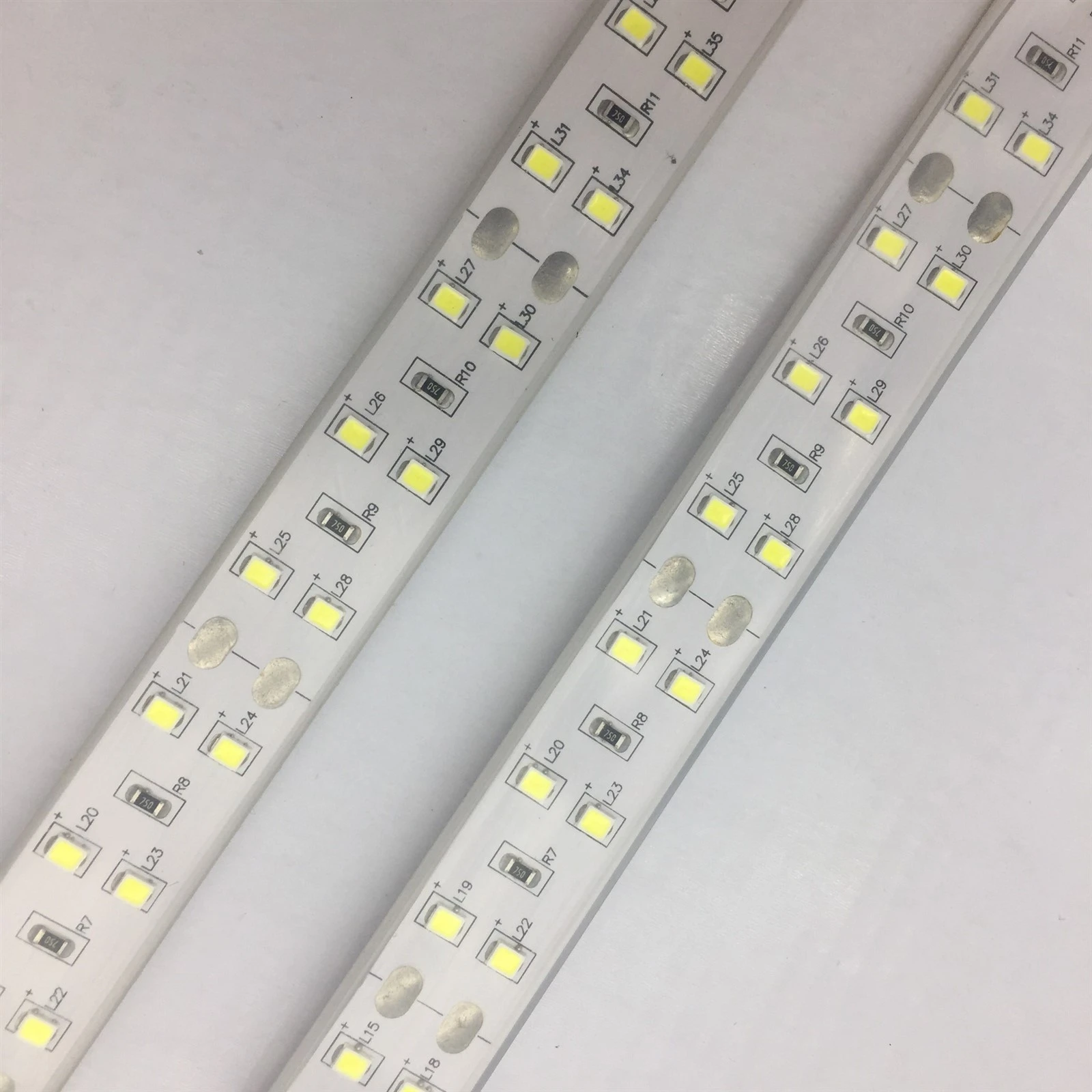
1. Basic Structure: Hardware Differences Between Single & Double-Row Beads on 19mm-Wide Aluminum PCB
All samples for comparison adopt the industry-standard 19mm-wide aluminum PCB, identical 2835 LED chips and uniform 1.2-meter length. The only distinction lies in single-row and double-row bead arrangements. Key hardware parameters are listed below:
| Parameter Item | Single-Row LED Linear Light | Double-Row LED Linear Light | Comparison Note |
|---|---|---|---|
| Total LED beads for 1.2m length | 60 pcs | 120 pcs | Double the quantity of LED beads |
| Rated power of single bead | 0.2W | 0.2W | No difference |
| Total rated power of the whole light | 12W | 24W | Power output increased by 100% |
| Effective heat-conducting area of aluminum PCB | Single central line of the substrate | Full left and right zones of the entire substrate | Heat dissipation area expanded by roughly 92% |
| Comprehensive factory material cost ratio | 100% (baseline benchmark) | 168% | Material cost 68% higher |
The table shows clearly that the double-row design doubles LED bead consumption, with simultaneous upgrades to aluminum PCB circuits, solder paste, SMT processing hours and driver power supply specifications. Higher raw material and production costs are the fundamental reason for its higher selling price.
2. Professional Optical Knowledge: Double-Row Beads Surpass in Brightness & Light Uniformity
Core evaluation metrics for LED lighting include luminous flux, illuminance and light spot uniformity. Field test data for 1.2m lights installed at a height of 3 meters is shown below:
| Optical Test Index | Single-Row Model | Double-Row Model | Professional Explanation |
|---|---|---|---|
| Total Luminous Flux | 1320lm | 2650lm | Nearly doubled brightness, delivering clearer illumination for large workshops and warehouses |
| Central ground illuminance | 118lux | 235lux | Sufficient brightness for industrial workstations to avoid dimness disrupting production operations |
| Ratio of dark zones in illuminated space | 21% | 3.5% | Single-row lights only emit light along one line with weak brightness on both sides; double-row dual-side lighting eliminates obvious shadows and dark areas |
Technical Principle
Single-row beads produce linear light from one side only, concentrating brightness directly under the fixture while illuminance drops sharply on the left and right, resulting in stark light-dark divisions. Double-row beads feature two parallel light-emitting columns whose light overlaps and blends evenly, covering the full surface of the 19mm aluminum PCB with consistent light distribution. The performance gap of double-row lights is visible to the naked eye for scenarios with strict uniformity requirements, such as fresh food supermarkets, factory assembly lines and underground parking lots.
3. Core Industry Heat Dissipation Principle: Double-Row Layout Inhibits Light Decay At The Source
Over 80% of LED lamp failures and brightness fading are caused by accumulated high heat on LED beads. A universal industry rule states: every 10℃ rise in LED chip junction temperature halves the lamp's service life.
Heat dissipation test data (surface temperature of LED beads after 8 consecutive hours of operation):
| Heat Dissipation Test Data | Single-Row Linear Light | Double-Row Linear Light |
|---|---|---|
| Surface temperature of beads after long-hour operation | 72℃ | 53℃ |
| Maximum temperature difference on aluminum PCB (hottest vs coldest zones) | 24℃ | 7℃ |
Professional Breakdown
For single-row lights, all heat sources cluster along one central line of the aluminum PCB with no sideways heat dispersion, leading to severe heat buildup. Persistent local high temperatures scorch LED phosphors and internal chips.
The double-row design evenly distributes all 120 beads across both sides of the substrate, spreading heat sources uniformly. The full 19mm aluminum PCB participates in heat conduction and dissipation, rapidly transferring heat to the lamp housing for release. Minimal temperature variation across the substrate eliminates overheated hot spots.
Lower operating temperatures drastically slow phosphor aging and gold wire oxidation, reducing lamp failure rates at the hardware level.
4. Service Life & Long-Term Operating Costs: Higher-Priced Lights Save More Money In The Long Run
Most customers only focus on upfront unit purchase prices while ignoring follow-up replacement and maintenance labor costs. We calculated full lifecycle data based on industrial usage of 12 lighting hours per day:
| Long-Term Usage Index | Single-Row Model | Double-Row Model |
|---|---|---|
| Standard industry lifespan until 50% light decay | 18,000 hours | 42,000 hours |
| Equivalent service life (12 hours daily) | Approx 4.1 years | Approx 9.6 years |
| Number of replacements required within 6 years | At least 2 times | 0 times |
| Total 6-year cost (products + maintenance labor fees) | 175% (multiple replacements + installation labor) | 100% (one-time purchase for long-term use) |
Analysis
Low-cost single-row lights seem budget-friendly at the initial purchase stage, yet their brightness fades drastically after 2 to 3 years and requires full batch replacement. Mass lamp replacement in factories and supermarkets generates extra disassembly labor fees and production downtime losses. Equipped with superior heat dissipation and abundant LED beads, double-row lights experience extremely slow light decay and require minimal maintenance for years, resulting in lower overall long-term operating costs.
5. Scenario-Based Selection Recommendations
Prioritize Double-Row LED Linear Lights
Industrial workshops, logistics warehouses, fresh food supermarkets, underground parking lots, sports courts and other spaces requiring long-hour, high-brightness continuous lighting.
Single-Row Lights Are Suitable For
Home storage rooms, temporary simple walkways, low-budget temporary lighting used less than 3 hours daily with no strict illuminance requirements.
summary
As a professional LED lighting manufacturer, we consistently convey one fact to our global customers: there are no equally high-quality, low-priced products in the lighting industry. The price difference between single-row and double-row LED strip lights essentially reflects a comprehensive gap in the number of LED chips, heat dissipation performance, and lifespan.
The extra cost of our double-row LED strip lights is entirely converted into three core values: higher brightness, stable temperature control, and an ultra-long lifespan. For importers, engineering contractors, and lighting distributors targeting the mid-to-high-end industrial and commercial markets, choosing the double-row model does not increase procurement costs, but rather reduces after-sales risks, improves end-user satisfaction, and secures stable, repeat orders in overseas markets over the long term.
✨Contact✨
🙋♀️Harriet
📫Email: bwzm88@benweilighting.com
📞Whatsapp: +8613007285242