Why Must the Photolithography Area Use Yellow Light? Do You Know the Secrets of T8 LED Yellow Light Tubes?
Walking into the photolithography area of a semiconductor factory or PCB circuit board workshop, you will find the entire room bathed in a faint yellow glow. This is not decoration but a critical measure to ensure product quality - yellow light is the "protective color" of photoresist.
1. Yellow Lighting: The "Protective Color" of Photoresist
In semiconductor and PCB manufacturing, photoresist is a key material used to etch tiny circuits. Its weakness is that it is highly sensitive to ultraviolet light and blue-violet light below 420nm to 500nm. If the lighting contains these short-wavelength rays, the photoresist will be pre-exposed, resulting in blurred circuit edges and a sharp drop in yield.
The wavelength of yellow light is about 570nm to 590nm, far beyond the sensitive range of photoresist, so it does not cause accidental exposure. At the same time, yellow light is softer than white light, greatly reducing reflections and glare on wafers and equipment surfaces, allowing operators to work more precisely.
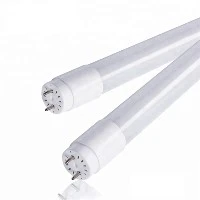
Traditionally, the sodium vapor yellow lamps used in photolithography areas are not only energy-intensive but also contain mercury and have a short lifespan. Today, T8 LED yellow light tubes, with their high efficiency, environmental friendliness, and long life, have become the standard for photolithography lighting.

2. Core Secret: 100% Filtration of Ultraviolet Light Below 500nm
The core technology of the Benwei T8 LED yellow light tube lies in precise spectral control. Through special optical coatings and filtering materials, it effectively absorbs and reflects UV and blue-violet light below 500nm, allowing only pure yellow spectrum (570-590nm) to pass through. This means that the short-wavelength light that photoresist fears most is 100% blocked, ensuring the accuracy and quality of circuit etching.
It is worth mentioning that this product uses German imported improved material technology, combined with PC raw material V2 flame retardant rating, balancing optical filtering performance with safety.
3. Brightness and Uniformity: The "Dual Requirements" of Precision Processes
Photolithography processes have strict requirements for both brightness and uniformity. Typically, the required brightness for photolithography exposure is 100-150mW/cm² - too low will lead to underexposure, affecting imaging clarity and precision. In terms of uniformity, the brightness distribution difference must be controlled within 1%-3%; otherwise, uneven chip exposure will occur.
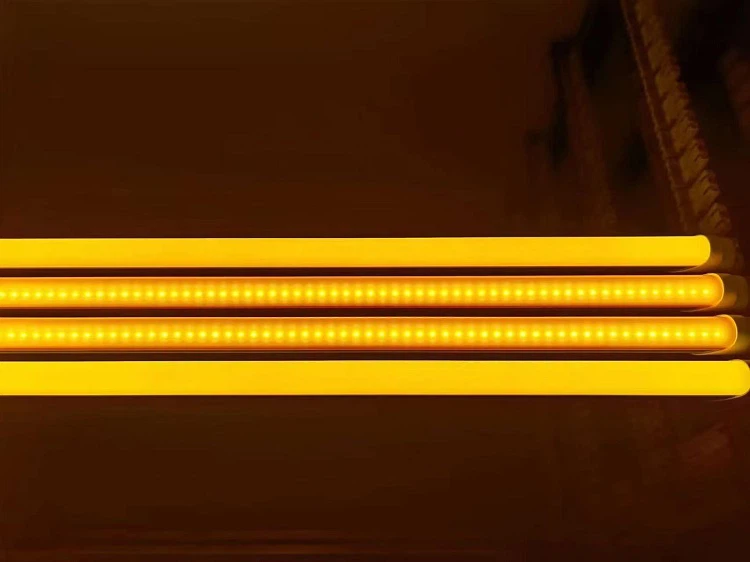
The Benwei T8 LED yellow light tube uses Taiwan Epistar LED chips, achieving a luminous efficacy of 100-120lm/W, with a stable color temperature of 1500K-2000K. It also features an isolated power supply with Rubycon capacitors, ensuring stable current output and uniform light distribution. The product is available in two cover types: transparent yellow and frosted yellow. The frosted version further softens the light and reduces glare.
4. High Energy Efficiency & Ultra-Long Life: The Inevitable Choice for Green Manufacturing
Compared to traditional fluorescent yellow light tubes, T8 LED yellow light tubes offer disruptive advantages in energy consumption and lifespan. The table below clearly compares Benwei T8 LED tubes with traditional fluorescent tubes and low-quality LED tubes:
| Parameter | Traditional Fluorescent Yellow Tube | Low-Quality LED Yellow Tube | Benwei T8 LED Yellow Tube |
| Power consumption (for same lumen output) | 100% (baseline) | ~50-60% of fluorescent | 30-50% of fluorescent |
| Lifespan (L70 / L90) | 8,000 – 15,000 hours (L70) | 15,000 – 25,000 hours (L70, often L90 not guaranteed) | >50,000 hours (L90) |
| Mercury content | Contains mercury | Mercury-free | Mercury-free |
| Lumen maintenance | Rapid depreciation | Moderate depreciation | Excellent (LM-80 certified) |
| Replacement frequency | High (every 1-2 years) | Medium (every 2-3 years) | Very low (every 5-7+ years) |
High-quality T8 LED tubes have passed LM-80 tests, with an L90 lifespan (maintaining 90% of initial luminous flux) of over 50,000 hours - 3-5 times that of traditional fluorescent tubes and twice that of low-quality LED tubes. In terms of energy consumption, LED tubes can reduce power usage by 50%-70%. This means lower electricity bills, fewer replacements, and lower maintenance costs.
5. Beyond Lithography: A Broader Range of Applications
The value of T8 LED yellow light tubes extends far beyond semiconductor lithography. They play a key role in PCB manufacturing, plate making, museum artifact displays, archive preservation of ancient books, cleanrooms, and any environment sensitive to UV light. They effectively prevent UV-induced fading of cultural relics and aging of collections, while creating a warm and comfortable display atmosphere.
Additionally, because yellow light has a longer wavelength and is much less attractive to mosquitoes than ordinary white light, Benwei's yellow light tubes also have a natural mosquito-repellent effect, making them suitable for outdoor use and mosquito-prone areas.
Conclusion
T8 LED yellow light tubes perfectly solve the core lighting challenges in photolithography and precision manufacturing through precise spectral filtering, stable brightness output, high energy efficiency, and ultra-long lifespan. They are not only the "guardians" of photoresist but also a key component for improving quality and efficiency in high-end manufacturing. Choosing Benwei T8 LED yellow light tubes means choosing precision, safety, and profitability for your production line.