When selecting underwater lights, many clients focus primarily on wattage and color, often overlooking a parameter that directly determines the lighting effect: the beam angle. For instance, a 10W light might create a soft, bright glow in a swimming pool, yet in a fountain, it could cause the light to scatter diffusely, failing to illuminate the water jet itself.
Choosing the wrong beam angle-even for an expensive fixture-will likely result in a poor outcome. Below, we break down the differences between wide and narrow beam angles across three common scenarios, helping you avoid pitfalls during product selection or when making recommendations to end clients.
Understanding the Basics: What is a Beam Angle?
A beam angle refers to the angular width of a light beam at the point where its intensity drops to half of its maximum (central) value. In simpler terms, it describes how widely the light "spreads out."
Narrow beam (typically 10°–30°): Concentrated light with a long throw and high central intensity-much like a flashlight.
Medium beam (typically 40°–60°): Offers a balance between brightness and coverage area.
Wide beam (typically 90°–120° or greater): Diffused light that covers a large area with a softer intensity-similar to a floodlight.
It is important to note that beam angle and lumen count are distinct concepts. Given the same total luminous flux, a narrower angle results in higher central illuminance, while a wider angle results in lower brightness per unit area but covers a larger overall space.
Swimming Pools: Choosing the Right Beam Angle
The goal of swimming pool lighting is to ensure the entire body of water is illuminated uniformly, while also maintaining safety and visual appeal for nighttime swimming.
Wide beams (90°–120°) are the preferred choice: A single fixture can cover a larger area, illuminating both the pool walls and the floor, which helps minimize dark spots.
For wall-mounted installations: A wide beam allows light to spread across the pool walls and the water surface, preventing the "bright spot surrounded by darkness" effect. For deep-water areas or longer pools: You may supplement with a few medium-beam lights, but the overall lighting scheme should primarily utilize wide-beam fixtures.
What to avoid: Directing narrow-beam lights at the bottom of the pool creates distinct, unnatural-looking "hot spots" (bright patches) and can cause glaring reflections on the water's surface.
Another practical consideration for pool lighting is the number of fixtures and the associated costs. Wide-beam lights cover larger areas, meaning fewer fixtures are typically required, which in turn reduces installation and wiring expenses.
Ponds: Choosing the Right Beam Angle
Ponds are generally focused on landscape and ecological aesthetics; the lighting approach should be subtle-"just enough" rather than brightly illuminated throughout.
To highlight water features, rocks, or aquatic plants: Use narrow or medium-beam lights (15°–45°) to focus illumination on specific elements, creating depth and layering.
To establish an overall atmosphere: Use wide-beam lights to provide soft background illumination, keeping the brightness levels moderate.
For ponds with fish: Wide-beam, low-intensity lighting is a safer choice; intense, narrow beams directed at close range can startle the fish.
In cases of turbid (cloudy) water: Narrow-beam light scatters more noticeably, creating a visible "beam" or "column of light" effect. This can be used to artistic advantage, though it may also appear jarring-it is best to test the lights before final installation.
Pond lighting often benefits from a mix of beam angles: a few narrow-beam fixtures for focal points, combined with one or two wide-beam fixtures for ambient base lighting, creates a much more natural effect than using a single beam angle alone.
Fountains: Choosing the Right Beam Angle
Fountains represent a scenario where beam angle is particularly critical, as the light must strike moving water; the angle directly determines whether the water feature is effectively illuminated.
For vertical water jets: Use narrow-beam lights (10°–25°). A concentrated upward beam ensures the water column is illuminated from the base all the way to the top.
For cascading water, water curtains, or arched fountains: Use medium-beam lights (30°–60°) to ensure the illuminated area matches the width of the water flow.
Overall Lighting for Fountain Pools: If you want the water surface itself to appear illuminated, consider adding wide-beam lights to complement the narrow-beam lights used for the water jets.
Fixture Placement: Lights are typically installed beneath or around the nozzles. The beam angle must be carefully coordinated with the height of the water jet and the distance from the nozzle; an angle that is too wide will cause light to "spill" to the sides of the water column, resulting in wasted illumination.
In short: the higher and thinner the water jet, the narrower the required beam angle.
Often-Overlooked Details During Selection
Underwater Refraction: As light passes from the fixture into the water, refraction occurs. The actual underwater beam angle may differ slightly from the nominal (rated) value; relying on data from underwater testing is more accurate.
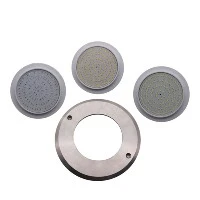
Versatility with Interchangeable Optics: Some models allow for the replacement of lenses or optical covers, enabling a single fixture to be adapted for various settings-a convenient feature for wholesalers and contractors managing inventory.
Consider Angle and Brightness Together: A narrow-beam light may appear very bright but covers a small area; a wide-beam light may seem dimmer, but that is simply because the light is more dispersed. Do not rely solely on lumen counts for comparison.
Waterproof Rating: Regardless of the beam angle, underwater lights should be rated IP68. Ensure the materials are corrosion-resistant-this is especially critical for chlorinated environments like swimming pools or fountains using seawater.
Electrical Safety: For swimming pools and ponds, low-voltage products (e.g., 12V or 24V) are typically used. Installation regulations vary by region; always ensure compliance with local standards.
Summary
Swimming Pools: Primarily use wide-beam lights to achieve uniform, soft, and safe illumination.
Ponds: Use narrow-beam lights for focal points and wide-beam lights for ambient effect; a combination of both creates the most natural look.
Fountains: Use narrow-beam lights for water jets, medium-beam lights for water curtains, and wide-beam lights to illuminate the pool surface.
Core Principle: Use wide-beam lights for area illumination and narrow-beam lights for highlighting specific features.
There is no such thing as an inherently "good" or "bad" beam angle-only one that is appropriate or inappropriate. Determine whether you intend to illuminate the "water body" or specific "features/objects" first, then choose your angle; this approach will help you avoid significant errors in product selection.
Need help selecting the right product? Contact us!
Not sure which beam angle is best for your project? Our underwater lights are available in a variety of beam angles. We can provide expert recommendations based on your pool dimensions, pond environment, or the height of your fountain jets. We also offer customization options for beam angles, power ratings, and colors to meet your specific requirements. Simply send us a message or an email with details about your application and the quantity needed-we will recommend the ideal model and provide a quote along with samples.
https://www.benweilight.com/professional-lighting/waterproof-stainless-steel-rgb-underwater-led.html